If you’re shopping for a wall mount faucet bracket, you’re usually in one of two spots: you’ve bought (or are about to buy) a wall-mounted faucet and realized it needs something solid to bolt onto, or your existing wall faucet has started to wiggle and you’re wondering whether the bracket is the fix. Either way, this is a small, unglamorous part that quietly decides whether your faucet feels like a $40 special or a built-in fixture for the next 15 years. Below, we’ll walk through exactly what the bracket does, how to pick the right one, the specs that actually matter, and how it gets installed — in plain English, from people who fit these for a living.
What does a wall mount faucet bracket actually do?
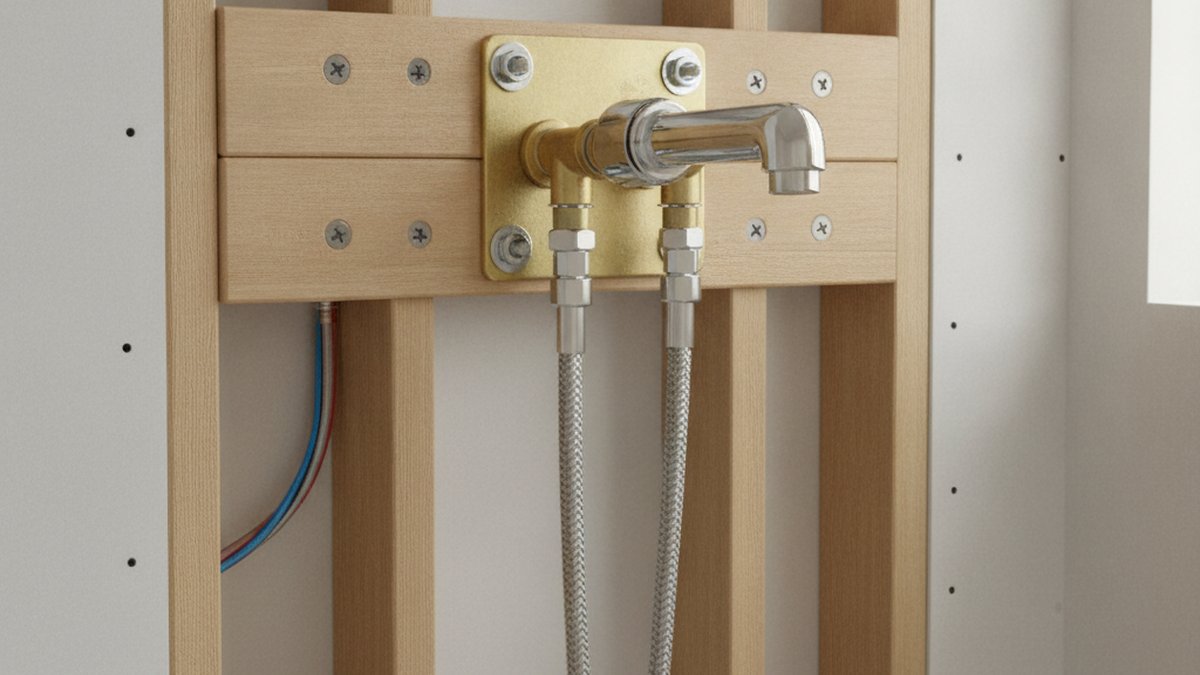
It transfers the load of the faucet from your fragile wall surface into the framing behind it. A wall-mounted faucet has nothing to sit on — no sink deck, no countertop — so all the twisting force from turning handles and pulling a sprayer would otherwise be carried by tile, drywall, or thin copper stubs. That’s a recipe for cracked grout and leaking joints. The bracket is a rigid metal plate (or pair of rings) that bolts to solid wood blocking inside the wall and gives the faucet’s inlet threads a fixed anchor point.
Most brackets do three jobs at once. First, they hold the faucet at the correct spacing — typically the standard 8-inch center-to-center for widespread wall faucets, though single-hole and 6-inch versions exist. Second, they set the depth so the finished faucet sits flush against your final wall surface, accounting for tile thickness. Third, they give the water supply a stable termination point, so the connection between your in-wall plumbing and the faucet doesn’t flex. When people say a wall faucet “feels solid,” they’re really complimenting the bracket.
How is it different from a deck plate or an escutcheon?
They’re not the same thing, and mixing them up leads to buying the wrong part. A bracket lives inside the wall and carries structural load. An escutcheon (the decorative cover flange) and a deck plate sit on the outside and only hide holes — they carry no weight. On a wall faucet you’ll often have both: the hidden bracket doing the work and a visible escutcheon making it look clean. If you’re used to sink-mounted faucets, the closest deck-mounted cousin is the trim plate — worth understanding the difference, which we cover in our guide to what a bathroom faucet deck plate is and whether you need one.
Do I actually need a wall mount faucet bracket, or can I skip it?
If your faucet is genuinely wall-mounted, you need one — skipping it is not a real option for a lasting install. The only faucets that don’t need a bracket are deck-mounted ones that bolt through a countertop or sink. Some inexpensive wall faucets ship with the bracket integrated into the faucet body, and a few very light-duty units rely on the threaded pipe stubs alone, but relying on bare pipe stubs to hold a faucet is exactly how you end up with a spout that droops within a year.
Here’s the honest test: grab your installed (or planned) faucet and imagine yanking a pull-out sprayer or cranking a stiff handle. Whatever absorbs that force needs to be steel bolted to wood, not solder joints in the wall. If the answer is “the copper pipe,” you need a bracket. This matters most for kitchen wall faucets, pot fillers, and heavy commercial-style bathroom faucets, where daily forces are higher.
- You definitely need a bracket: widespread wall faucets, pot fillers, wall-mounted kitchen faucets, anything with a movable spout or sprayer.
- You may already have one built in: some sealed single-unit wall faucets — check the box and spec sheet before buying separately.
- You don’t need one: standard deck/countertop faucets, which mount through the sink or counter instead.
What types of wall mount faucet brackets are there?
There are three common styles, and the right one depends on your faucet’s configuration and whether you’re building new or retrofitting. Below is a quick comparison of what you’ll run into on the market and where each makes sense.
| Bracket type | Best for | Typical spacing | Install difficulty | Notes |
|---|---|---|---|---|
| Two-piece rough-in plate | New construction, open walls | 8″ widespread | Moderate | Bolts to blocking before the wall is closed; most rigid option |
| Integrated body bracket | Single-unit wall faucets | Fixed to faucet | Easy | Comes with the faucet; less flexibility on placement |
| Retrofit clamp bracket | Existing walls, remodels | 6″–8″ adjustable | Harder | Fits through an access panel or opened section; slightly less rigid |
| Pot filler mounting plate | Kitchen pot fillers | Single inlet | Moderate | Heavy-duty; must handle a long swinging arm |
For most bathroom and kitchen wall faucets in a new or gutted wall, the two-piece rough-in plate is the gold standard — it gives the flattest, most rigid mount. Retrofit clamp brackets exist for a reason (nobody wants to tear open finished tile), but they demand more care to get level and solid, so budget extra time.
How do you install a wall mount faucet bracket the right way?
Install it during the rough-in stage, bolted to solid wood blocking between studs, set to the exact depth for your finished wall thickness. That one sentence covers the 90% that people get wrong. Rushing this step — or setting the depth before you know your tile thickness — is what forces people to reopen a finished wall later. Here’s the sequence that keeps you out of trouble.
- Add blocking. Cut a piece of 2×6 or 2×8 lumber and fasten it horizontally between the two studs at your faucet height. This is the wood the bracket bites into.
- Set your height. For a bathroom vessel-sink wall faucet, the spout usually lands a few inches above the rim; for a kitchen wall faucet, high enough to clear pots. Measure to the finished floor and sink, not the subfloor.
- Bolt the bracket to the blocking. Use the supplied lag screws or wood screws — all of them. Half-driven screws are half a bracket.
- Dial in the depth. The bracket’s threaded ports must project the correct amount so the faucet sits flush after tile or paneling goes on. Account for backer board + tile + thinset.
- Connect and pressure-test water. Run your supply lines to the bracket ports, then pressure-test before you close the wall. Finding a drip now is free; finding it later means demolition.
- Close the wall, then mount trim. Finish the surface, then thread the faucet body onto the bracket and add the escutcheon.
You’ll need decent tools for this — an accurate level, a socket set, and proper connectors. If you’re building out a kitchen sink from scratch at the same time, our walkthrough on how to install a kitchen sink faucet and drain in an afternoon pairs well, and it’s worth checking you have the right sink faucet install tools before you start rather than mid-job.
What supply lines and connections work with a wall bracket?
Most brackets terminate in 1/2-inch inlets — either threaded or sweat (solder) — that connect to your in-wall supply stubs. The bracket itself doesn’t come with flexible hoses the way a deck faucet does; instead, the in-wall plumbing runs up to the bracket ports. If you’re comfortable with the difference between braided flex lines and rigid connections, you’ll be fine here; if that’s new territory, our primer on what a faucet supply line under the sink is and which one to buy explains the connection types you’ll see. The key rule: whatever meets the bracket should be secured so it can’t move, because movement at a joint is what turns into a slow leak inside a closed wall.
What should I look for when buying a wall mount faucet bracket?
Buy for rigidity, correct spacing, and material that won’t corrode inside a damp wall — in that order. A pretty faucet on a flimsy bracket is a faucet that will disappoint you. Here’s what genuinely separates a good bracket from a throwaway one:
- Material: stainless or heavy zinc-plated steel resists rust in the humid wall cavity. Thin stamped metal flexes — avoid it for anything you’ll use daily.
- Spacing accuracy: confirm it matches your faucet’s center spread (8-inch widespread is most common). A 1/8-inch mismatch means the faucet won’t thread on square.
- Depth adjustment: a bracket that lets you fine-tune projection saves you when your tile ends up thicker than planned.
- Included hardware: quality lag screws and a mounting template beat guessing. Cheap kits skip these.
- Compatibility: ideally buy the bracket that’s engineered for your specific faucet. Universal brackets work, but matched sets align perfectly.
At fransiton, we design our wall faucet brackets from corrosion-resistant stainless with laser-cut mounting holes and an included paper template, because we got tired of seeing beautiful faucets ruined by an afterthought bracket. If you’re matching a bracket to one of our wall faucets, the model number on the faucet box maps directly to the compatible bracket — no guesswork.
Why is my wall-mounted faucet wobbling, and is the bracket the problem?
A wobbly wall faucet is almost always a bracket or blocking problem, not a faucet problem. Nine times out of ten, either the bracket was never bolted to solid wood (just screwed into drywall), the screws backed out over time, or there was no blocking behind the plate at all. The faucet itself is rarely the culprit — it’s just the visible end of a loose anchor.
To diagnose it: with the water off, gently move the spout and watch where the movement originates. If the whole faucet body shifts against the wall, the bracket connection is loose. If only the handle or a cartridge feels sloppy, that’s a trim or internal issue, not the bracket. For genuine bracket looseness, the real fix is usually access — through a panel behind the wall or by opening a small section — to re-secure the plate into proper blocking. It’s not glamorous, but band-aid fixes (like caulking around a wobbling escutcheon) only hide the problem while the joints inside keep flexing and eventually leak.
Author note & credibility
This guide was written by the fransiton fixtures team, drawing on hands-on rough-in and remodel installs of wall-mounted faucets across bathrooms and kitchens. We manufacture and test faucets, brackets, and trim, and every wall bracket we ship is checked against standard 8-inch widespread tolerances and pressure-rated connections. Our fixtures are backed by a limited warranty, and we build to the mounting and material standards you’d expect from a fixture that lives hidden inside a wall for well over a decade — because you should only have to install it once.
FAQ
Can I install a wall mount faucet bracket in an existing finished wall?
Yes, but it’s harder than new construction. You’ll need to open an access point — either an existing panel behind the wall or a cut section — to add blocking and bolt the bracket to solid wood. Retrofit clamp-style brackets are made for this, but you must still get them level and firmly anchored, so it’s a real project rather than a five-minute swap.
What spacing do most wall mount faucet brackets use?
The most common is 8-inch center-to-center for widespread wall faucets, which matches standard rough-in plumbing. Single-hole and 6-inch versions exist too, so always match the bracket spacing to your specific faucet before buying — a mismatch means the faucet body won’t thread on squarely.
Does a wall mount faucet bracket come with the faucet?
Sometimes. Many quality wall faucets include a matched bracket or have one integrated into the body, while budget units and universal kits sell it separately. Check the spec sheet on the box — if it lists a “rough-in plate” or “mounting bracket,” it’s included; if not, buy the compatible bracket before you start.
What’s the difference between a wall mount faucet bracket and an escutcheon?
The bracket is hidden inside the wall and carries all the structural load; the escutcheon is the decorative flange on the outside that only covers holes and carries no weight. You typically use both together on a wall faucet — the bracket does the work, the escutcheon makes it look clean.
How much weight does a wall mount faucet bracket need to hold?
More than you’d think, because it’s not just the faucet’s static weight — it’s the repeated twisting and pulling forces from daily use, plus the leverage of a long spout or sprayer arm. That’s why a stamped-metal bracket screwed into drywall fails, while a steel plate lag-bolted into 2x wood blocking stays rock-solid for years.
Can a loose bracket cause a leak inside the wall?
Yes, and it’s one of the sneakier failure modes. When the bracket moves, it flexes the supply connections behind it, and repeated movement can loosen or crack a joint that then drips inside a closed wall — often undetected until you see stains or damage. Securing the bracket properly the first time is the cheapest leak insurance there is.