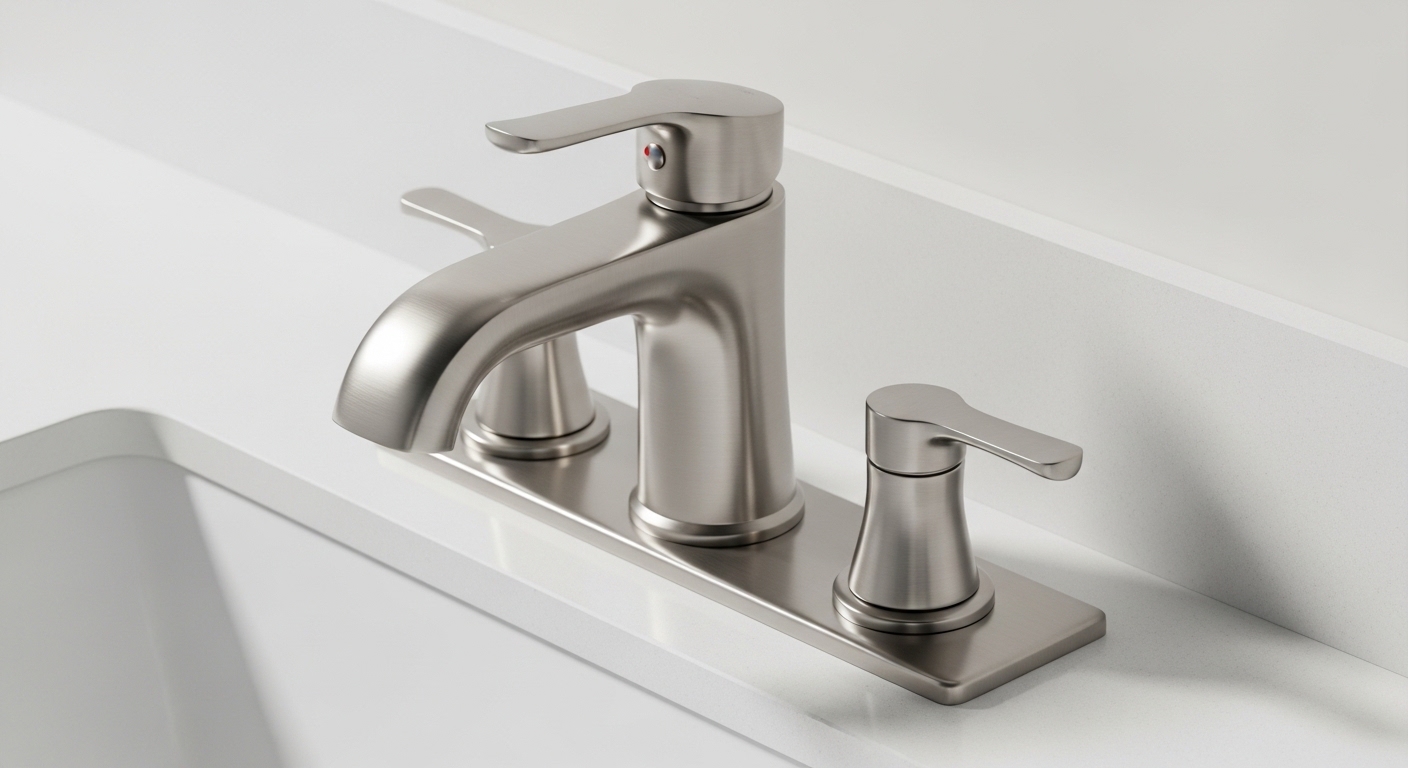
If you’ve ever pulled a sleek single-handle faucet out of the box, set it on your 3-hole sink, and realized there are two empty holes staring back at you, you’ve met the exact problem a bathroom faucet deck plate solves. It’s a small, inexpensive part that most people never think about until they’re mid-install — and then it becomes the one thing standing between them and a finished bathroom. This guide walks through what a deck plate actually does, when you genuinely need one (and when you can skip it), what sizes and finishes to buy, and how to install it without leaks.
We’ll keep it practical: real hole spacing numbers, real scenarios, and the specific mistakes that send people back to the hardware store twice in one weekend.
What is a bathroom faucet deck plate, and what does it actually do?
A deck plate is a flat metal or plastic plate that sits between your faucet base and the sink surface, spanning the width of your sink’s pre-drilled holes. Its job is twofold: it covers unused mounting holes so you don’t see straight down into the countertop, and it gives a single-hole faucet a wider, more finished footprint that reads as intentional rather than undersized.
Manufacturers also call it an escutcheon plate or a base plate. On kitchen faucets you’ll hear the same part called an “optional deck plate” — it’s the same idea. The plate typically slides over the faucet’s threaded shank before you drop the whole assembly into the center hole, then a gasket or bead of plumber’s putty seals it to the counter.
Bathroom sinks in North America are almost always drilled to one of two standards. Knowing which one you have decides everything:
- Single-hole (1 hole): One opening, usually 1-3/8″ diameter. A single-hole faucet drops straight in — no deck plate needed.
- 3-hole, 4-inch centerset: Three holes spaced 4″ apart center-to-center. The most common vanity configuration in homes.
- 3-hole, 8-inch widespread: Three holes spaced 8″ (sometimes 6″-16″) apart for widespread faucets with separate handles.
The mismatch between a modern single-hole faucet and a legacy 3-hole sink is the single most common reason people buy a deck plate. If you’re weighing which faucet style suits your sink in the first place, our breakdown of centerset vs. widespread faucets explains the hole spacing differences in more detail.
Do I need a deck plate for a single-hole faucet on a 3-hole sink?
Yes — in almost every case. If you’re installing a single-hole faucet into a sink drilled for three holes, you need a deck plate (typically a 4-inch or 8-inch escutcheon) to cover the two outer holes. Without it, you’re left with two open holes on either side of the faucet, which look unfinished and let water and debris drip into the vanity cabinet below.
There’s one exception: some 3-hole sinks can accept a single-hole faucet if you install separate accessories in the outer holes — a soap dispenser and a separate lever, for example. But for a clean single-faucet look, the deck plate is the standard fix. Match the plate to your hole spacing:
- 4″ centerset sink → 4-inch deck plate (roughly 6-7″ long overall)
- 8″ widespread sink → 8-inch deck plate (roughly 10-12″ long overall)
A word of warning that saves a return trip: buy the deck plate and faucet together, ideally from the same brand and finish batch. A “brushed nickel” plate from one maker rarely matches “brushed nickel” from another. More on that below.
Deck plate vs. no deck plate: which faucet setup is right for you?
The honest answer: it depends entirely on your sink’s existing holes and the look you want. If you’re buying a brand-new sink or vanity top, you can pick a single-hole faucet and a single-hole sink and skip the deck plate entirely for the cleanest possible look. If you’re replacing a faucet in an existing sink, the sink’s holes make the decision for you.
| Scenario | Deck plate needed? | What to buy |
|---|---|---|
| Single-hole faucet + single-hole sink | No | Faucet only |
| Single-hole faucet + 4″ 3-hole sink | Yes | Faucet + 4″ deck plate |
| Single-hole faucet + 8″ 3-hole sink | Yes | Faucet + 8″ deck plate |
| Centerset faucet (built-in plate) + 4″ sink | No (integrated) | Centerset faucet only |
| Widespread faucet + 8″ 3-hole sink | No | Widespread 3-piece faucet |
| Replacing faucet, want to change sink hole count | Maybe | Deck plate to reduce holes, or new sink |
Note the difference between a deck plate and a centerset faucet. A centerset already has its base plate built in — the spout and both handles mount on one solid 4″ body — so you never buy a separate plate. A deck plate is for turning a single-hole faucet into something that fits a multi-hole sink. If you’re still deciding on the whole faucet, our guide on how to choose the right bathroom faucet covers matching style, handle type, and finish to your sink.
What size and shape deck plate should I buy?
Measure the center-to-center distance between your sink’s outer two holes — if it’s about 4 inches, buy a 4-inch deck plate; if it’s about 8 inches, buy an 8-inch one. That single measurement is the most important thing you’ll do before ordering. Get it wrong and the plate either won’t cover the holes or will overhang the back of the sink.
Beyond size, you’re choosing between a few practical variables:
- Shape: Rectangular plates (with rounded corners) are the most common and read modern. Oval and racetrack shapes suit transitional bathrooms. Round mini-plates exist for single-hole cover-ups.
- Length/depth: A 4-inch (spacing) plate is usually 6-7″ long and 2-2.5″ deep. Check the depth clears your backsplash and doesn’t hang over the front edge.
- Material: Solid brass plates feel substantial and resist corrosion; stainless is durable and budget-friendly; zinc-alloy and plastic are the cheapest but can feel light and may chip at the finish over time.
- Sealing method: Some plates come with a rubber or foam gasket underneath (cleaner, easier); others expect you to use plumber’s putty (better seal on uneven surfaces).
If your countertop has any texture or isn’t perfectly flat, a plate with a soft gasket plus a thin bead of silicone will seal better than gasket alone. And if you’re chasing a specific look, remember the finish has to match not just the faucet but the drain and any other visible metal in the room.
Which deck plate finish holds up best — brushed nickel, chrome, matte black, or brass?
For most bathrooms, brushed nickel is the safest, most forgiving finish — it hides water spots and fingerprints far better than polished chrome or matte black. But the “best” finish is really the one that matches your faucet exactly and fits how much cleaning you’re willing to do.
| Finish | Hides spots/prints | Durability | Best for |
|---|---|---|---|
| Brushed nickel | Excellent | High | Busy family bathrooms |
| Polished chrome | Poor (shows spots) | Very high | Bright, classic looks; easy to wipe |
| Matte black | Good (shows dried water) | High | Modern, high-contrast designs |
| Champagne / brushed gold | Good | High | Warm, upscale vanities |
| Oil-rubbed bronze | Excellent | High (living finish) | Traditional, rustic spaces |
The critical rule: buy the deck plate and faucet as a matched set whenever possible. “Brushed nickel” and “satin nickel” and “brushed steel” can all look slightly different in person, and finishes from different manufacturers won’t reliably match even under the same name. If your brand sells the deck plate as an accessory to a specific faucet, buy that one. For a deeper look at why nickel is such a popular pick, see our take on whether brushed nickel faucets are worth it.
How do I install a bathroom faucet deck plate without leaks?
Installing a deck plate takes about 20-30 minutes and the plate slides onto the faucet before the faucet goes into the sink. The only real skill involved is sealing it properly so water on the counter can’t seep into the holes underneath. Here’s the reliable sequence:
- Shut off the water at the two supply valves under the sink and open the faucet to release pressure.
- Remove the old faucet (if replacing). Disconnect supply lines, loosen the mounting nuts, and lift it out. Clean off old putty or gunk around the holes.
- Fit the gasket or putty. If your plate has a rubber gasket, seat it on the underside. If not, roll a pencil-thick rope of plumber’s putty and press it around the plate’s underside rim.
- Slide the deck plate onto the faucet shank, then feed the faucet’s supply lines and shank down through the sink’s center hole.
- Center everything so the plate evenly covers all three holes, then hand-tighten the mounting nut from below, followed by a snug quarter-turn with a basin wrench.
- Wipe away squeezed-out putty, reconnect the supply lines, and turn the water back on. Run it and check underneath for drips.
Two things people get wrong: over-tightening (which can crack a ceramic sink or warp a thin plate) and skipping the seal entirely because “the gasket looks good enough.” Always seal. Water pools around faucets, and an unsealed plate lets it run straight into your vanity. The overall process mirrors a standard faucet swap — if you want the full walkthrough for the faucet itself, our step-by-step faucet installation guide covers the supply-line and mounting-nut steps in more depth.
Can a deck plate cover holes I no longer use?
Yes — that’s one of its most useful jobs. If you’re downsizing from a widespread 3-piece faucet to a single-hole model, or you removed a side sprayer or soap dispenser, a deck plate is the cleanest way to hide the leftover holes without replacing the entire sink. It’s dramatically cheaper than cutting or plugging a countertop.
The catch is spacing again: the plate has to be wide enough to reach the outermost hole you’re covering. An 8-inch deck plate covers 8″ widespread holes; a 4-inch plate won’t reach. If your leftover holes are oddly spaced (some older sinks are 6″ or non-standard), measure carefully and look for an adjustable or extra-long plate. For a single stray hole set apart from the faucet, a small round hole-cover button is often a tidier fix than an oversized plate.
E-E-A-T: Who wrote this and why you can trust it
Author note: This guide was written by the Fransiton fixtures team — the same people who spec, test, and photograph the faucets we sell. We’ve installed hundreds of deck plates across single-hole, 4-inch, and 8-inch sinks, and the advice here reflects the mismatches and sealing failures we see customers run into most.
About Fransiton: Fransiton designs and sells bathroom and kitchen faucets, shower systems, and fixture accessories at fransiton.net. Our deck plates are made from corrosion-resistant solid brass and stainless steel and are finish-matched to our faucet lines so the plate and spout read as one piece. Every faucet and matched deck plate is tested to meet ASME A112.18.1 / NSF 61 standards for plumbing fixtures and lead-free water contact, and our fixtures carry a limited lifetime warranty on finish and function. If a plate arrives with a finish that doesn’t match your faucet, our support team will replace it — matching is on us, not you.
FAQ
Is a deck plate the same thing as an escutcheon?
Essentially, yes. “Escutcheon” is the technical plumbing term for a plate that covers a hole or opening around a fixture. In the context of a sink faucet, an escutcheon plate and a deck plate refer to the same part — the flat cover that spans the sink’s mounting holes.
Can I use a single-hole faucet without a deck plate on a 3-hole sink?
Only if you fill the outer two holes another way — for example with a matching soap dispenser and a separate accessory. If you just install the faucet alone, you’ll be left with two visible open holes. For a clean single-faucet look on a 3-hole sink, a deck plate is the standard solution.
What’s the difference between a deck plate and a centerset faucet?
A centerset faucet has the base plate built into its body — spout and handles all mount on one 4″ unit, so you never buy a separate plate. A deck plate is a separate accessory that lets a single-hole faucet cover the extra holes on a multi-hole sink.
Does a deck plate stop water leaking under the sink?
It helps, but only if you seal it. A properly installed deck plate with a gasket or plumber’s putty keeps counter water from running down into the mounting holes and your vanity cabinet. An unsealed plate looks finished but still lets water seep underneath, so never skip the gasket or putty.
Do I measure 4 inches or 8 inches for my deck plate?
Measure center-to-center between the two outer holes on your sink. About 4 inches means you need a 4-inch (centerset) deck plate; about 8 inches means an 8-inch (widespread) deck plate. When in doubt, measure twice before ordering — the wrong spacing won’t cover the holes.
Will any brushed nickel deck plate match my brushed nickel faucet?
Not reliably. Finishes vary between manufacturers even under the same name, so a plate from one brand may look slightly warmer, cooler, or shinier than your faucet. The safest move is to buy the deck plate as a matched accessory to your specific faucet, ideally from the same brand.
Pingback: Is a Brass Faucet With Soap Dispenser Worth Buying for Your Kitchen in 2026? - Fransiton
Pingback: What Is a Wall Mount Faucet Bracket, and Do You Need One for Your Sink? - Fransiton