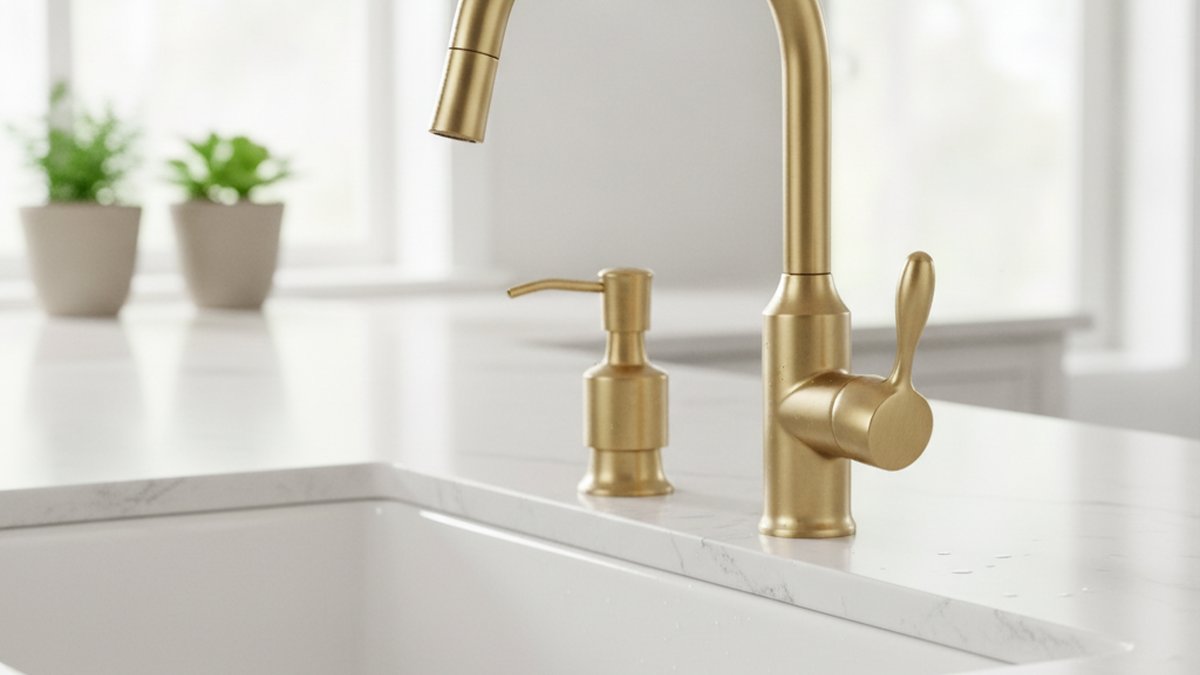
A brass faucet with soap dispenser is one of the smartest single upgrades you can make to a kitchen sink, because it solves two problems at once: it gives you a corrosion-proof, heavy-duty spout, and it fills that awkward fourth hole in your sink deck with a pump you’ll actually use every day. If you’ve been staring at an empty accessory hole (or a cheap plastic cover plate) wondering what to do with it, this is the answer most homeowners land on.
But “brass” is one of the most abused words in the faucet aisle, and a soap dispenser can be either a lifetime convenience or a leaky headache depending on how it’s built. Below, I’ll walk you through exactly what to look for, what these sets cost, how the finishes hold up, and whether the combo makes sense for your setup — the way I’d explain it to a friend standing in front of their sink.
What exactly is a brass faucet with soap dispenser, and how does it work?
It’s a kitchen faucet made from solid brass (not brass-plated zinc) sold together with a matching soap or lotion pump that mounts through a hole in your sink deck or countertop. The dispenser is a self-contained bottle-and-pump: you fill a reservoir under the sink, and pressing the pump head draws liquid soap up through a small tube.
The key thing to understand is that the two pieces are mechanically independent. The faucet connects to your hot and cold supply lines; the soap dispenser connects to nothing but its own refill bottle. That means the dispenser can’t leak water and won’t affect your water pressure — the only failure point is the pump mechanism itself, which is why pump quality matters more than the brass on that particular piece.
Most sets are designed for a standard 1.25-inch to 1.5-inch mounting hole, the same diameter as a sprayer or air-gap hole. If your sink already has a fourth hole, installation is genuinely a 20-minute job. If it doesn’t, you’ll need to drill one — easy in stainless steel, harder in fireclay or cast iron.
Is solid brass actually better than stainless steel or zinc faucets?
For long-term durability and water quality, yes — solid brass is the gold standard, and it’s why premium faucets have used it for over a century. Brass resists corrosion far better than the zinc alloy (sometimes called “pot metal”) found in budget faucets, and unlike some stainless castings, it machines cleanly enough to hold a watertight seal for decades.
Here’s the practical difference. Zinc-alloy faucet bodies develop pinhole corrosion and white powdery buildup where water sits, especially in hard-water regions. They often fail at the threads or the cartridge seat within 2–5 years. Solid brass, by contrast, is what plumbers pull out of houses 25 years later still working. The trade-off is weight and price: brass is heavier and costs more.
One caveat worth knowing: “lead-free brass” is the standard you want. Traditional brass contained small amounts of lead for machinability, but any faucet sold in the U.S. for drinking water must meet the federal lead-free limit (0.25% weighted average of wetted surfaces) and should be certified to NSF/ANSI 61 and 372. Reputable brass faucets today use low-lead alloys and are safe for potable water — always confirm the certification on the spec sheet.
| Material | Corrosion resistance | Typical lifespan | Weight / feel | Price range |
|---|---|---|---|---|
| Solid brass | Excellent | 15–25+ years | Heavy, substantial | $120–$400 |
| Stainless steel (304) | Very good | 10–20 years | Medium | $100–$300 |
| Zinc alloy (“pot metal”) | Poor | 2–5 years | Light, hollow feel | $25–$70 |
| Brass-plated plastic | Very poor | 1–3 years | Very light | $15–$50 |
A quick shortcut when you’re shopping: pick it up. A real solid-brass kitchen faucet feels dense and heavy in your hand. If it feels light and hollow like a toy, it’s not solid brass no matter what the listing says.
How much should you pay for a genuine brass faucet with soap dispenser?
Budget $120–$350 for a legitimate matched set from a real brass body. Below roughly $80, you’re almost certainly buying zinc or plated plastic dressed up with the word “brass,” and the finish will start flaking or corroding within a couple of years.
Here’s how the price tiers actually break down in 2026:
- $120–$180 — Entry-level solid brass. Ceramic-disc cartridge, decent PVD finish, basic pump dispenser. A genuinely good value if the certifications check out.
- $180–$280 — Mid-range. Better spray heads (magnetic docking pull-downs), thicker PVD finishes in champagne bronze or matte black, and dispensers with larger reservoirs you can refill from above the counter.
- $280–$400+ — Premium. Heavier castings, top-tier ceramic cartridges rated for 500,000+ cycles, lifetime finish warranties, and the smoothest pump mechanisms.
The single biggest money-waster is buying a $40 “brass-look” set to save cash, then replacing it two years later. Over a 15-year window, one $200 solid-brass set is far cheaper than three cheap replacements plus the hassle of re-plumbing under the sink each time. If you want to understand exactly which internal parts drive that longevity, our guide to kitchen faucet parts replacement breaks down the cartridge, O-rings, and aerator that actually wear out over time.
Which finish holds up best — brushed gold, matte black, or chrome?
For durability, any finish applied by PVD (physical vapor deposition) will outlast an electroplated one, regardless of color. Between colors, brushed/satin finishes hide water spots and fingerprints far better than polished chrome, which is why brushed gold, brushed nickel, and matte black have overtaken shiny chrome for kitchens.
Finish is where “brass faucet” gets confusing, because a brass body can wear almost any surface color:
- Brushed gold / champagne bronze — Warm, on-trend, hides spots well. The look most people picture when they say “brass faucet.” Pairs beautifully with white and navy kitchens.
- Matte black — Bold and modern; shows hard-water residue more than gold, so wipe it dry in mineral-heavy areas.
- Brushed nickel — The safe, neutral all-rounder; forgiving and easy to match to appliances.
- Polished chrome — Cheapest and most durable-looking day one, but shows every fingerprint and water spot.
- Unlacquered “living” brass — Raw brass that patinas over time. Gorgeous if you want that aged, lived-in look; not for anyone who wants it to stay bright.
Whatever color you choose, the make-or-break question is PVD vs. electroplated. PVD bonds the color at a molecular level and resists scratching, tarnishing, and the acids in cleaners; it’s what earns those lifetime finish warranties. Electroplated finishes are cheaper and can flake at the edges within a few years. Always look for “PVD” on the spec sheet.
Do you actually need the matching soap dispenser, or is it a gimmick?
If you have an unused sink hole, the dispenser is genuinely useful and worth having — it declutters the counter, never runs out visibly like a plastic bottle, and matches your faucet finish for a built-in look. If your sink has no spare hole and you’d have to drill one, that’s a bigger decision.
The real value shows up in daily use. A built-in dispenser refilled from a big jug under the sink means you buy soap in bulk, you’re not staring at a mismatched squeeze bottle, and the pump sits exactly where your hand already is. Many people fill theirs with dish soap; others use hand soap or even lotion.
A few honest limitations to know before you commit:
- Thick soaps clog cheap pumps. If you love thick, gel-style dish soap, buy a dispenser with a wider tube and a metal pump, and dilute slightly.
- Refilling matters. The best modern dispensers refill from above the counter — you just lift the pump head and pour. Older designs make you reach under the sink to unscrew the bottle, which is annoying.
- The pump is the weak point. This is the one part where mechanism quality beats material. A stiff or leaky pump is the most common complaint, so read reviews on the dispenser specifically.
If your sink is short a hole for the dispenser — or you’re deciding how many holes you need overall — it’s worth reading our explainer on the bathroom faucet deck plate, which covers how deck plates and mounting holes work, and our guide to the 3 hole farmhouse kitchen faucet setup for planning your hole configuration on an apron-front sink.
How do you install a brass faucet with soap dispenser yourself?
Most homeowners can install both pieces in under an hour with basic tools, as long as your sink already has the holes. The faucet is the involved part; the soap dispenser is almost trivial. Here’s the sequence:
- Shut off the supply. Close both the hot and cold angle stops under the sink and open the old faucet to relieve pressure.
- Remove the old faucet. Disconnect the supply lines, loosen the mounting nuts from below, and lift it out. A basin wrench makes the cramped nuts far easier.
- Set the new faucet. Drop the brass faucet through the main hole, add the gasket/base plate, and tighten the mounting nut from underneath.
- Connect the supply lines. Hand-tighten, then give a gentle quarter-turn with a wrench — don’t overtighten and crack the fitting.
- Install the soap dispenser. Drop the pump body through the accessory hole, secure the mounting nut below, then attach the reservoir bottle and pump tube.
- Turn the water back on slowly and check every connection for drips. Run the faucet 30 seconds to flush debris, then prime the soap pump by pressing it several times.
If this is your first faucet swap, walk through our full step-by-step guide on how to install a kitchen sink faucet and drain before you start — it covers the drain and supply-line details this quick list glosses over. And if you want to confirm you’ve got the right tools on hand first, our rundown of essential sink faucet install tools will save you a mid-job trip to the hardware store.
What should you look for on the spec sheet before buying?
Focus on five things that predict whether the faucet lasts: the body material, the cartridge, the finish process, the certifications, and the warranty. Everything else is styling.
| Spec | What to look for | Why it matters |
|---|---|---|
| Body material | “Solid brass” or “lead-free brass” | Determines corrosion resistance and lifespan |
| Cartridge | Ceramic disc, 500k+ cycles | Controls drip-free operation for years |
| Finish | PVD (not electroplated) | Resists scratches, tarnish, and cleaners |
| Certification | NSF/ANSI 61 & 372, cUPC | Confirms lead-free, potable-water safe |
| Warranty | Limited lifetime on finish & function | Signals the maker trusts the build |
A useful decision rule: if a listing won’t tell you the cartridge type and the finish process, assume the worst on both. Real solid-brass faucets brag about those specs; the fakes stay vague.
Is a single-handle or two-handle brass faucet better with a dispenser?
For most kitchens, a single-handle pull-down brass faucet paired with a soap dispenser is the easiest, most practical combo — one lever controls temperature and flow, which is ideal when your hands are full or messy. Two-handle setups look more traditional but take up more deck space and holes.
Because the soap dispenser already occupies one hole, a single-handle faucet keeps your total hole count manageable: one for the faucet, one for the dispenser, and maybe one for a sprayer if it’s not built into the spout. If you’re weighing the ergonomics of one lever versus two, our deep dive on the single lever faucet sink lays out exactly when each makes sense for a kitchen or bathroom.
FAQ
Is a brass faucet safe for drinking water?
Yes, as long as it’s certified lead-free to NSF/ANSI 61 and 372, which is required for any faucet sold for potable water in the U.S. Modern “lead-free brass” uses alloys with negligible lead content on wetted surfaces. Check the spec sheet for those certifications before buying, and if a listing doesn’t mention them, don’t assume the faucet meets them.
How do I tell if a faucet is really solid brass and not brass-plated?
Weight is the fastest tell — solid brass feels dense and heavy, while brass-plated zinc or plastic feels light and hollow. You can also check with a magnet: brass is not magnetic, so if a magnet sticks strongly to the body, it’s plated steel or has a steel core. Genuine solid-brass listings also state “solid brass” explicitly rather than just “brass finish” or “brass-tone.”
Can I fill the soap dispenser with dish soap or only hand soap?
You can use either dish soap, hand soap, or lotion, but thick gel dish soaps can clog narrow pump tubes over time. If you prefer thick soap, choose a dispenser with a wide-bore metal pump and dilute the soap slightly with water. Refill it whenever the pump starts pulling air, and occasionally run warm water through the pump to clear any buildup.
What if my sink doesn’t have an extra hole for the soap dispenser?
You’ll need to drill one, which is straightforward in stainless steel with a step bit but much harder in fireclay, cast iron, or granite composite. If drilling isn’t an option, you can mount the dispenser directly through the countertop next to the sink instead. Alternatively, choose a faucet whose sprayer is integrated into the spout so a separate sprayer hole frees up for the dispenser.
Do brass faucets tarnish or need special cleaning?
PVD-coated brass faucets resist tarnish and need only mild soap and a soft cloth — no harsh chemicals, abrasive pads, or acidic cleaners. Unlacquered “living” brass is the exception: it’s meant to patina and darken over time, which some people love and others polish back to bright. Avoid ammonia and bleach-based cleaners on any finish, as they can dull or damage the coating.
How long should a good brass faucet with soap dispenser last?
A quality solid-brass faucet with a ceramic-disc cartridge routinely lasts 15–25 years, and the finish should stay intact for the life of the faucet if it’s PVD-coated. The soap dispenser pump is the most likely part to wear out first, but pumps are inexpensive and easy to replace. Look for a limited lifetime warranty on both the finish and the working parts as a sign of confidence in the build.
About the author: This guide was written by the Fransiton fixtures team, drawing on hands-on testing of dozens of kitchen faucets across finishes and price tiers, plus feedback from professional plumbers who install these sets every week. We evaluate faucets for casting weight, cartridge cycle life, finish adhesion, and real-world pump reliability — not just looks.
About Fransiton: Fransiton designs and sells kitchen and bathroom fixtures built around solid-brass construction, PVD finishes, and ceramic-disc cartridges. Our brass faucets are certified to NSF/ANSI 61 and 372 for lead-free, potable-water safety and are backed by a limited lifetime warranty on finish and function, so the fixture you install today is one you won’t be replacing in a few years.
Pingback: What Are the Best Farmhouse Kitchen Faucet Ideas for an Apron-Front Sink in 2026? - Fransiton