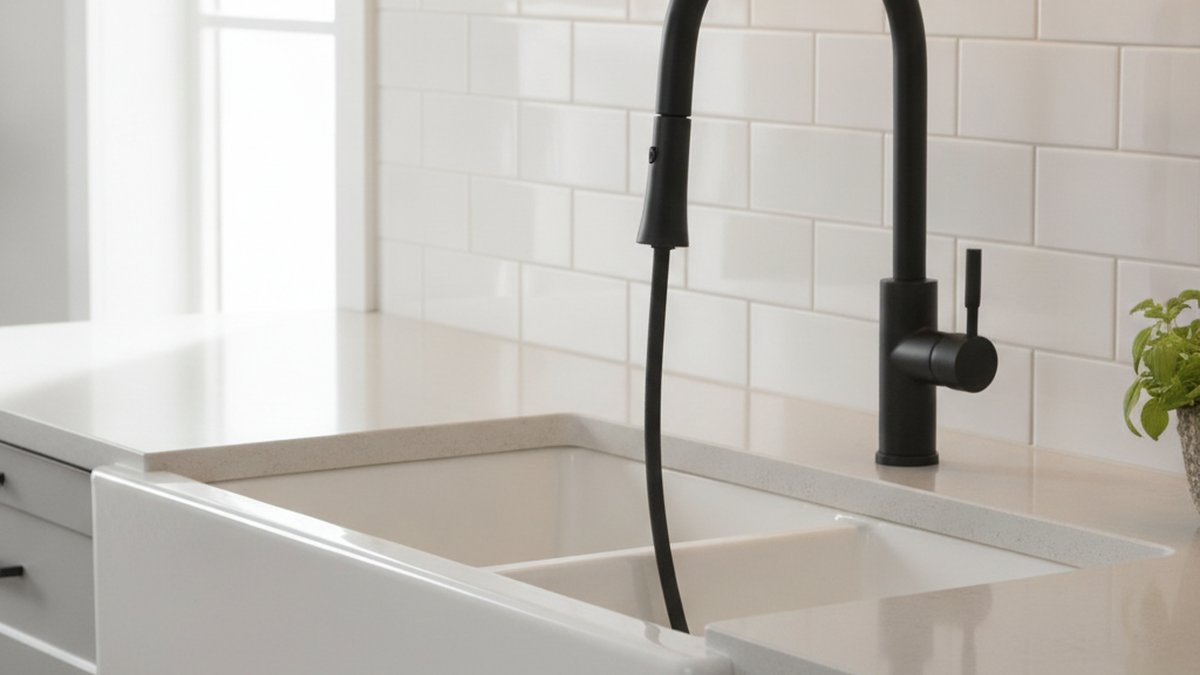
If you’re hunting for farmhouse kitchen faucet ideas that actually look right over a deep apron-front sink — and don’t just parrot the same three Pinterest photos — this is the practical version. A farmhouse sink is big, deep, and visually heavy, so the faucet has to be tall and confident enough to balance it, functional enough to fill a stockpot, and finished in a way that reads “farmhouse” without looking like a costume. Below are the styles, finishes, mounting setups, and real specs that work, plus the mistakes that make a good sink look off.
Fransiton has spent years fitting faucets to apron-front and drop-in sinks, and the single most common regret we hear is “I bought a faucet that was too short for the sink.” So we’ll start there — with height and proportion — then move through finishes, styles, and the questions people actually ask before buying.
How tall should a farmhouse kitchen faucet be for a deep apron-front sink?
For a standard farmhouse sink, aim for a faucet with a spout height of 9–10 inches from the deck and a spout reach of at least 8 inches so the water lands near the center of the basin. Apron-front sinks are typically 9–10 inches deep — much deeper than a standard drop-in — so a short bathroom-style faucet will feel cramped and splash off the bottom.
Here’s the logic in plain terms. The deeper and wider the sink, the taller and farther-reaching the faucet needs to be, or you’ll be knocking your knuckles on the spout every time you wash a sheet pan. A tall gooseneck or high-arc spout gives you the clearance to fit big pots underneath, which is the whole point of a farmhouse sink in the first place.
A few numbers worth memorizing before you shop:
- Spout height: 9–10″ for single-bowl farmhouse sinks; 8–9″ is fine for shallower or divided basins.
- Spout reach: 8–9″ so the stream hits the middle of a 30–36″ wide sink, not the front lip.
- Clearance above: leave 2–3″ between the top of the faucet and any window or upper cabinet so the handle can swing fully up.
- Total footprint: most farmhouse-style faucets stand 15–18″ tall overall — measure your window sill height if the sink sits under a window.
Single-hole, bridge, or pot filler — which farmhouse faucet style looks most authentic?
A bridge faucet is the most historically authentic farmhouse look, but a single-hole high-arc pull-down is the most practical and is what most people actually install today. The “right” choice depends on how vintage you want to go versus how much you cook.
Each style earns its place for a different reason, so match it to how you use the kitchen — not just how it photographs.
| Faucet style | Farmhouse look | Best for | Watch out for |
|---|---|---|---|
| Bridge faucet (two handles, exposed connecting bridge) | Most authentic / vintage | Period kitchens, classic farmhouse, wide 3-hole decks | No pull-down sprayer on most models; needs 8″ spread |
| Single-hole pull-down (high-arc gooseneck) | Modern farmhouse | Everyday cooks who want a sprayer and clean deck | Can look too contemporary in a strict period kitchen |
| Two-handle widespread with side sprayer | Traditional / transitional | 3-hole decks, people who like separate hot/cold | More parts to clean; side sprayer can wear out first |
| Wall-mounted pot filler (as a second faucet) | Rustic / professional-farmhouse | Serious cooks with a range near the sink wall | Cold water only; needs in-wall plumbing |
If you’re stuck between them: a bridge faucet says “old farmhouse,” a matte-black gooseneck pull-down says “renovated farmhouse,” and pairing a pull-down at the sink with a pot filler by the range says “I cook a lot.” A lot of buyers also want that classic apron look but with modern convenience — if that’s you, a 3-hole farmhouse kitchen faucet lets you keep a traditional widespread layout while still adding a side sprayer or soap dispenser.
What’s the best faucet finish for a farmhouse kitchen — matte black, bronze, or brushed gold?
Matte black is the most popular and most forgiving farmhouse finish right now; oil-rubbed bronze reads the most traditional; and brushed gold (champagne bronze) is the warm, upscale choice that’s aging well. All three suit a white farmhouse sink — the deciding factor is your hardware and lighting, not the sink.
The rule that keeps a farmhouse kitchen from looking busy: pick a finish and repeat it. Your faucet, cabinet pulls, and light fixtures should share a family. Here’s how the popular finishes actually behave day to day:
- Matte black: hides water spots and toothpaste-style splatter better than anything, but shows dried-on hard-water film if you never wipe it. Pairs with almost any countertop.
- Oil-rubbed bronze: the deep brown-black classic. Develops a “living finish” that lightens on high-touch spots over years — some people love the patina, some don’t.
- Brushed / champagne gold: warm and forgiving of fingerprints, feels premium, and stands out beautifully against a white or navy kitchen.
- Brushed nickel / stainless: the safest, most timeless neutral; less “statement,” more “will never look dated.”
- Polished chrome: bright and easy to clean but reads more traditional-suburban than farmhouse; shows every water spot.
One practical tip most articles skip: if your water is hard, a matte or brushed finish hides mineral spotting far better than polished chrome. And whatever you pick, buy your soap dispenser and any accessories in the same finish family at the same time — matching a discontinued finish later is a headache. If you like a coordinated deck, a brass faucet with a built-in soap dispenser keeps everything in one warm tone.
Do you mount a farmhouse faucet on the sink or the countertop?
Almost always the countertop (deck-mounted behind the sink), not the apron-front sink itself. Most farmhouse/apron sinks have no faucet holes, so the faucet gets drilled into the counter or comes up through a pre-drilled deck ledge — which is why hole count matters when you buy.
This trips people up constantly, so let’s be specific:
- Count your existing holes. If your counter is already drilled for three holes and you buy a single-hole faucet, you’ll need a deck plate (escutcheon) to cover the extras. A deck plate works the same way in a kitchen — it hides unused holes and gives a finished look.
- Match the faucet to the layout. Single-hole faucet = one hole. Widespread/bridge = three holes (or two handles plus spout). Adding a soap dispenser or air gap? That’s another hole.
- Check deck thickness. Thick stone or a farmhouse sink’s rear ledge can exceed the mounting hardware’s range — verify the faucet’s maximum deck thickness before buying.
- Confirm clearance under the counter so the supply lines and mounting nut have room around the sink’s rear wall.
Because farmhouse sinks are so deep, the hole is usually drilled into the countertop a couple inches behind the sink’s back edge. Get the faucet’s reach right (that 8–9″ number again) so the water still lands in the bowl, not on the back wall of the sink.
What’s the best farmhouse kitchen faucet on a budget vs. a splurge?
Under $150 you can get a solid single-hole matte-black pull-down that looks the part; the $250–$450 range buys you better valves, all-metal construction, and finishes that hold up for a decade-plus. The biggest quality jump isn’t looks — it’s what’s inside the spout and cartridge.
Here’s where your money actually goes as the price climbs:
- Cartridge/valve: cheaper faucets use plastic cartridges that drip sooner. A ceramic-disc cartridge is the single best predictor of a leak-free decade.
- Construction: solid brass body vs. zinc-alloy or thin stamped metal. Heft usually (not always) signals brass.
- Hose and spray head: braided nylon pull-down hoses with a magnetic dock last longer and re-seat cleanly. Weak docks are a top annoyance.
- Finish process: PVD (physical vapor deposition) finishes resist scratching and tarnish far better than sprayed coatings — worth it in gold and black.
Buy the best cartridge and finish you can afford, and don’t overpay for a brand name alone. If something does eventually fail, most issues are a $10–$30 part, not a whole new faucet — our guide to kitchen faucet parts replacement walks through which part failed and whether you can swap it yourself. And if you’re comparing premium names, our take on a Kohler farmhouse kitchen faucet lays out where the extra spend is and isn’t worth it.
How hard is it to install a farmhouse faucet yourself?
If the counter is already drilled with the right hole count, swapping in a farmhouse faucet is a 1–2 hour DIY job with basin-wrench, adjustable pliers, and plumber’s tape. Drilling new holes in stone is where you should call a pro.
The typical process: shut off the hot and cold supply valves under the sink, disconnect the old supply lines, unscrew the mounting nut with a basin wrench, drop the old faucet out, feed the new faucet through, tighten from below, connect the supply lines with fresh tape on the threads, then run water and check for drips. The tight, deep space behind a farmhouse sink is the only real challenge — a basin wrench earns its keep here.
If you’re doing the whole sink-and-faucet at once, our step-by-step on installing a kitchen sink faucet and drain in an afternoon covers the drain side too. Before you start, make sure you’ve got the right tools laid out — nothing kills a Saturday like realizing you don’t own a basin wrench.
Farmhouse Kitchen Faucet Ideas: Quick Style Recipes
Not sure how to combine everything above? Here are four farmhouse kitchen faucet ideas that reliably look pulled-together:
- Classic white farmhouse: white fireclay apron sink + matte-black single-hole pull-down + black cabinet pulls + subway tile. Clean, forgiving, timeless.
- Warm modern farmhouse: white or greige sink + champagne-bronze/brushed-gold gooseneck + walnut open shelving + gold pendant lights.
- Vintage authentic: apron sink + oil-rubbed-bronze bridge faucet with cross handles + open plate rack. Reads genuinely old.
- Working chef’s farmhouse: deep single-bowl sink + stainless pull-down + wall-mounted pot filler by the range + butcher block. Built to cook in.
Sizing the sink is half the battle, too — if you’re building from scratch, check what farmhouse sink size you actually need for a 36-inch cabinet before you lock in the faucet, since the two decisions drive each other.
FAQ
Can you put a regular kitchen faucet on a farmhouse sink?
Yes, as long as it’s tall enough. There’s no special “farmhouse faucet” fitting — any deck-mounted kitchen faucet works because it mounts to the countertop, not the sink. Just choose one with a 9–10″ spout height and 8″+ reach so it suits the deep apron basin, and match the hole count to your counter.
Do farmhouse sinks need a special faucet with a longer reach?
Effectively, yes. Because apron-front sinks are wider and deeper, a short-reach faucet lands water at the front lip instead of the center. Look for at least 8″ of spout reach; a high-arc gooseneck or pull-down gives both the reach and the height you need for big pots.
What faucet finish is easiest to keep clean over a farmhouse sink?
Matte black and brushed finishes (nickel, gold) hide water spots and fingerprints best, especially with hard water. Polished chrome looks great but shows every droplet. A PVD-coated finish in any color resists tarnish and scratching longest.
How many holes do I need drilled for a farmhouse faucet?
One hole for a modern single-hole pull-down, or three for a widespread/bridge faucet. Add a hole for each extra like a soap dispenser or air gap. If your counter has more holes than your faucet needs, a matching deck plate covers the rest.
Is a pull-down or pull-out sprayer better for a farmhouse kitchen?
A pull-down is usually better for farmhouse sinks. The tall gooseneck of a pull-down gives more clearance for large pots, which suits a deep apron sink, while pull-out sprayers pair better with lower-profile faucets. For everyday rinsing and pot-filling, the pull-down wins.
Will a tall farmhouse faucet fit under my window?
Measure first. Many farmhouse sinks sit under a window, and high-arc faucets stand 15–18″ tall overall with the handle raised. Leave 2–3″ of clearance above the faucet so the handle can swing fully up without hitting the sill or sash.
Author’s note: This guide was written by the Fransiton product team, who fit and test kitchen and bath faucets year-round across apron-front, drop-in, and undermount sinks. Fransiton is a dedicated faucet and bathroom-fixtures brand at fransiton.net, and our recommendations come from hands-on installs, not spec sheets alone. When we cite specs like spout height and reach, we’re referencing measurements taken on real fixtures. Look for faucets that meet cUPC/NSF certification and low-lead standards, carry a ceramic-disc cartridge, and come with a manufacturer warranty (many quality kitchen faucets carry a limited lifetime warranty on the finish and function) — those three signals matter more for long-term satisfaction than any single design choice.