Getting the farmhouse kitchen sink size right is the single most important measurement in the whole project, because unlike a drop-in sink, an apron-front farmhouse sink is partly supported by the cabinet itself and its front panel is exposed. Order one an inch too wide and it simply won’t drop between the cabinet sides; order one too small and you’ll have ugly filler gaps and a wobbly install. This guide walks through exactly how to measure, which sizes fit which cabinets, single vs. double bowl trade-offs, and the depth and reveal details most buyers forget until it’s too late.
How do I know what size farmhouse sink fits my cabinet?
Measure the interior width of your sink base cabinet, then subtract about 3 inches — that’s your target sink width. Farmhouse (apron-front) sinks are sized to the cabinet, not to the countertop cutout, so the cabinet is the number that matters.
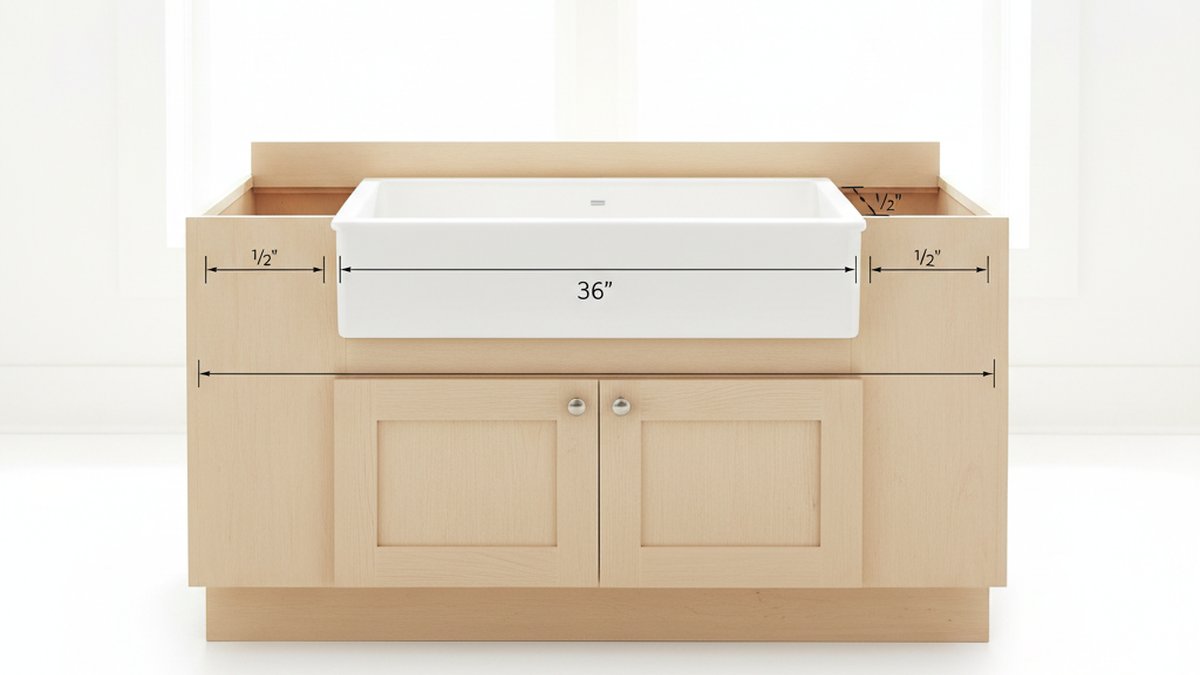
Here’s the practical method. Open the sink base cabinet and measure the inside width between the two cabinet walls at the front, near the top where the sink will rest. A “36-inch cabinet” is a nominal size; the actual interior opening is usually around 34 to 34.5 inches once you account for the face frame and side panels. You want the sink body (not counting any rim) to slide down into that opening with roughly a half-inch of wiggle room on each side.
That’s why the 3-inch rule works: a 36″ cabinet fits a 33″ sink comfortably, a 33″ cabinet fits a 30″ sink, and a 30″ cabinet fits a 27″ sink. If you’re building or ordering cabinets, tell your cabinet maker the exact sink you bought — a farmhouse sink often needs a modified base cabinet with a cut-down front stretcher and a support ledger to carry the weight.
What is the most common farmhouse kitchen sink size?
The 33-inch single-bowl farmhouse sink is the most common size sold in the U.S., because it pairs perfectly with the standard 36-inch sink base cabinet found in most kitchens. If you’re not sure and you have a typical 36″ cabinet, 33 inches is the safe default.
After 33 inches, the next most popular sizes are 30-inch (for tighter 33″ cabinets or smaller kitchens) and 36-inch (for larger 42″+ cabinets or big-batch cooks who want a huge single bowl). Widths below 27 inches or above 36 inches exist but are specialty items — great for a bar prep station or a grand chef’s kitchen, respectively, but harder to find and pricier.
- 24″ sink — bar or prep sink, or a very small galley kitchen; needs a 27″ cabinet.
- 27″ sink — compact primary sink; fits a 30″ cabinet.
- 30″ sink — good middle ground; fits a 33″ cabinet, or a 36″ cabinet if you want extra side room.
- 33″ sink — the default best-seller; fits a 36″ cabinet.
- 36″ sink — large single bowl or roomy double bowl; needs a 42″ cabinet.
Which cabinet width fits which sink size?
Match the sink to the cabinet using the table below — it’s the fastest way to avoid a return. Remember the sink width should land about 3 inches under the nominal cabinet width.
| Nominal cabinet width | Recommended sink width | Best for | Bowl style |
|---|---|---|---|
| 27″ | 24″ | Small kitchens, prep/bar station | Single bowl |
| 30″ | 27″ | Apartments, galley kitchens | Single bowl |
| 33″ | 30″ | Mid-size kitchens | Single or 60/40 double |
| 36″ | 33″ | Most standard kitchens (best-seller) | Single or double bowl |
| 42″ | 36″ | Large kitchens, avid cooks | Large single or 50/50 double |
| 48″+ | 36″–39″ | Chef’s kitchens, islands | Double or workstation |
One caveat: these are guidelines, not guarantees. Always confirm the specific sink’s cutout and minimum cabinet spec sheet before buying, because bowl wall thickness and apron overhang vary between fireclay, cast iron, and stainless models.
How deep should a farmhouse sink be, and does depth matter more than width?
Most farmhouse sinks are 9 to 10 inches deep, and for a primary kitchen sink that depth is the sweet spot — deep enough to hide a stack of dirty pots and cut down on splashing without forcing you to hunch over. Width determines what fits beside your dishes; depth determines what fits under them.
A 10-inch bowl handles roasting pans and cookie sheets laid flat. Go deeper — some run 11 to 12 inches — and you gain capacity but add strain if you’re shorter, since you’ll bend further to reach the bottom. Shallower bowls (7–8 inches) are easier on your back and better for a low counter, but they splash more and hide less.
Two depth details people miss:
- Apron height vs. bowl depth — the exposed front apron is usually taller than the bowl is deep, so a “10-inch deep” sink might have a front panel that’s 10 inches tall or more. Confirm the apron height matches your cabinet’s cut-down front.
- Faucet clearance — a deep bowl plus a tall faucet is great, but measure from the deck to your window sill or upper cabinet so the faucet handle actually clears. If you’re choosing a faucet at the same time, our guide to the best farmhouse style kitchen sink faucet for an apron-front sink covers matching spout height to bowl depth.
Single bowl or double bowl at the same size — which should I get?
At any given width, a single bowl gives you more usable space and a double bowl gives you separation for multitasking — and for farmhouse sinks under 33 inches, a single bowl is almost always the smarter pick. Splitting a 30-inch sink into two bowls leaves each side too small for a large pot.
Once you’re at 33 inches or wider, a double bowl becomes practical. A 60/40 split (larger bowl on one side) is the most versatile: wash in the big side, rinse or dry in the small side. A 50/50 split looks symmetrical and suits people who like one side for soaking and one for a drying rack. If you run a garbage disposal or wash oversized cookware daily, most cooks still prefer a big single bowl even at 36 inches.
| Factor | Single bowl | Double bowl |
|---|---|---|
| Big pots & sheet pans | Excellent | Limited by divider |
| Multitasking (wash/rinse) | Manual | Built-in separation |
| Best minimum width | 24″+ | 33″+ |
| Cleaning ease | Fewer crevices | More edges |
| Resale appeal | Modern favorite | Traditional favorite |
What size farmhouse sink works in a small kitchen or an island?
For a small kitchen, a 27- or 30-inch farmhouse sink in a 30″ or 33″ cabinet gives you the apron-front look without eating your whole counter; for an island, size the sink to the island’s base cabinet and leave at least 15–18 inches of landing space on each side. The sink shouldn’t dominate the run.
In a compact galley kitchen, resist the urge to cram in the biggest bowl you can. A 27-inch single bowl at 9 inches deep holds plenty for one or two people and keeps counter space on either side for a drying mat and a cutting board. If your total counter run is under 8 feet, going wider than 30 inches usually costs you more prep space than it’s worth.
On an island, the plumbing and cabinet depth constrain you as much as width. Islands often use deeper 24-inch cabinets, so you have room for a slightly deeper bowl, but you still size the width to the base — a 33″ island cabinet takes a 30″ sink. Because you’ll likely stand on the open side, a workstation sink with an integrated ledge for cutting boards and colanders earns its keep here.
Do I need special faucet holes, and how many?
Most farmhouse sinks come with no pre-drilled faucet holes, because the faucet mounts in the countertop or a wall behind the sink — so the number of holes you need is a countertop decision, not a sink-size decision. This trips up a lot of first-time buyers.
Decide how many holes to drill (or order) based on your faucet setup: one hole for a modern single-lever pull-down, two for a faucet plus a separate side sprayer or soap dispenser, three for a faucet with escutcheon plus accessories. If you want a fireclay or cast-iron sink that comes with the holes already there, or you’re weighing holes vs. a clean deck, read our breakdown of a farmhouse kitchen sink with faucet holes versus a sink with no holes at all before you order — it’s much harder to add holes to fireclay after the fact.
Because farmhouse installs put the faucet in the counter or wall, plan the whole assembly at once. If you’re doing it yourself, our step-by-step on how to install a kitchen sink faucet and drain in an afternoon covers sequencing the sink, faucet, and drain so you’re not fighting a heavy sink after the counter’s already down.
How much clearance and reveal should I plan for?
Plan for about a half-inch of side clearance between the sink and cabinet walls, and decide your reveal — how the countertop meets the sink rim — before the counter is templated. Farmhouse sinks are installed as undermount, so the counter fabricator needs the exact sink in hand to template accurately.
There are three reveal styles, and this affects both looks and cleaning:
- Positive reveal — counter sits back from the bowl edge, showing a lip of the sink rim. Easiest to fabricate, but the exposed lip catches crumbs.
- Zero (flush) reveal — counter edge lines up exactly with the bowl. Cleanest look, but requires precise templating.
- Negative reveal — counter slightly overhangs the bowl. Sweeps water straight in, but a fabrication error shows badly.
For weight, a fireclay or cast-iron 33-inch sink can weigh 80–120 pounds empty, so the cabinet needs a support ledger or plywood cradle rated to hold the sink plus water and dishes — figure the sink can hold 100+ pounds of water when full. Never rely on the countertop alone to carry a farmhouse sink.
Fireclay, cast iron, or stainless — does material change the size I can get?
Material doesn’t change the width categories, but it changes availability and weight at each size. Fireclay and cast iron dominate the classic white apron look and top out around 36 inches; stainless steel offers the widest size range and the lightest weight, which matters for DIY installs and for very large sinks.
| Material | Typical sizes | Weight (33″) | Look & notes |
|---|---|---|---|
| Fireclay | 24″–36″ | ~90–110 lb | Classic white matte; chip-resistant glaze |
| Cast iron (enameled) | 30″–36″ | ~100–120 lb | Heavy, warm colors; needs strong support |
| Stainless steel | 24″–39″ | ~25–40 lb | Lightest; modern, easy DIY; check gauge (16–18) |
| Copper | 30″–36″ | ~35–50 lb | Living finish; premium price |
If you’re leaning white farmhouse, fireclay in 30″ or 33″ is the classic combination. If you want the biggest possible bowl or an island workstation and easy handling, stainless in 36″–39″ is the practical route.
FAQ
What size farmhouse sink fits a 36-inch cabinet?
A 33-inch farmhouse sink fits a standard 36-inch base cabinet best. It leaves the roughly half-inch of side clearance you need for the apron to drop in and for the support ledger. Some 36″ cabinets can take a 30″ sink if you prefer more counter space on the sides.
Can I put a 36-inch farmhouse sink in a 36-inch cabinet?
No — a 36-inch sink will not fit a 36-inch cabinet, because the interior opening is only about 34 inches. A 36-inch farmhouse sink needs at least a 42-inch base cabinet. Always size the sink about 3 inches under the nominal cabinet width.
How deep are most farmhouse kitchen sinks?
Most are 9 to 10 inches deep, which comfortably hides pots and reduces splashing. Deeper 11–12 inch bowls add capacity but require more bending; shallower 7–8 inch bowls are easier on your back but splash more. Match depth to your height and counter height.
Is a 30-inch or 33-inch farmhouse sink better?
Choose 33 inches if you have a 36″ cabinet and want maximum bowl space; choose 30 inches if you have a 33″ cabinet or want extra counter room beside the sink. Both work as single bowls; only 33 inches and up make a practical double bowl.
Do farmhouse sinks come with faucet holes?
Usually not — most apron-front sinks ship with no faucet holes because the faucet mounts in the countertop or wall. You decide the hole count (typically one to three) when the counter is templated. Some fireclay models offer pre-drilled options, but adding holes to fireclay later is very difficult.
How much does a farmhouse sink weigh, and does the cabinet need reinforcement?
A 33-inch fireclay or cast-iron sink weighs roughly 90–120 pounds empty, and much more full of water and dishes. Yes, the base cabinet needs a support ledger or plywood cradle rated for the load — never let the countertop alone carry the sink.
The bottom line on sizing your farmhouse sink
Measure your cabinet’s interior width, subtract about 3 inches, and you have your sink width — 33 inches for the typical 36″ cabinet, scaling up or down from there. Then confirm depth (9–10 inches for most people), decide single vs. double bowl by width, plan your faucet holes in the counter, and make sure the cabinet is reinforced for the weight. Nail those five things and the install goes smoothly.
If your apron-front project also involves a heavy fireclay sink and matching finish, our guide to the right Kohler farmhouse kitchen faucet for your apron-front sink pairs well with the sizing advice here.
Author note: This guide was written by the Fransiton fixtures team, who spec and test kitchen sinks and faucets year-round. About Fransiton: Fransiton (fransiton.net) designs and sells kitchen and bath fixtures direct to homeowners, and we size-test our apron-front sinks against standard North American cabinet dimensions. Our fixtures are built to meet cUPC/NSF standards for potable-water fittings, and our kitchen sinks carry a limited lifetime warranty against manufacturing defects — always follow the included spec sheet and support requirements to keep that warranty valid.