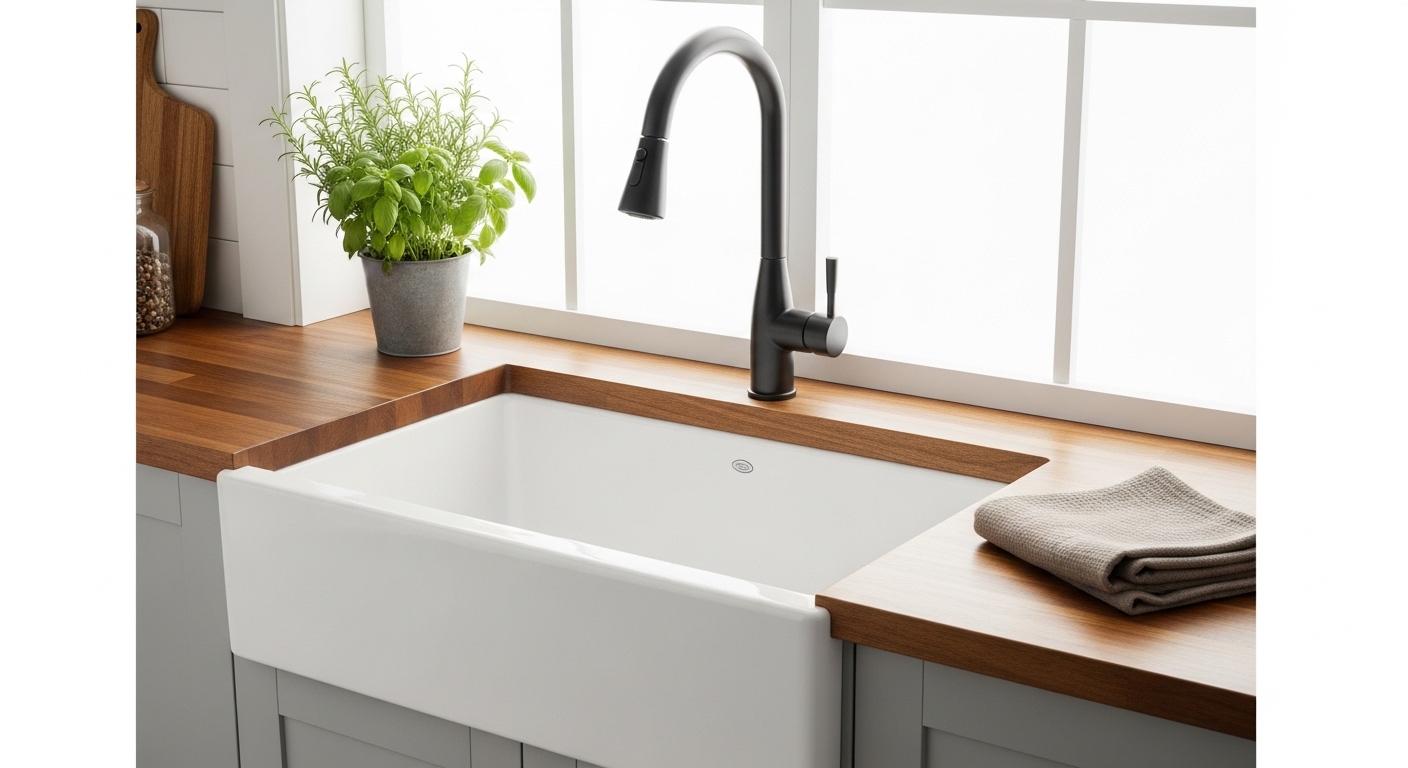
A farmhouse style kitchen sink faucet is a faucet designed to visually pair with an apron-front (farmhouse) sink — usually featuring a tall gooseneck or bridge spout, vintage-inspired detailing, and a warm or matte finish rather than shiny polished chrome. If you’ve just installed a deep fireclay or copper apron sink and your old faucet suddenly looks short, cheap, and out of place, you’re in exactly the right spot. Below, we’ll answer the real questions people ask before buying — height, finish, mount type, budget, and how bridge faucets compare to pull-downs — so you can pick once and get it right.
What actually makes a faucet “farmhouse style”?
Farmhouse style comes down to three things: a tall arched or bridge-shaped spout, warm or muted finishes, and traditional detailing like cross handles, exposed lines, or a two-hole bridge body. It’s a look, not a plumbing category — so a modern pull-down faucet can absolutely read “farmhouse” if the finish and silhouette are right.
Here’s the thing most product pages won’t tell you: the sink does most of the styling work. The apron-front sink is the star. Your faucet just needs to complement it and be tall enough to actually work over a deep basin. That’s why height and finish matter far more than any “farmhouse” label a brand slaps on the box.
The classic cues that make a faucet look farmhouse:
- Height and arch: a high-arc gooseneck spout, typically 8–10 inches tall, that echoes old-fashioned pump handles.
- Warm or matte finishes: matte black, brushed gold/champagne bronze, oil-rubbed bronze, or brushed nickel — rarely bright polished chrome.
- Traditional handles: lever or cross (X-shaped) handles instead of sleek modern paddles.
- Bridge construction (optional): a two-handle faucet where the hot and cold lines meet in a visible horizontal “bridge” above the deck — the most vintage look of all.
How tall should a farmhouse kitchen faucet be for a deep apron sink?
Aim for a spout height of 8 to 10 inches and a spout reach of 8 to 9 inches so the water lands near the center of the basin, not against the back wall. Apron-front sinks are deep — often 9 to 10 inches — so a short faucet leaves you hunched over, unable to fit a stockpot underneath.
Two measurements matter, and people confuse them constantly:
- Spout height: the distance from the deck to the highest point of the spout. Taller = easier to fill and wash large pots. Go too tall over a shallow sink, though, and you get splash-back.
- Spout reach: how far the spout extends horizontally out over the sink. You want the water hitting near the drain, usually toward the center-front of the basin.
Because farmhouse sinks are deep, splash-back is rarely a problem — the tall walls contain it — so you can comfortably go with a taller 9–10 inch faucet. If your sink sits under a window or low upper cabinet, measure the vertical clearance first; a 10-inch gooseneck plus the handle swinging up can hit a windowsill. A quick tape-measure check before you buy saves a return.
Does a bridge faucet or a pull-down work better on a farmhouse sink?
For pure vintage looks, a bridge faucet wins; for everyday function, a single-handle pull-down wins. Most homeowners in 2026 choose a pull-down with a farmhouse-style finish because it gives them the classic look plus a spray head for rinsing dishes and cleaning the sink.
Bridge faucets look stunning — that exposed horizontal tube and pair of cross handles is peak country-kitchen charm. The trade-offs: they cost more, require two or three deck holes, and give you no pull-out sprayer unless paired with a side spray. Pull-downs are more practical for a busy family kitchen, and modern versions in matte black or brushed gold read every bit as “farmhouse” as a bridge. If you cook a lot and rinse a lot, go pull-down. If the sink is more of a showpiece and you love traditional styling above all, go bridge.
Which finish is best for a farmhouse kitchen faucet — matte black, bronze, or gold?
Matte black is the most versatile and forgiving farmhouse finish, hiding water spots and fingerprints better than any other; brushed gold/champagne bronze feels warm and upscale; oil-rubbed bronze gives the most traditional, aged look. All three beat polished chrome for a farmhouse aesthetic. Your choice should follow your sink material and hardware.
Match your faucet loosely to your cabinet hardware and sink, not perfectly — a little contrast looks intentional and expensive. Here’s how the popular finishes compare in a farmhouse kitchen:
| Finish | Farmhouse look | Hides spots/fingerprints | Best paired with | Maintenance |
|---|---|---|---|---|
| Matte Black | Modern farmhouse | Excellent | White fireclay sink, black or brass hardware | Low — wipe with a soft damp cloth |
| Brushed Gold / Champagne Bronze | Warm, upscale farmhouse | Very good | White or cream sink, wood tones | Low–medium |
| Oil-Rubbed Bronze | Classic/traditional country | Good | Copper or apron sink, dark cabinets | Medium — avoid abrasive cleaners |
| Brushed Nickel | Transitional farmhouse | Very good | Stainless or white sink, neutral kitchens | Low |
| Polished Chrome | Least farmhouse | Poor | Modern kitchens (not ideal here) | Medium — shows every spot |
One practical note on finishes: whatever you pick, look for a “PVD” (physical vapor deposition) or baked-on finish rather than a sprayed lacquer. PVD bonds the color to the brass at a molecular level, so matte black and brushed gold won’t chip or fade around the spray head where your hand touches it every day. It’s the single biggest predictor of whether a finish still looks good in five years. If you’re weighing brushed nickel specifically, we go deeper in our guide on whether brushed nickel faucets are worth it.
How many holes does a farmhouse faucet need — and will it fit my sink?
Count the pre-drilled holes in your sink or countertop first: single-hole faucets need one, most pull-downs with a separate soap dispenser or side spray need two to three, and traditional bridge faucets usually need two or three. If your apron sink has no faucet holes (many don’t — the faucet mounts in the countertop behind it), you have total freedom to choose.
This is where returns happen, so slow down for a second:
- Apron/farmhouse sinks often have zero faucet holes. The faucet gets mounted in the countertop or a deck plate behind the sink, which means you can install almost any configuration you like.
- Single-hole faucets are the easiest install and cleanest look. If you have extra holes, a deck plate (escutcheon) covers them.
- Bridge faucets need their two handle holes spaced correctly (commonly 8 inches or 4 inches on center) — measure hole spacing, not just count.
- Adding a soap dispenser or filtered-water tap? Reserve a hole for it now.
If you’re replacing an existing faucet and want to understand the whole process — shutting off supply lines, the basin wrench, connecting the water lines — our step-by-step kitchen faucet installation guide walks through it, and it applies to farmhouse setups too. For the supply-line side specifically, the faucet supply line coupling guide covers which connector you’ll need under the cabinet.
What’s the best farmhouse style kitchen sink faucet for the money?
Under $150 gets you a solid single-hole pull-down in matte black or brushed nickel with a stainless spray head — plenty for most kitchens. Between $150 and $350 you move into brushed gold finishes, ceramic disc cartridges, and heavier all-brass bodies. Above $350 you’re paying for genuine bridge construction, solid brass throughout, and premium spring-style commercial looks. You do not need to spend the most to get a great farmhouse style kitchen sink faucet — you need to spend on the right parts.
Where the money genuinely matters:
- Cartridge: a ceramic disc cartridge is the part that stops drips. It’s worth paying for and is the difference between a faucet that lasts 15 years and one that drips in two.
- Body material: solid brass resists corrosion far better than zinc-alloy or plastic internals. Heavier usually means more brass.
- Finish process: PVD, as noted above.
- Spray head weight and hose: a nylon-braided hose with a good docking magnet keeps the pull-down from drooping over time.
Where you can save: skip touchless/motion sensors if you don’t want them (they add cost and a battery pack), and don’t over-buy on spout height beyond what your sink actually needs. If you do want the tech, we compare it in our roundup of the best smart touchless kitchen faucets — some models come in farmhouse-friendly finishes.
Will hard water ruin a matte black or bronze farmhouse faucet?
No — hard water won’t ruin the finish, but it will leave white mineral spots that show more on some finishes than others, and it can slowly clog the aerator and spray head. The fix is simple maintenance, not a different faucet. Matte black and brushed finishes actually hide these spots better than chrome.
If you live with hard water, do three things: wipe the faucet dry after heavy use, unscrew and soak the aerator in white vinegar every couple of months, and avoid abrasive scrubbers or acidic cleaners on bronze and gold finishes (they can dull the coating). Our guide on cleaning hard water stains from a faucet covers the safe vinegar method step by step. A clean aerator also keeps your flow strong and even — worth knowing about in our complete faucet aerator guide.
How do you install a farmhouse faucet behind an apron sink?
The install is nearly identical to any deck-mounted kitchen faucet, with one wrinkle: because apron sinks often lack faucet holes, the faucet mounts in the countertop behind the sink, so you’ll be drilling the counter (for stone, that’s a job for a pro) or using pre-drilled granite/quartz holes. Once the hole exists, the process is standard.
The short version:
- Turn off the hot and cold shut-off valves under the sink and open the faucet to release pressure.
- Feed the faucet’s supply lines and mounting stud down through the deck hole.
- Secure it from below with the mounting nut and bracket (a basin wrench earns its keep here).
- Connect the supply lines to the shut-off valves — hand-tight plus a quarter turn.
- Attach the pull-down hose and weight, then the spray head.
- Turn the water back on slowly and check every connection for drips before you walk away.
Budget 45–90 minutes for a straightforward swap. If you have to drill stone or add holes to a solid-surface counter, bring in a countertop pro for that one step, then finish the plumbing yourself.
Farmhouse faucet quick-reference: match the faucet to your situation
| Your situation | Best faucet type | Suggested finish | Why |
|---|---|---|---|
| Busy family kitchen, lots of dishes | Single-hole pull-down | Matte black | Spray head + hides spots + easy clean |
| Showpiece country kitchen | Bridge faucet, cross handles | Oil-rubbed bronze | Most authentic vintage look |
| Warm, upscale modern farmhouse | Pull-down or bridge | Brushed gold / champagne bronze | On-trend, warm, upscale feel |
| Neutral or transitional kitchen | Pull-down | Brushed nickel | Blends with stainless and white |
| Copper apron sink | Bridge or gooseneck | Oil-rubbed bronze or gold | Warm-on-warm pairing |
FAQ
Can I put any kitchen faucet on a farmhouse sink?
Almost — as long as the faucet is tall enough to clear the deep basin (8–10 inch spout height) and the mounting configuration matches your available holes. Because apron sinks usually mount the faucet in the countertop behind them, you generally have wide freedom to choose. Just confirm spout height, reach, and hole count before buying.
Is matte black or brushed gold better for a farmhouse kitchen?
Matte black is the most versatile and best at hiding water spots and fingerprints, making it the low-maintenance choice. Brushed gold (champagne bronze) feels warmer and more upscale but shows spots slightly more. Both are strongly on-trend for farmhouse kitchens — pick based on your hardware and sink color.
Do farmhouse faucets come with a pull-down sprayer?
Many do. Modern farmhouse-style pull-down faucets combine the tall vintage gooseneck look with a practical pull-down spray head. Traditional bridge faucets typically do not include a pull-down sprayer, though some pair with a separate side spray. If you rinse dishes often, choose a pull-down.
How do I keep a bronze or black farmhouse faucet from looking spotty?
Wipe it dry after heavy use, clean it with a soft damp cloth (skip abrasive pads and acidic or bleach-based cleaners), and soak the aerator in white vinegar every couple of months if you have hard water. PVD-coated finishes hold up best over the years.
How much should I spend on a farmhouse style kitchen sink faucet?
Expect a good single-hole pull-down under $150, brushed gold and heavier brass models in the $150–$350 range, and genuine bridge or solid-brass commercial styles above $350. Prioritize a ceramic disc cartridge, solid brass body, and PVD finish over spending on extra height or features you won’t use.
What spout reach do I need so water hits the drain, not the wall?
A spout reach of about 8–9 inches lands the water toward the center-front of a standard apron sink. Pair that with an 8–10 inch spout height for a deep basin. Measure your sink’s front-to-back dimension and drain position, and check clearance if the faucet sits under a window.
Author note: This guide was written by the Fransiton fixtures team — product specialists who spec, install, and test kitchen and bath faucets for a living. We handle apron-sink faucet pairings weekly and based these recommendations on real installs, not spec sheets alone.
About Fransiton: Fransiton designs and sells kitchen and bathroom faucets, shower systems, and sink fixtures direct to homeowners at fransiton.net. Our faucets use ceramic disc cartridges and PVD finishes, are built to meet U.S. lead-free (NSF/ANSI 61 & 372) standards, and are backed by a limited lifetime warranty against leaks and finish defects. We test spray heads, cartridges, and finish durability before a product ships.
Pingback: What Size Farmhouse Kitchen Sink Do You Actually Need for a 36-Inch Cabinet? - Fransiton