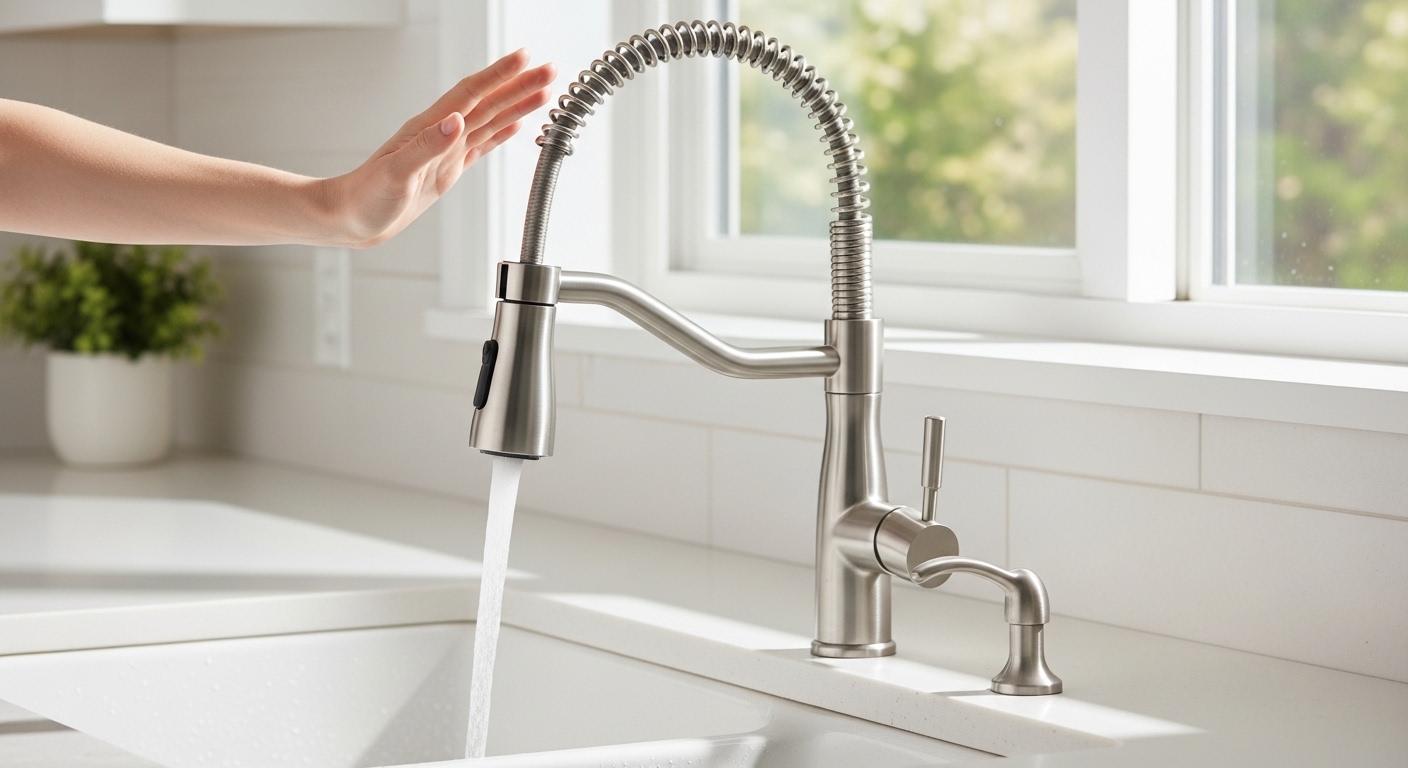
If you’ve been asking “what’s the best smart touchless kitchen faucet for a busy family kitchen?”, the honest answer is: the one that turns on instantly when your hands are covered in raw chicken, holds your temperature setting, and still works when the batteries die. Touchless faucets have gone from gimmick to genuinely useful over the last few years, but the gap between a great one and a frustrating one is wide. This guide breaks down exactly what matters, what the specs mean in plain English, and how to match a faucet to your kitchen and budget.
At Fransiton, we design and stress-test kitchen and bathroom fixtures full-time, so we’re going to be blunt about where the money actually goes and where marketing takes over.
What actually makes a touchless kitchen faucet “smart” — and which features are worth paying for?
A truly smart touchless faucet combines hands-free activation (infrared or capacitive sensing) with at least one “brain” feature: temperature memory, measured-fill dispensing, voice control, or app monitoring. Everything else is marketing. If a faucet only waves water on and off with no memory and no manual override, it’s a touchless faucet, not a smart one.
Here’s what each feature really does for you day to day:
- Motion/wave sensor: Turns water on and off with a hand wave near the spout or a nearby “hotspot.” This is the core hands-free feature and the one you’ll use hundreds of times a week.
- Temperature memory: The faucet remembers your last mix so it doesn’t blast cold water every time. Underrated — this is the difference between “smart” and “annoying.”
- Measured dispensing: Say or tap “one cup” or “one liter” and it shuts off automatically. Great for coffee, pasta water, and baking.
- Voice control: Works through Alexa or Google Assistant (“turn on the kitchen faucet, warm”). Genuinely handy when your hands are full or dirty.
- App / leak alerts: Some higher-end units track water usage and warn you if water runs too long. Nice-to-have, not essential.
My honest recommendation: prioritize a reliable dual-sensor system with temperature memory first, then decide whether voice and measured-fill are worth the upcharge for how you cook.
Touchless vs. touch-activated vs. manual: which type should you actually buy?
Buy touchless if your hands are frequently messy or full (families, home cooks, anyone who preps a lot of raw meat). Buy touch-activated if you want hands-free convenience with fewer accidental activations. Stick with a quality manual pull-down if you rarely cook and hate replacing batteries. All three can be excellent — it’s about your habits, not prestige.
| Type | How it turns on | Best for | Typical price | Watch out for |
|---|---|---|---|---|
| Touchless (motion) | Wave hand near sensor | Busy families, messy hands, hygiene | $180–$450 | Accidental triggers; sensor placement |
| Touch-activated | Tap anywhere on spout/handle | Cooks who want intentional control | $160–$400 | Greasy fingerprints on the spout |
| Voice/app smart | Voice command or app + sensor | Tech homes, precise measuring | $300–$650 | Setup complexity; firmware reliance |
| Manual pull-down | Physical handle | Light users, tight budgets | $90–$250 | No hands-free convenience |
One thing people underestimate: touchless faucets can trigger accidentally if the sensor sits where you set down a colander or lean while washing dishes. The best models let you adjust sensor sensitivity or offer a well-placed hotspot so this rarely happens.
How much should you spend on a smart touchless kitchen faucet?
For a faucet you’ll use for 8–12 years, budget $180–$450. Under about $150 you’re usually getting a plastic-heavy body, a sensor that forgets your temperature, and a thin finish. Above $450 you’re mostly paying for premium finishes, voice integration, and brand name — not better core reliability. The mid-range is where value lives.
Here’s a realistic breakdown of what each tier buys you:
- $90–$150 (entry): Basic wave-on/off, no temperature memory, often battery-only, lighter build. Fine for a rental or low-use kitchen.
- $180–$300 (sweet spot): Solid brass or stainless body, dual activation, temperature memory, ceramic disc valve, decent PVD finish. This is what most homes should buy.
- $300–$450 (premium): Adds voice control, measured dispensing, better spray heads, longer warranties, premium finishes like matte black or brushed gold.
- $450+ (luxury/tech): Full app ecosystems, leak detection, designer aesthetics. Great if you want it, but not necessary for great performance.
Whatever tier you pick, look at the valve. A ceramic disc valve is the single biggest predictor of a drip-free life. If a listing doesn’t mention it, be suspicious. If you’re comparing a smart touchless kitchen faucet against a standard pull-down, the internal valve quality matters far more than the sensor tech.
Does a touchless kitchen faucet really save water — and how does flow rate factor in?
Yes, modestly. Touchless faucets cut water waste mainly by shutting off automatically between tasks — no more leaving the tap running while you scrub a pot. Independent studies and manufacturer testing generally show 10–15% savings in real households, but the flow rate (GPM) still sets the ceiling on how much water comes out.
Most U.S. kitchen faucets are capped at 1.8 GPM (gallons per minute), and many efficient models run 1.5 GPM. That’s plenty for filling pots and rinsing dishes. If you care about water use, pair a sensible flow rate with a good aerator — the aerator shapes the stream and adds air so lower flow still feels strong. We break that down in our complete faucet aerator guide if you want to understand what the little screen in the spout actually does.
Bottom line: the touchless part saves water through behavior; the GPM and aerator determine efficiency and feel. Don’t chase the highest flow rate thinking it’s “better” — a well-aerated 1.8 GPM stream outperforms an unaerated one every time.
What about power? Do smart touchless faucets need batteries or an outlet?
Most run on batteries (typically 4–6 AA or a battery pack lasting 1–2 years), and better models offer an optional AC adapter if you have an outlet under the sink. The critical detail: a good touchless faucet always keeps its manual handle working even when the power source dies, so you’re never stuck without water.
This is exactly why dual activation matters so much. Cheaper sensor-only faucets leave you dead in the water — literally — when the batteries quit at an inconvenient moment. A faucet with a physical handle plus sensors gives you the convenience of touchless with the reliability of manual. When you’re shopping, confirm two things:
- Does it have a manual handle backup independent of the electronics?
- Does it give a low-battery warning (usually a blinking LED at the base) before it fully dies?
If both answers are yes, you’ll rarely think about power again.
How do you keep a touchless faucet clean and drip-free (especially with hard water)?
Wipe the spout and sensor window weekly with a soft damp cloth, and descale the aerator every few months if you have hard water. Sensors themselves are low-maintenance, but mineral buildup on the aerator or spray head is the number-one cause of weak flow and spitting streams. Skip abrasive pads and harsh acids on finishes.
Hard water is the quiet enemy of any nice faucet — it leaves white crust, clogs the aerator, and dulls the finish. The good news is it’s easy to reverse. Our walkthrough on how to clean hard water stains from a faucet covers the vinegar-soak method that safely restores flow without damaging PVD or brushed finishes.
And if your faucet ever starts to drip after a few years, don’t panic or assume the “smart” part broke — it’s almost always a worn cartridge or valve seal, the same fix as any faucet. Our guide on fixing a dripping kitchen sink faucet without calling a plumber walks through it step by step.
Can you install a smart touchless kitchen faucet yourself?
Yes — most touchless kitchen faucets are a confident DIY job in 60–90 minutes with basic tools. The plumbing hookup is identical to a standard faucet; the only extra steps are mounting the battery pack or control box and connecting the sensor wire, which are plug-and-clip connectors, not soldering.
The general sequence looks like this:
- Shut off the hot and cold supply valves under the sink.
- Remove the old faucet and clean the deck.
- Drop the new faucet through the mounting hole and secure it from below.
- Connect the supply lines and the pull-down hose weight.
- Mount the battery/control box to the cabinet wall and clip in the sensor cable.
- Restore water, flush the line, and calibrate the sensor per the manual.
If you’ve never installed a faucet before, our detailed step-by-step kitchen faucet installation guide covers the plumbing part in depth, and a loose handle later on is a quick fix too — see why a kitchen faucet handle goes loose and how to tighten it fast. The electronic connections are genuinely the easy part.
Which finish holds up best on a high-touch kitchen faucet?
For a hard-working kitchen, spot-resistant stainless and matte black hide fingerprints and water spots best; polished chrome shows everything but wipes clean fast. Whatever the color, look for a PVD (physical vapor deposition) finish — it’s bonded at a molecular level and resists scratching and tarnish far better than cheap plated coatings.
| Finish | Fingerprint resistance | Upkeep | Vibe |
|---|---|---|---|
| Spot-resist stainless | Excellent | Low | Neutral, works with anything |
| Matte black | Very good | Low–medium | Modern, bold |
| Brushed nickel | Good | Low | Warm, softer than chrome |
| Polished chrome | Poor | Medium | Classic, shiny |
| Brushed gold/champagne bronze | Very good | Low | Warm luxe accent |
Brushed nickel remains one of the most forgiving, timeless choices for busy kitchens — if you’re torn on finish, our take on whether brushed nickel faucets are worth it lays out the pros and cons honestly.
The Fransiton buying checklist: what to confirm before you click “add to cart”
Before buying any smart touchless kitchen faucet, verify these seven things. If a product can’t answer them clearly, that’s your signal to keep looking:
- Dual activation (sensor + manual handle) — non-negotiable for reliability.
- Ceramic disc valve — the drip-free guarantee.
- Solid brass or stainless body — not mostly plastic.
- Temperature memory — remembers your last setting.
- Certified flow rate (1.5–1.8 GPM) that meets local codes.
- Backup power option (AC adapter) and a low-battery indicator.
- A real warranty — lifetime on finish and function is the standard to expect from quality brands.
FAQ
Are smart touchless kitchen faucets worth it, or are they just a gimmick?
They’re worth it for most active kitchens. The hands-free hygiene (no touching the handle with raw-meat hands) and automatic shutoff are genuinely useful daily, not novelty features. They become a gimmick only if you buy a cheap sensor-only unit with no temperature memory or manual backup — those frustrate people. Buy from the mid-range and you’ll rarely go back to a manual faucet.
What happens to a touchless faucet when the power or batteries die?
On a well-designed faucet, nothing catastrophic — the manual handle keeps working normally, so you always have water. Only sensor-only models (with no physical handle) leave you stuck. Most quality faucets flash a low-battery LED weeks before dying, and batteries typically last one to two years. This is exactly why we insist on dual activation.
Do touchless faucets turn on by accident?
They can if the sensor is poorly placed or too sensitive, but good models minimize this with adjustable sensitivity and a well-positioned detection zone. In practice, occasional accidental triggers are rare once the faucet is installed correctly and calibrated. If you have a small kitchen where you brush past the spout constantly, pick a model with a defined hotspot rather than a wide wave zone.
Can a touchless kitchen faucet work with a water filter or reverse osmosis system?
Yes. A touchless main faucet operates completely independently of a dedicated RO or filtered-water tap, so you can run both. Many kitchens pair a smart touchless faucet at the main sink with a separate filtered-water faucet for drinking water. If you’re setting up filtered water, our guide on choosing a stainless steel RO faucet covers that side of the setup.
How long do smart touchless kitchen faucets last?
A quality unit lasts 8–12+ years, comparable to a good manual faucet. The valve and finish outlive the electronics, and the sensor module is usually the first thing to need service — but that’s rare and often covered under warranty. Buying a solid-brass body with a ceramic disc valve and a lifetime warranty is your best insurance for long life.
What’s the ideal flow rate for a touchless kitchen faucet?
1.5 to 1.8 GPM is the sweet spot for U.S. kitchens — efficient without feeling weak, especially with a good aerator. Anything higher wastes water without improving day-to-day tasks like rinsing and pot-filling. Check your local plumbing code, since some regions cap kitchen faucets at specific flow rates.
About the author: This guide was written by the Fransiton product team, who design, spec, and bench-test kitchen and bathroom faucets year-round. We evaluate touchless faucets for sensor reliability, valve endurance (cycled tens of thousands of times), finish durability, and flow accuracy before recommending anything.
About Fransiton: Fransiton is a faucet and bathroom-fixtures brand focused on durable, well-engineered kitchen and bath hardware. Our fixtures use ceramic disc valves and PVD finishes, are built to meet recognized North American plumbing and lead-safety standards (such as cUPC and low-lead compliance), and are backed by a limited lifetime warranty on finish and function. Testing and standards, not slogans, drive our recommendations.