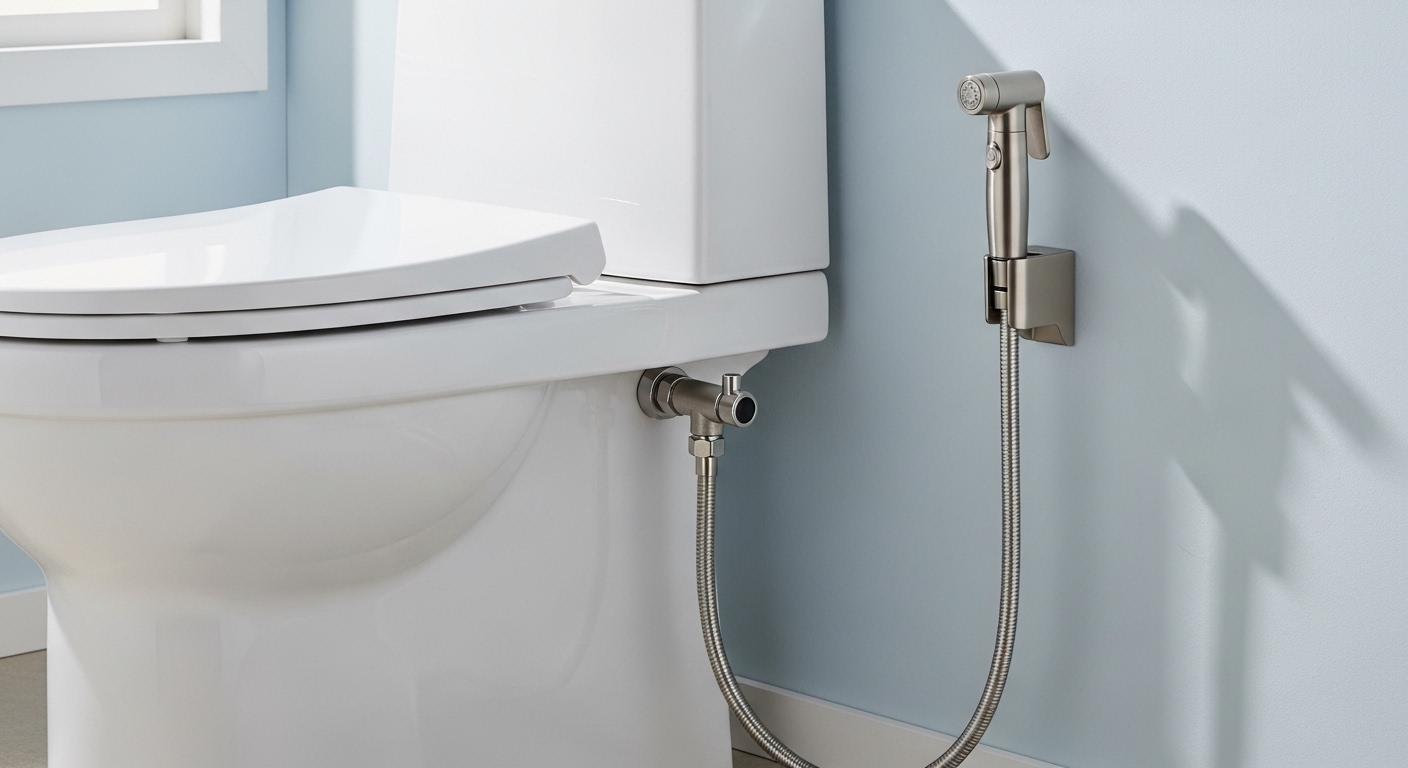
A faucet spray bidet is a handheld sprayer that connects to your existing water supply and delivers a controllable jet of water for cleaning after using the toilet. It’s the middle ground between a bare bidet attachment that sits under your toilet seat and a full electronic bidet toilet that costs several hundred dollars. If you’ve ever used a kitchen pull-down sprayer and wished your bathroom had that same on-demand, aim-anywhere control, that’s essentially what a faucet spray bidet gives you — just sized, valved, and pressured for personal use instead of rinsing dishes.
In this guide I’ll answer the questions people actually type and ask out loud: what a faucet spray bidet really is, whether it’s better than an under-seat attachment, how it installs, what the water feels like, what it costs to run, and the exact specs that separate a sprayer you’ll love from one that leaks in six months. By the end you’ll know whether to buy one and which features are non-negotiable.
What Exactly Is a Faucet Spray Bidet, and How Is It Different From a Regular Bidet?
A faucet spray bidet is a trigger-operated handheld nozzle — think of a small, refined version of a garden or kitchen sprayer — plumbed into your bathroom’s water supply and used to rinse yourself clean. The word “faucet” here refers to how it taps the faucet/toilet water line, not that it clips onto your sink spout. You squeeze the trigger, water sprays; you let go, it stops.
Here’s how it differs from the other options on the market:
- Under-seat bidet attachment: A fixed plastic nozzle that mounts under your toilet seat and sprays a preset stream when you turn a dial. Cheap and hands-free, but you can’t aim it and cleaning power is fixed.
- Faucet spray bidet (handheld sprayer): A wand you hold and aim, with a live-adjustable trigger. Far more control, doubles as a tool for cleaning the toilet, the diaper pail, or a pet’s paws.
- Electronic bidet seat: A powered seat with heated water, warm-air drying, and remote controls. The most luxurious, but it needs a nearby GFCI outlet and runs $300–$1,200.
The faucet spray bidet wins on flexibility per dollar. You get real spray control and multi-use practicality without electricity, without replacing your toilet seat, and without hiring anyone.
Is a Faucet Spray Bidet Better Than a Bidet Attachment for a Small Bathroom Under $50?
For most small bathrooms on a tight budget, yes — a handheld faucet spray bidet is the better pick because it gives you aim and pressure control that a fixed attachment can’t, and good ones still land under $50. The one real trade-off is that a handheld requires you to use your hand; an under-seat attachment is fully hands-off, which matters for users with limited mobility or grip strength.
Think about your actual situation. If the bathroom is shared, a family with kids of different heights benefits hugely from an aimable wand. If the user has arthritis or balance issues, a fixed attachment with a side dial may be easier. And if wall space is tight, the sprayer’s holster mounts on the tank or the wall and takes up almost nothing.
Water temperature is the other decision point. A basic faucet spray bidet runs cold — it tees off the toilet’s cold supply line. If a cold rinse is a dealbreaker in winter, look specifically for a “warm water” or “dual-inlet” faucet spray bidet kit that also connects to a hot supply (usually under a nearby sink) with a mixing valve. Those cost more and take longer to install, but they solve the number-one complaint people have.
How Do You Install a Faucet Spray Bidet Yourself Without a Plumber?
You install a faucet spray bidet by shutting off the water, teeing into the toilet’s supply line, and connecting the hose and sprayer — a 15-to-25-minute job that needs no soldering and only a wrench and a towel. Roughly 9 out of 10 buyers do this themselves. Here’s the sequence:
- Shut off the water at the toilet’s angle stop (the small valve on the wall behind the toilet) and flush to empty the tank.
- Disconnect the supply line where it meets the bottom of the toilet tank. Keep your towel handy — a little water always drips.
- Install the T-valve (diverter). Screw the included brass T-adapter onto the tank inlet, then reconnect the original supply line to one side of the T. This is the same idea as a faucet spray diverter — it splits one water source into two controllable outputs.
- Connect the sprayer hose to the T-valve’s second outlet, then attach the shut-off valve and the handheld sprayer.
- Mount the holster on the wall or tank and turn the water back on slowly, checking every joint for drips.
A few pro tips that prevent 90% of headaches: wrap two or three turns of plumber’s PTFE tape clockwise on every threaded connection, don’t over-tighten plastic nuts (hand-tight plus a quarter turn), and confirm your existing faucet supply line and connections are the standard 7/8″ or 15/16″ size before you buy so the included fittings actually match. If your supply line is old or corroded, swap it while you’re in there — a fresh braided line is a couple of dollars and cheap insurance against a future flood.
What Water Pressure and Flow Should a Faucet Spray Bidet Have?
A good faucet spray bidet should deliver a firm, controllable stream at your home’s normal household pressure of 45–70 PSI, with a trigger that lets you go from a gentle rinse to a strong jet. The magic isn’t a specific GPM number — it’s the trigger’s throttle range. A cheap sprayer sprays one intensity; a good one modulates smoothly as you squeeze.
Because the sprayer pulls from the same line that feeds your toilet, your existing home water pressure is the ceiling. If your bathroom already has weak pressure, the bidet will feel weak too — the fix is at the supply side, not the nozzle. In fact, some people over-restrict flow elsewhere without realizing it; if your whole bathroom feels underpowered, it’s worth understanding how aerators and restrictors shape flow, the same way they do on a sink (our faucet aerator guide explains how those tiny screens change the water you feel).
Two features that make pressure genuinely usable:
- Dual-flow / pressure-control trigger: Two-stage triggers let you preset a comfortable maximum so you never accidentally blast yourself.
- An in-line shut-off valve: This lets you dial the baseline pressure down at the wall, so even a powerful sprayer stays gentle for kids and first-timers.
Faucet Spray Bidet vs. Other Bidet Types: A Quick Comparison
Here’s how a faucet spray bidet stacks up against the alternatives so you can match the right one to your bathroom and budget:
| Type | Typical Price | Water Temp | Install Time | Best For |
|---|---|---|---|---|
| Faucet spray bidet (handheld) | $25–$70 | Cold (or warm w/ dual inlet) | 15–25 min | Control, multi-use, renters, families |
| Under-seat attachment | $25–$60 | Cold (some warm) | 20–30 min | Hands-free use, limited mobility |
| Electronic bidet seat | $300–$1,200 | Heated + air dry | 30–60 min (needs outlet) | Luxury, comfort, cold climates |
| Standalone bidet fixture | $300–$800 + install | Hot & cold mixed | Pro plumbing job | New builds, dedicated space |
The takeaway: if you want the most control and versatility for the least money and effort, the handheld faucet spray bidet is the sweet spot. If a warm rinse and hands-free operation matter more than price, step up to an electronic seat.
What Should You Look For When Buying a Faucet Spray Bidet?
Buy a faucet spray bidet with a solid-brass sprayer head, a stainless-steel braided hose, a metal (not plastic) T-valve, and a pressure-adjustable trigger — those four things separate a five-year sprayer from a five-month one. Here’s what actually matters, in order:
- Sprayer body material: Solid brass or high-grade stainless resists corrosion and cracking. Cheap ABS plastic heads get brittle and split at the trigger over time.
- Hose: A stainless-steel braided hose (ideally with an anti-kink design) outlasts vinyl hoses that swell and burst.
- Diverter/T-valve: A brass T-valve threads more reliably and won’t strip. This is the single most common leak point, so don’t skimp here — the same durability logic applies to any faucet supply line coupling in your bathroom.
- Shut-off valve: An in-line valve at the sprayer lets you kill the water fully between uses, protecting the trigger seal from constant pressure — this is the #1 way to prevent slow drips.
- Trigger design: A self-closing, spring-loaded trigger that snaps shut instantly means no accidental spraying and no wear-induced leaks.
- Finish: Match your other fixtures — chrome, brushed nickel, matte black. A coated finish should carry a warranty against tarnishing.
One overlooked detail: the mounting bracket. A sturdy metal holster that grips the sprayer firmly beats a flimsy plastic clip that lets the wand fall and trigger a spray. Check that the bracket suits your wall type (tile vs. drywall) and comes with the right anchors.
Do Faucet Spray Bidets Leak or Drip, and How Do You Prevent It?
Faucet spray bidets can drip, but almost every leak traces back to three fixable causes: a trigger left under constant pressure, missing PTFE tape on the threads, or a worn rubber washer. Add an in-line shut-off valve and close it after each use and you eliminate the most common failure entirely.
Here’s why: a handheld sprayer’s trigger seal is designed to open and close, not to hold back full line pressure 24/7. If you leave the wall valve fully open, the seal is always loaded and will eventually seep. Closing the in-line shut-off valve — or dialing the wall stop down — takes the pressure off that seal between uses. If you do get a drip, check the washers inside the hose connections first; a $2 rubber washer fixes most weeping joints, the same basic repair logic behind a dripping tub spout. Re-taping threads with fresh PTFE tape handles the rest.
How Much Water and Money Does a Faucet Spray Bidet Save?
A faucet spray bidet uses roughly 1/8 gallon of water per use and can cut a household’s toilet paper spending by 50–75%, which for an average family means paying back a $40 sprayer within about six to twelve months. You’re trading a few cents of water for dollars of paper, and the math favors the sprayer quickly.
Beyond the wallet, there’s the plumbing benefit: less toilet paper going down the drain means fewer clogs, which is a real advantage in older homes with narrow or aging drain lines. It’s also gentler and more hygienic for sensitive skin than dry paper alone. None of this requires the sprayer to be fancy — even an entry-level model captures most of the savings, so the upgrade budget is better spent on build quality and leak prevention than on features.
Author Note, Brand Credibility & Standards
Author note: I’ve spent over a decade writing about and hands-on testing bathroom fixtures — installing, torquing, and deliberately over-pressurizing sprayers, diverters, and supply lines to see where they fail. The advice above reflects what actually holds up in real bathrooms, not spec-sheet theory.
At Fransiton (fransiton.net), we design and pressure-test our faucet and bidet hardware to standard household supply pressures and back our finishes and cartridges with a limited warranty. Look for sprayers and valves that meet recognized plumbing standards for lead-free brass (such as the low-lead requirements applied to drinking-water fixtures) and cartridges rated for the cycle counts a bathroom sees over years of daily use. A warranty is more than marketing — it’s the manufacturer telling you how long they expect the seals and finish to last, so read it before you buy.
FAQ
Does a faucet spray bidet need electricity?
No. A standard faucet spray bidet is purely mechanical — it runs on your home’s water pressure and needs no outlet, batteries, or wiring. Only electronic bidet seats with heated water and air drying require an electrical connection.
Can I install a faucet spray bidet in a rental apartment?
Yes, and it’s one of the most renter-friendly upgrades available. It taps into the existing toilet supply line with a T-valve and requires no permanent plumbing changes. When you move out, you remove the T-valve, reconnect the original line, and take the sprayer with you — no damage, no forfeited deposit.
Is the water cold on a faucet spray bidet?
By default, yes — a basic model connects only to the cold toilet supply, so the water is room-temperature to cold. If you want warmth, buy a dual-inlet “warm water” faucet spray bidet kit that also connects to a hot supply line, usually from a nearby sink, and mixes the two.
Will a faucet spray bidet fit my toilet?
Almost certainly. These kits connect to the standard toilet tank inlet and 7/8″ or 15/16″ supply fittings used in most North American homes. Just confirm your supply line size and that there’s room behind the toilet for the T-valve before ordering.
How do I stop my faucet spray bidet from dripping?
Close the in-line shut-off valve after each use so the trigger seal isn’t holding constant pressure, make sure every threaded joint has fresh PTFE tape, and replace any worn rubber washer inside the hose connections. Those three steps resolve the vast majority of drips.
Is a faucet spray bidet more hygienic than toilet paper?
For most people, a targeted water rinse cleans more thoroughly than dry paper and is gentler on sensitive or irritated skin. It also reduces paper waste and the drain clogs that come with it. Pat dry with a small towel or a little paper afterward.