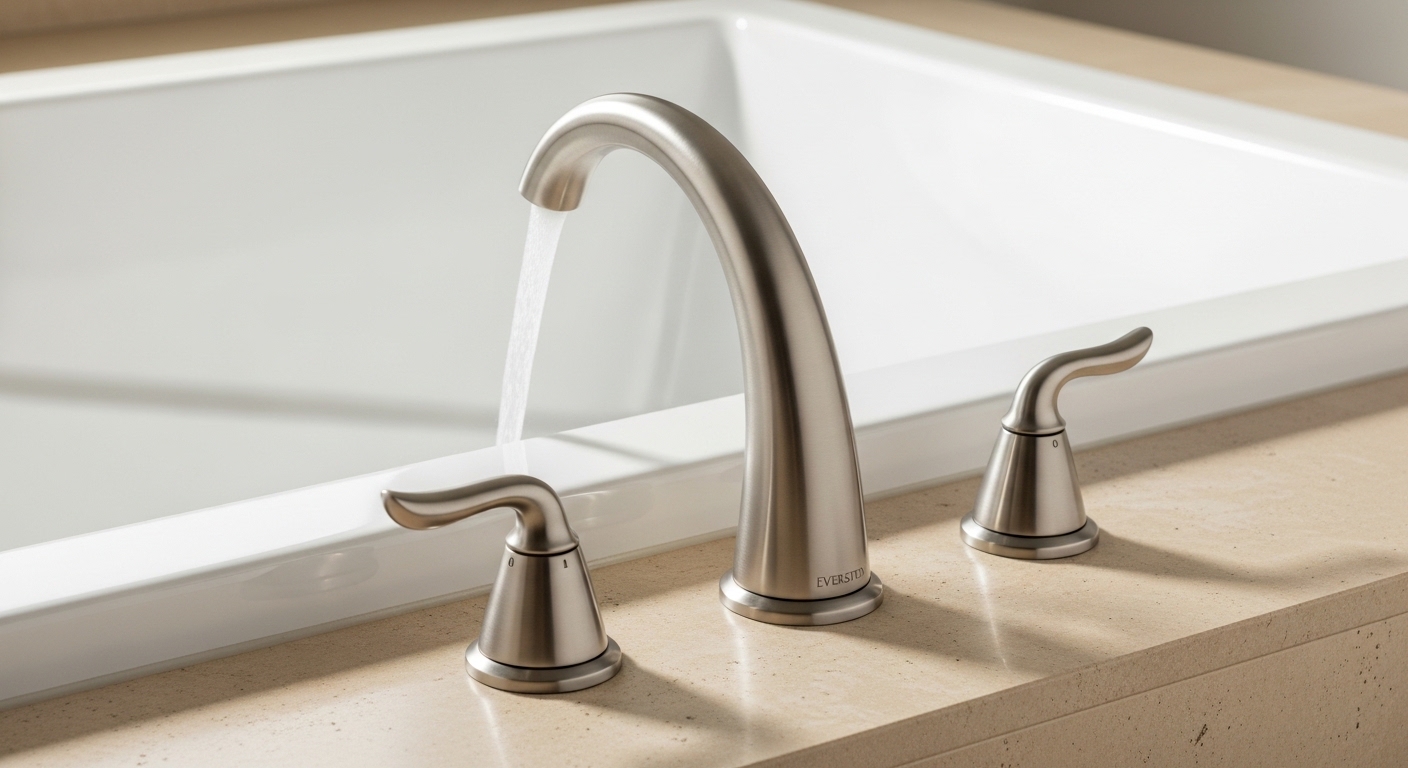
If you’ve been searching for an everstein roman tub faucet, you’re almost certainly staring at a bathtub with two, three, or four holes drilled into the flat deck around the rim, wondering which faucet actually drops into those holes and looks right doing it. That’s the whole point of a Roman tub faucet: it’s a low-profile, high-flow filler that mounts on the deck of the tub, arches over the edge, and pours a wide waterfall of water into the basin. Below, I’ll walk you through exactly when it’s the right choice, how to measure so you don’t order the wrong configuration, how the finishes hold up, and what to check before you commit — the same way I’d explain it to a friend standing in the aisle.
What exactly is a Roman tub faucet, and how is it different from a regular tub filler?
A Roman tub faucet is a bathtub filler that mounts on the deck (the flat rim) of the tub instead of on the wall or the floor. Water comes up through the deck and pours down through a high, gently curved spout — the shape people call a “Roman arc.” That’s the core difference: a standard wall-mounted tub spout sticks out of tile above the tub, and a freestanding filler rises up from the floor on a tall pipe, but a Roman faucet lives on the tub’s own rim.
This matters because the mounting surface dictates everything else. Deck-mounted means you need a tub with a wide enough flat ledge and the correct number of holes already drilled (or a deck you can drill). It also means the plumbing connections are hidden underneath the deck, so access panels or an open apron are part of the plan. If your tub is against a wall with tile above it, you likely want a wall-mounted spout instead — and if that’s your situation, our guide on why a tub spout can leak at the wall and how to fix it fast is more relevant to your setup than anything on this page.
Roman fillers are the default look for garden tubs, drop-in soaking tubs, and undermount tubs set into a tiled or stone deck. They’re prized for two things: a clean, uncluttered profile and serious fill speed.
How many holes does an Everstein Roman tub faucet need, and how do I measure?
Most Roman tub faucets need either two, three, or four deck holes, and you have to match the faucet to the holes you already have — you can’t rearrange existing holes in a solid tub deck. Before ordering, measure the center-to-center spread between the outermost holes and count them. That single measurement decides which configuration you buy.
Here’s the quick breakdown of the common layouts:
- 2-hole: a single-handle spout plus one lever, or a spout with an integrated diverter. Compact, minimal.
- 3-hole: the classic Roman setup — spout in the center, one handle on each side. This is the most common by far.
- 4-hole: spout, two handles, and a separate handheld shower or diverter hole. Common on larger jetted and garden tubs.
Typical widespread Roman faucets span roughly 8 to 16 inches center-to-center, but there’s no universal standard, so measure yours in inches to the sixteenth. Also check three things people forget: the hole diameter (usually 1-1/4″ to 1-3/8″), the deck thickness the mounting shanks must clamp through (thin acrylic vs. a 2″+ stone slab need different length hardware), and the clearance below the deck for the valve bodies and supply lines. If you’re weighing spacing choices in general terms, the logic mirrors what we cover in centerset vs. widespread faucets — spread and hole count drive the whole decision.
Is an Everstein Roman tub faucet good for filling a big soaking tub fast?
Yes — fast fill is the main reason to choose a Roman deck faucet over a slim wall spout. Roman tub fillers are engineered for high flow, typically in the 8–12 GPM range (some large-bore models push higher), because a 60–80 gallon soaking tub filled through a low-flow spout is a cold, slow, disappointing experience.
Why the big difference? Roman spouts use a wider internal waterway and don’t carry the flow restrictors that bathroom lavatory faucets must have. A standard bathroom sink faucet is capped around 1.2–1.5 GPM by efficiency rules; a tub filler is treated as a fixture meant to fill a vessel, so it’s allowed to move real volume. The practical payoff: an Everstein-style Roman filler can top off a deep tub in a handful of minutes instead of fifteen, and the water arrives hot because it isn’t dribbling and cooling on the way down.
One caveat worth knowing: high flow only helps if your home’s supply lines and water heater can keep up. Roman fillers usually connect to 1/2″ supplies at minimum; some large models want larger. If your hot water heater is small, a giant tub will still outrun it regardless of the faucet — that’s a tank problem, not a faucet problem.
Do I need a handheld sprayer with it?
Only if you want one — it’s optional, and it’s the reason 4-hole configurations exist. A handheld shower on a Roman tub is genuinely useful for rinsing hair, cleaning the tub itself, and bathing kids or pets. If your deck has that fourth hole, adding a handheld is easy. If it doesn’t, don’t drill blindly into a stone or acrylic deck without confirming clearance underneath and using the right bit for the material — a cracked deck is an expensive mistake.
Which finish should I pick, and will it hold up to daily use?
Pick the finish that matches your other bathroom hardware first, then weigh maintenance — and know that brushed/satin finishes hide water spots far better than polished chrome. On a tub deck, where standing water and soap film are constant, that spot-hiding matters more than most people expect.
Here’s how the common Roman tub faucet finishes actually compare in daily life:
| Finish | Look | Shows water spots / fingerprints | Best for |
|---|---|---|---|
| Polished Chrome | Bright, mirror-like | Yes — most visible | Classic, budget-friendly, easy to find matching pieces |
| Brushed Nickel | Warm, satin gray | Minimal — hides spots well | Everyday bathrooms, hard-water areas, families |
| Matte Black | Bold, modern | Shows dust & mineral film | Contemporary and modern-farmhouse decks |
| Brushed Gold / Champagne Bronze | Warm, luxe | Low | Spa-style and statement bathrooms |
| Oil-Rubbed Bronze | Dark, traditional | Low, but can “living finish” over time | Traditional and rustic looks |
For most families, brushed nickel is the practical sweet spot — it’s forgiving, it coordinates with almost everything, and it doesn’t broadcast every splash. If you’re on the fence about that specific finish, we go deep on it in are brushed nickel faucets worth it. Whatever you choose, the finish is only as durable as the plating process beneath it; look for a PVD (physical vapor deposition) finish on premium models, which resists scratching and tarnish far better than a simple electroplate.
How do I keep a Roman tub faucet looking new in hard water?
Wipe it dry after use and clean it with mild soap and water — never abrasive pads or acidic descalers on the finish. Hard water is the number one enemy of any deck faucet because water pools around the base and evaporates into chalky white mineral rings.
A simple routine keeps it flawless:
- After a long soak, run a soft cloth over the spout and base to pull off standing water.
- Weekly, wipe with a drop of dish soap on a damp microfiber cloth, then buff dry.
- For existing mineral buildup, wrap the spot with a cloth dampened in equal-parts white vinegar and water for 10–15 minutes, then rinse — but keep vinegar off delicate living finishes and check the manufacturer’s care sheet first.
- Never use bleach, steel wool, or bathroom scrubs with grit; they micro-scratch the finish and dull it permanently.
If your tub deck already has stubborn white rings, our step-by-step on how to clean hard water stains from a faucet walks through the safe methods finish by finish. Softening your home’s water, or at least drying the faucet, does more for long-term looks than any single cleaning product.
How hard is it to install a Roman tub faucet myself?
It’s a moderate DIY job — harder than a bathroom sink faucet, easier than moving plumbing — and the difficulty is almost entirely about access underneath the deck, not the faucet itself. If you can reach the underside of the tub deck through an access panel or open apron, a handy homeowner can do it in an afternoon.
The general sequence looks like this:
- Shut off the water and confirm the deck holes match your faucet’s spread and diameter.
- Drop the spout and valve bodies into their holes from above and secure the mounting hardware from below.
- Connect the hot and cold supply lines to the correct valve bodies (hot on the left as you face the tub).
- Connect the spout’s flexible waterway to the valve/diverter per the diagram — this hidden hose is what makes deck fillers work.
- Turn the water on slowly, check every connection for drips, and run the faucet a full cycle before calling it done.
The part people underestimate is working blind under a heavy tub. Give yourself room, a headlamp, and a helper. If your tub is fully enclosed with no access panel, cutting one in is often the real project — and at that point, many people call a plumber for the connection step. If you’re generally comfortable with faucet work, the mindset is similar to our step-by-step kitchen faucet install guide, just with the added deck-access wrinkle.
Should I choose a Roman tub filler or a full shower-and-tub system?
Choose a Roman tub filler if your tub is a standalone soaker with no showering above it; choose an integrated system if you shower in the same space. A deck-mounted Roman faucet fills the tub beautifully but doesn’t put a shower head overhead. If you need both functions, that’s a different product category — we break down the trade-offs in whether you need a shower-system tub spout or just a shower head. Match the faucet to how you actually use the tub, not just to the holes that happen to be there.
What should I check before buying an Everstein Roman tub faucet?
Confirm five specs and you’ll almost never get a wrong-fit return: hole count, center-to-center spread, hole diameter, deck thickness, and clearance below the deck. Everything else — finish, handle style, whether it includes a handheld — is preference. Those five numbers are physics.
A short pre-purchase checklist:
- Configuration: Does the faucet’s hole count match your tub exactly (2, 3, or 4)?
- Spread: Is the center-to-center measurement within the faucet’s adjustable range?
- Flow: Is the GPM high enough to fill your tub’s gallon capacity in a reasonable time?
- Valve type: Ceramic-disc cartridges last far longer and drip less than rubber-washer designs.
- Warranty & compliance: Look for a lifetime finish/function warranty and lead-free compliance (meeting the U.S. “lead-free” standard for potable-water fixtures).
Once those line up, you’re choosing between good options rather than gambling on fit. If you’re still deciding on the broader bathroom look before you get to the tub, our general primer on how to choose the right bathroom faucet helps you coordinate the whole room.
FAQ
What does “Roman” mean in a Roman tub faucet?
“Roman” refers to the tall, gently arched spout shape and deck-mounted style, evoking classical Roman baths that were filled from an elevated pour. Functionally it just means a high-arc filler that mounts on the tub’s deck and pours down into the basin, rather than a spout that comes out of the wall.
Can I put a Roman tub faucet on any bathtub?
No — you need a tub with a wide, flat deck and the correct pre-drilled holes, or a deck you can safely drill. Freestanding tubs, alcove tubs against a tiled wall, and tubs with narrow rims aren’t candidates. Drop-in, undermount, and garden tubs with a proper ledge are the right match.
How many GPM should a Roman tub filler have?
Aim for 8 GPM or higher for a large soaking tub; many Roman fillers deliver 8–12 GPM so a deep tub fills in minutes with hot water. Unlike bathroom sink faucets, tub fillers aren’t restricted to low flow, which is exactly why they fill big tubs comfortably — provided your water heater can supply the hot water.
Are the handles reversible for hot and cold?
On most quality Roman faucets, yes — the valve bodies are typically installed with hot on the left and cold on the right as you face the tub, and the handles index accordingly. Always follow the included diagram, because reversing the supply connections is the most common install mistake and leaves you with backward hot/cold.
Do Roman tub faucets drip over time, and can I fix them?
They can, but modern ceramic-disc cartridges rarely drip and are replaceable when they eventually wear. A drip is almost always a worn cartridge or O-ring, not a dead faucet — swap the cartridge and it’s usually good as new. The same repair logic we cover for other fixtures in how to fix a dripping faucet at home applies here.
Does an Everstein Roman tub faucet come with a warranty?
Reputable Roman tub fillers ship with a warranty covering finish and function — often a limited lifetime warranty on the finish and drip-free operation for residential use. Register your product and keep the receipt; warranty coverage is one of the biggest differences between a budget no-name filler and a fixture built to last.
About the author: This guide was written by the Fransiton fixtures team, drawing on hands-on testing of deck-mounted tub fillers across chrome, brushed nickel, matte black, and bronze finishes. We evaluate flow rate, cartridge longevity, and finish durability under repeated hard-water exposure.
About Fransiton: Fransiton designs and sells faucets and bathroom fixtures built to meet U.S. lead-free potable-water standards, with ceramic-disc valving and PVD-grade finishes tested for everyday residential use. Our product recommendations are based on real installation and durability testing, not spec sheets alone.