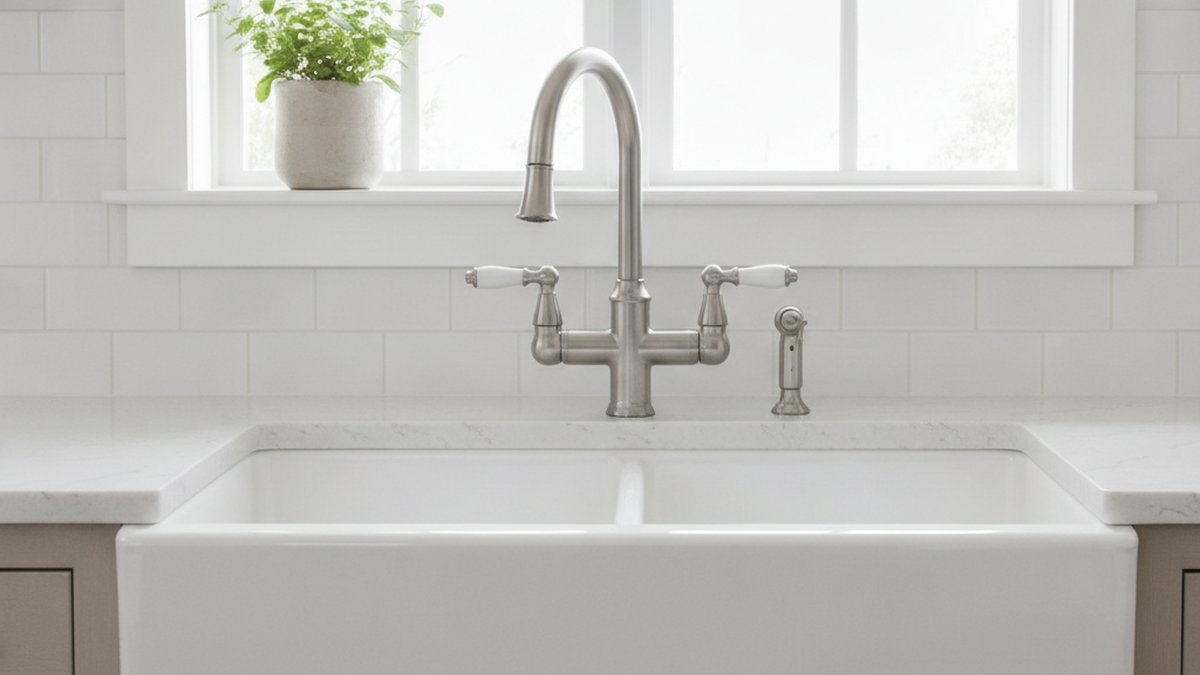
If you’re staring at an apron-front sink and wondering whether a 3 hole farmhouse kitchen faucet is the right call, the short version is this: it depends entirely on how many holes your sink or counter has and how much control you want over hot and cold water. Three-hole configurations give you a classic, timeless look with separate hot and cold handles — but they demand precise hole spacing, and getting that spacing wrong is the single most common mistake people make. This guide walks you through exactly how to choose, measure, and buy the right one.
What exactly is a 3 hole farmhouse kitchen faucet?
A 3-hole faucet is any kitchen faucet that requires three separate holes drilled into the sink deck or countertop to mount. In a farmhouse kitchen, that almost always means one of two layouts: a center spout with two flanking handles (hot on the right, cold on the left), or a single-handle spout paired with two accessory holes for a side sprayer and a soap/lotion dispenser.
The “farmhouse” part refers to the styling — think bridge faucets, gooseneck spouts, cross or lever handles, and finishes like matte black, brushed gold, oil-rubbed bronze, or classic chrome. It’s the look you pair with an apron-front (farmhouse) sink. The three holes are what separate this from a modern single-hole faucet, which needs only one opening.
Here’s the part that trips people up: the three holes have to sit at a standard spacing, usually 4 inches (centerset) or 8 inches (widespread), measured center-to-center between the outer holes. If your sink was drilled for 8-inch spread and you buy a 4-inch faucet, it will not fit. We’ll cover measuring below.
Do I actually need a 3-hole faucet, or should I get a single-hole one?
Get a 3-hole faucet if your sink or countertop is already drilled with three holes and you want the traditional farmhouse look with separate temperature handles. Get a single-hole faucet if you have one hole, prefer one-handed temperature control, or want a sleeker modern profile.
The deciding factor is almost never taste alone — it’s your existing sink. Apron-front sinks are frequently sold with no faucet holes at all (the faucet mounts behind the sink in the countertop), while others come pre-drilled with one, three, or four holes. Before you fall in love with any faucet, count your holes. If you’re still choosing a sink, our guide on whether you need a farmhouse kitchen sink with faucet holes or one with no holes at all is the right place to start, because that decision dictates every faucet you can buy afterward.
A quick way to think about it:
- Three holes, want two handles → classic widespread or bridge farmhouse faucet. Best temperature precision, most traditional look.
- Three holes, want one handle → single-handle faucet plus a deck plate (escutcheon) to cover the extra two holes, OR a faucet that ships with a matching soap dispenser and side spray to fill them.
- One hole → single-hole pull-down faucet; a 3-hole faucet won’t work without re-drilling.
- No holes → any single-hole or 3-hole faucet works, because you drill the counter to match the faucet you choose.
If you like the idea of one lever controlling everything, it’s worth reading whether a single lever faucet sink is the right choice for your kitchen before committing to two separate handles.
How do I measure my sink’s hole spacing before buying?
Measure center-to-center from the middle of the left hole to the middle of the right hole. If it’s about 4 inches, you need a 4-inch centerset faucet; if it’s 6–8 inches (usually 8), you need an 8-inch widespread faucet. The distance between holes — not the number of holes — is what determines fit.
Here’s the exact process, which takes two minutes:
- Clear everything off the sink deck and locate all the holes (some are hidden under caps or the existing faucet base).
- Use a tape measure to find the distance from the center of the far-left hole to the center of the far-right hole.
- Note the hole diameter too — most faucets need holes between 1-3/8″ and 1-1/2″ (35–38 mm). Standard pre-drilled sinks are usually 1-3/8″.
- Check whether the middle hole is centered between the two outer holes. On a true widespread setup, the spout and handles are independent pieces connected under the deck, so minor spacing flex is fine; on a centerset, they’re often on one base plate and spacing is fixed.
One more thing: measure your deck thickness. Farmhouse sinks made of thick fireclay or stone can be over 1 inch thick, and some faucet mounting hardware isn’t long enough to clamp down through a thick deck. Check the faucet’s maximum mounting thickness spec. And if you’re still sizing the sink itself for your cabinet, our breakdown of what size farmhouse sink you need for a 36-inch cabinet pairs naturally with this — the sink size affects how much deck room you have for a three-hole spread.
Widespread vs. centerset vs. bridge: which farmhouse layout is best?
For most farmhouse kitchens, a widespread (8-inch) or a bridge faucet gives the most authentic look and the easiest handle access; centerset (4-inch) is more compact and better for smaller prep sinks. Bridge faucets have the highest visual impact but cost more and need solid mounting. Here’s how they stack up.
| Layout | Hole spacing | Look | Best for | Typical price |
|---|---|---|---|---|
| Widespread (3 separate pieces) | 8″ center-to-center | Traditional, elegant, handles set wide | Standard 33″–36″ farmhouse sinks | $180–$400 |
| Centerset (one base plate) | 4″ center-to-center | Compact, tidy | Small prep or bar sinks | $120–$250 |
| Bridge faucet | 8″ (exposed connecting bridge above deck) | Vintage / farmhouse showpiece | Statement kitchens, high ceilings | $250–$600 |
| Single-handle + 2 accessories | Varies (uses 3 holes) | Modern-transitional | Anyone wanting soap dispenser + spray | $150–$350 |
A bridge faucet is the one people picture when they say “farmhouse” — hot and cold rise up separate legs and join in a horizontal bridge before the spout. It’s gorgeous, but the exposed pipe above the deck can collect grime and the whole assembly puts more leverage on your mounting holes, so a rock-solid install matters. Widespread hides all its plumbing under the deck and is the more practical everyday choice.
What should I look for in build quality and finish?
Prioritize a solid-brass faucet body, a ceramic-disc valve cartridge, and a PVD (physical vapor deposition) finish — those three things separate a faucet that lasts 15 years from one that leaks in 18 months. Skip zinc-alloy bodies and cheap electroplated finishes if you can.
Breaking that down in plain terms:
- Body material: Solid brass resists corrosion and won’t crack. Zinc alloy is cheaper and heavier-feeling but prone to pinhole corrosion over time, especially with hard water.
- Valve/cartridge: Ceramic-disc cartridges are the gold standard — they’re what stops drips. If yours ever does start dripping, most of the time it’s a worn cartridge, which is a cheap fix; see our walkthrough on which kitchen faucet part failed and whether you can fix it yourself.
- Finish: PVD finishes (common on brushed gold, matte black, brushed nickel) are extremely scratch- and tarnish-resistant. Lacquer or standard electroplate finishes wear faster around the handles.
- Flow rate: Most U.S. kitchen faucets are capped at 1.8 GPM (gallons per minute) or 2.2 GPM. If your water pressure feels weak, that aerator or a flow restrictor is usually why — not the faucet being defective.
- Reach and height: Measure your spout height against any window or cabinet above the sink, and check the spout reach lands in the center of the sink bowl, not the back wall.
Finish choice is where farmhouse style really lives. Matte black and brushed gold are the two most-searched farmhouse finishes right now; oil-rubbed bronze and chrome are the timeless classics. Whatever you pick, coordinate it with your sink drain, cabinet hardware, and any pot filler so the metals don’t clash.
How hard is it to install a 3-hole farmhouse faucet myself?
Most people can install a 3-hole farmhouse faucet in one to two hours with basic tools, as long as the holes already exist and match the faucet’s spacing. The hardest parts are working in the tight cabinet space under the sink and getting the supply-line connections leak-free. Drilling new holes in fireclay or stone is where you should consider a pro.
The basic sequence: shut off the water at the supply valves, disconnect and remove the old faucet, drop the new spout and handles into the three holes, secure the mounting nuts from underneath, connect the supply lines to the hot and cold valves, then run water and check every joint for drips. If you want the full step-by-step version, our guide on how to install a kitchen sink faucet and drain yourself in an afternoon covers the drain too.
A few farmhouse-specific gotchas:
- Thick decks fight you. Fireclay farmhouse sinks are thick, so budget for longer supply lines and confirm the mounting studs reach.
- Widespread faucets have flexible connectors between the spout and handles under the deck — route them carefully so they don’t kink.
- If you have three holes but want a single-handle faucet, you’ll need a deck plate to cover the extra two. That’s a common and totally fine solution — here’s exactly what a faucet deck plate is and whether you need one (the same principle applies to kitchen sinks).
Do not overtighten the mounting nuts on a fireclay or stone sink — you can crack the deck. Hand-tight plus a quarter turn with a basin wrench is plenty.
What’s a realistic budget, and where’s the sweet spot?
The sweet spot for a durable, good-looking 3-hole farmhouse faucet is $180–$300. Below $120 you’re usually buying zinc-alloy bodies and finishes that won’t age well; above $400 you’re paying for premium brand names and designer finishes that don’t necessarily last longer than a well-made mid-range fixture.
Think of it in three tiers:
- Budget ($100–$150): Fine for a rental, a secondary sink, or a short-term fix. Expect zinc parts and a shorter lifespan.
- Mid-range ($180–$300): Solid brass, ceramic cartridge, PVD finish, real warranty. This is where most homeowners should shop.
- Premium ($350–$600+): Designer brands, bridge styling, lifetime warranties, boutique finishes. Worth it if the faucet is a centerpiece and budget allows. For a name-brand comparison, see whether a Kohler farmhouse kitchen faucet is the right match for your apron-front sink.
Whatever tier you choose, factor in that a good faucet outlives most kitchen remodels. Spending an extra $80 for solid brass over zinc is one of the highest-return upgrades in the whole kitchen.
FAQ
Can I put a 3-hole faucet on a sink with only one hole?
Not without modification. A 3-hole faucet needs three openings at the correct spacing. If your sink has one hole, you’d have to drill two more — easy in stainless steel, risky in fireclay or stone — or choose a single-hole faucet instead. It’s almost always simpler to match the faucet to the sink you already have.
What do I do with the extra holes if I want a single-handle faucet?
Cover them with a deck plate (also called an escutcheon), which is a base plate designed to hide unused holes, or fill them with a matching soap/lotion dispenser and a side sprayer. Many single-handle faucets ship with a deck plate specifically so they can mount on a 3-hole sink.
Is 8-inch or 4-inch spacing standard for farmhouse faucets?
Eight-inch widespread is the most common and most traditional for full-size farmhouse kitchens; 4-inch centerset is used on smaller prep and bar sinks. Always measure your actual center-to-center distance before buying, because the two are not interchangeable.
Are two-handle farmhouse faucets harder to maintain than single-handle ones?
Slightly. A two-handle faucet has two cartridges instead of one, so there are two potential drip points — but each cartridge is inexpensive and easy to swap. The upside is more precise temperature control and a more authentic farmhouse look. For most people the maintenance difference is minor.
Will a 3-hole farmhouse faucet work with low water pressure?
Yes, the faucet itself doesn’t lower your pressure — but its aerator and flow restrictor cap the flow rate to meet water-efficiency rules. If the stream feels weak, cleaning the aerator or checking the restrictor usually fixes it. Don’t blame the faucet type; a two-handle or single-handle faucet behaves the same on the same plumbing.
How long should a good 3-hole farmhouse kitchen faucet last?
A solid-brass faucet with a ceramic-disc cartridge should last 10–15 years or more, with the cartridge being the only part you’re likely to replace along the way. Cheaper zinc-alloy faucets often start leaking or corroding within a few years, which is why build quality matters more than styling in the long run.
About the author: This guide was written by the Fransiton fixtures team, drawing on hands-on installation and testing of kitchen and bathroom faucets across a range of sink types and finishes. We evaluate faucets the way homeowners actually use them — measuring hole spacing, stress-testing cartridges, and checking finishes against real-world wear.
About Fransiton: Fransiton designs and sells faucets, shower systems, and bathroom fixtures built around solid-brass bodies, ceramic-disc valves, and PVD finishes. Our kitchen faucets are engineered to meet U.S. lead-free (NSF/ANSI 372) and flow-rate standards, and quality-tested cartridges are backed by our manufacturer warranty so a worn part never means a whole new faucet.
Pingback: What Are the Best Farmhouse Kitchen Faucet Ideas for an Apron-Front Sink in 2026? - Fransiton