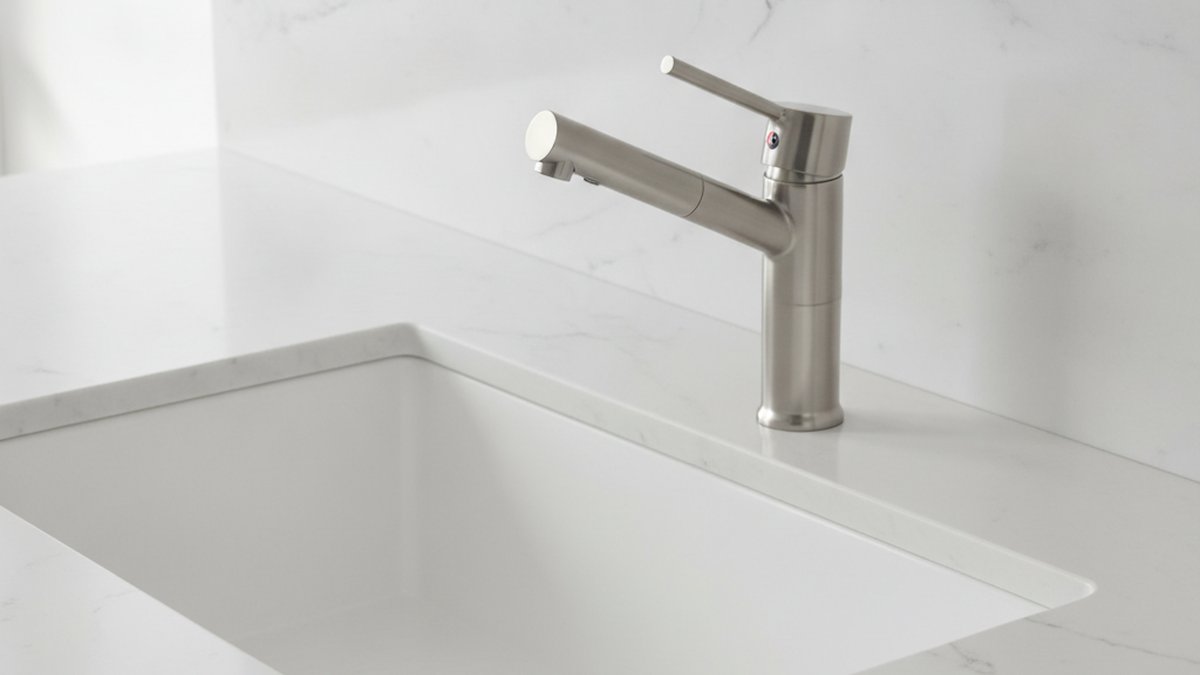
If you’re shopping for a single lever faucet sink combination, here’s the short version: you’re choosing the most popular faucet style in North America for good reason. One lever, one hole, one intuitive motion — push up for more water, tilt left for hot, right for cold. It fits nearly any sink, installs faster than a widespread faucet, and has fewer parts to leak over time. Below, we’ll walk through exactly when a single lever makes sense, how to pick the right one for your sink, what specs actually matter, and how Fransiton’s models stack up — so you can buy once and buy right.
What exactly is a single lever faucet, and how is it different from a two-handle one?
A single lever faucet uses one handle to control both water volume and temperature at the same time. Inside, a ceramic disc or ball cartridge mixes hot and cold water based on where you position that one lever. A two-handle faucet, by contrast, splits the job across two separate valves — one for hot, one for cold — that you adjust independently.
The practical difference shows up every single day at the sink. With a single lever, you can nudge the temperature to “just warm” and turn it off, then flick it back on later to the exact same temperature. You can do it with the back of your wrist when your hands are covered in raw chicken or soapy dishes. A two-handle faucet forces you to balance two valves every time you want warm water, which is fussier but gives you finer, more repeatable control if you care about it.
- Single lever (single-hole): fastest to use, one mounting hole, fewer leak points, modern look.
- Two-handle (widespread or centerset): traditional look, precise separate control, needs 2–3 holes.
- Touchless/smart: often built on a single-lever body with a motion sensor added on top.
If you’re weighing the two styles for a tub instead of a sink, the trade-offs shift a bit — we cover that in our guide on whether a bathtub faucet two-handle setup is still the right choice.
Is a single lever faucet better than a two-handle for a busy family kitchen?
For a busy family kitchen, yes — a single lever faucet is almost always the better choice. Speed and one-handed operation win the day when you’re rinsing dishes, filling pots, and washing hands dozens of times daily. The one-motion design cuts the fumbling, and there’s simply less hardware to wear out.
Here’s the reasoning in plain terms. In a high-use kitchen, the faucet gets touched more than any other fixture in the room. Every extra second and every extra part matters. A single lever design means:
- One-handed everything. Turn it on with an elbow, adjust temp with a knuckle. Huge when your hands are dirty or full.
- Fewer failure points. One cartridge instead of two valves means half the seals that can eventually drip.
- Simpler repairs. When it does drip, you replace one cartridge — a 20-minute job, not a two-valve teardown.
- Faster temperature memory. Set it to comfortable once; it returns to roughly the same spot each time.
The one honest downside: if two people crank the hot side hard in a home with marginal water pressure, a single lever can feel slightly less “dialed in” than independent valves. For 95% of households, that’s a non-issue. If your faucet ever starts dripping down the road, the fix is usually a worn cartridge — see our walkthrough on why a faucet drips from the spout and how to stop it fast.
How do I know if a single lever faucet will fit my sink?
Check your sink’s mounting holes first — a single lever faucet needs just one hole, but many sinks come pre-drilled with three. That’s fixable: a deck plate (escutcheon) covers the extra holes so a single-hole faucet looks intentional on a three-hole sink.
Run through this quick fit checklist before you buy:
- Number of holes: 1 hole = single lever drops right in. 3 holes = use a deck plate to cover the extras.
- Hole diameter: Standard US faucet holes are 1⅜” (34.9 mm). Most single lever faucets fit 1¼”–1½”.
- Deck thickness: Confirm the mounting shank is long enough for your countertop plus sink deck (thick stone counters need longer shanks).
- Spout reach & height: Measure from the faucet base to your sink’s center drain. Aim the spout stream at the drain, not the sink wall.
- Backsplash clearance: If the faucet sits close to a wall, make sure the handle can tilt fully back without hitting it.
If your sink is three-hole and you’d rather not stare at open gaps, our explainer on what a bathroom faucet deck plate is and whether you need one covers the sizing details. For kitchen sinks specifically, the same principle applies — a single lever plus a 10-inch deck plate makes a three-hole sink look like it was made for it.
What specs actually matter when buying a single lever faucet sink combo?
The specs that matter most are the cartridge type, the finish, the flow rate, and the spout style. Everything else is secondary. Nail those four and you’ll be happy for a decade.
Cartridge: Ceramic disc cartridges are the gold standard — they resist hard-water scale, last 15–20 years, and give that smooth, notch-free lever feel. Cheaper faucets use ball or rubber-seal valves that wear faster. Always buy ceramic.
Finish: This is aesthetic and durability combined. Brushed nickel and stainless hide water spots and fingerprints best. Matte black looks striking but shows limescale in hard-water homes. Chrome is the cheapest and easiest to clean but shows every drop.
Flow rate: Measured in GPM (gallons per minute). US kitchen faucets are capped at 2.2 GPM; many efficient models run 1.5–1.8 GPM. Bathroom faucets are capped at 1.2 GPM in several states. Lower GPM saves water; if it ever feels weak, the aerator or restrictor is usually the culprit.
Spout: High-arc gooseneck for big pots and deep sinks; low-arc for tight spaces under cabinets or windows. Pull-down sprayers add reach and are worth it in a kitchen.
| Feature | Single Lever Faucet | Two-Handle Faucet | Touchless Single Lever |
|---|---|---|---|
| Mounting holes | 1 (or 3 w/ deck plate) | 2–3 | 1 (or 3 w/ deck plate) |
| One-handed use | Excellent | Poor | Excellent (hands-free) |
| Temperature precision | Good | Excellent | Good |
| Leak points | Fewest (1 cartridge) | Most (2 valves) | Few + sensor/battery |
| Install difficulty | Easiest | Moderate | Moderate (wiring) |
| Typical price (2026) | $60–$220 | $80–$300 | $180–$450 |
Curious whether the touchless upgrade is worth the premium? We break it down in the best smart touchless kitchen faucet guide for 2026.
Can I install a single lever faucet myself, or do I need a plumber?
You can absolutely install a single lever faucet yourself — it’s one of the easiest plumbing swaps there is, typically 45–90 minutes for a first-timer. Because it uses a single mounting hole and one set of supply connections, there’s less to align and tighten than a widespread faucet.
Here’s the basic sequence:
- Shut off the hot and cold supply valves under the sink and open the old faucet to release pressure.
- Disconnect the supply lines and the old faucet’s mounting nut; lift the old faucet out.
- Clean the deck, drop in the new single lever faucet (with deck plate if needed), and tighten the mounting nut from below.
- Connect new braided supply lines to the hot and cold valves.
- Turn the water back on slowly, remove the aerator, and flush for 30 seconds to clear debris before checking for leaks.
The tools are minimal — a basin wrench is the one that saves your knuckles in tight cabinets. We list the full kit in what sink faucet install tools you actually need, and there’s a complete afternoon walkthrough in how to install a kitchen sink faucet and drain yourself. One tip that prevents 90% of callbacks: hand-tighten supply lines, then give them just a quarter-turn with a wrench — over-tightening cracks the fittings and causes the very leaks you’re trying to avoid.
Which finish holds up best for a single lever faucet in a hard-water home?
In a hard-water home, brushed nickel and brushed stainless hold up best because their textured surface hides the white limescale spots that plague shiny finishes. Matte black looks great but shows mineral haze fastest, and polished chrome shows every water droplet.
That said, finish is only skin-deep — what protects it is the coating underneath. Look for PVD (physical vapor deposition) finishes, which bond the color at a molecular level and resist scratching, tarnishing, and corrosion far better than cheap electroplating. A Fransiton PVD brushed-nickel faucet will look the same in ten years; a bargain electroplated one can flake within two, especially where hard water sits.
- Brushed nickel / stainless: best all-rounder, hides spots and fingerprints — top pick for hard water.
- Matte black: bold and modern, but wipe it dry to avoid limescale haze.
- Chrome: cheapest, brightest, easiest to sanitize — but shows every drop.
- Champagne bronze / gold: warm and trendy; choose PVD for longevity.
If your water is genuinely hard, pair any finish with a quality aerator you can unscrew and soak in vinegar periodically — that single habit keeps flow strong and prevents the “weak stream” complaints that make people think their faucet is failing.
How long does a single lever faucet last, and what usually breaks first?
A quality single lever faucet lasts 15–20 years, and the part that fails first is almost always the cartridge — the internal mixing valve that controls flow and temperature. When a single lever faucet starts dripping or gets stiff, it’s the cartridge nine times out of ten, and it’s an inexpensive, DIY-friendly replacement.
The good news about single lever design is exactly this: one cartridge to replace, not two valves. Most manufacturers, Fransiton included, sell exact-match replacement cartridges and cover them under warranty. If your handle ever feels loose or wobbly (a different, simpler issue), the fix is usually a set screw — see why a kitchen faucet knob gets loose and how to tighten it in 10 minutes.
To maximize lifespan: install a whole-home water softener if you’re on hard water, clean the aerator twice a year, and don’t crank the lever to its hard stop every time — ease it into position. These small habits routinely push a good faucet past the two-decade mark.
How much should you spend on a single lever faucet sink in 2026?
For a single lever faucet you’ll actually keep, budget $60–$120 for a solid bathroom model and $120–$220 for a full-featured kitchen faucet with a pull-down sprayer. Below about $50, you’re usually paying for plastic internals and thin electroplating that won’t survive daily use.
Here’s where the money goes as you spend more: solid brass body (not zinc alloy), a genuine ceramic cartridge, PVD finish, and braided stainless supply lines. Those four upgrades are the difference between a faucet that lasts two years and one that lasts twenty. You don’t need to buy the most expensive model on the shelf — you need those specific things. A well-made mid-range single lever faucet outperforms a poorly made premium one every time.
FAQ
Does a single lever faucet fit a standard three-hole sink?
Yes. A single lever faucet mounts in the center hole, and a deck plate (also called an escutcheon) covers the two outer holes so everything looks intentional. Most single-hole faucets include a deck plate or offer one as an inexpensive add-on. Just confirm your holes are the standard 4-inch or 8-inch spread and buy the matching plate size.
Can one lever really control temperature accurately?
Yes — a ceramic disc cartridge blends hot and cold based on how far you tilt the lever left or right, and how you position it holds the temperature steady. It’s slightly less precise than two independent valves, but for everyday washing, cooking, and hand-washing it’s more than accurate enough, and far faster to set.
Why is my single lever faucet dripping even when it’s off?
A drip when the faucet is fully off almost always means a worn ceramic cartridge or a damaged seal inside it. Sediment from hard water can also score the cartridge. The fix is to shut off the supply, pull the old cartridge, and drop in an exact-match replacement — usually a 20-minute job with no plumber needed.
Is a single lever or two-handle faucet easier to clean?
A single lever faucet is easier to clean because there’s one handle and fewer crevices where grime and limescale collect. Two-handle faucets have more nooks around each valve base. Wipe any faucet dry after use in hard-water areas to keep the finish spotless.
What GPM should I look for in a single lever kitchen faucet?
Aim for 1.5–1.8 GPM for a good balance of water savings and usable pressure; US code caps kitchen faucets at 2.2 GPM. If the flow ever feels weak, the aerator or an internal flow restrictor is usually the reason — cleaning or adjusting it restores full pressure without replacing the faucet.
Do single lever faucets come with a warranty?
Reputable brands back single lever faucets with limited lifetime warranties on the finish and function, plus replacement cartridges. Fransiton faucets are pressure-tested and built to ASME A112.18.1 / CSA B125.1 standards, with a lifetime limited warranty on the ceramic cartridge and finish for residential use — always register your product and keep the receipt.
About the author: This guide was written by the Fransiton product team, who spec, pressure-test, and install kitchen and bathroom faucets year-round. We evaluate every single lever faucet against real-world hard-water, high-use, and DIY-install conditions before it earns a spot in our lineup.
About Fransiton: Fransiton (fransiton.net) designs and sells solid-brass faucets, shower systems, and bathroom fixtures built with genuine ceramic cartridges and PVD finishes. Every faucet meets US and Canadian plumbing standards (ASME A112.18.1 / CSA B125.1), is lead-free compliant, and is backed by a lifetime limited residential warranty — so you can install with confidence and buy once.