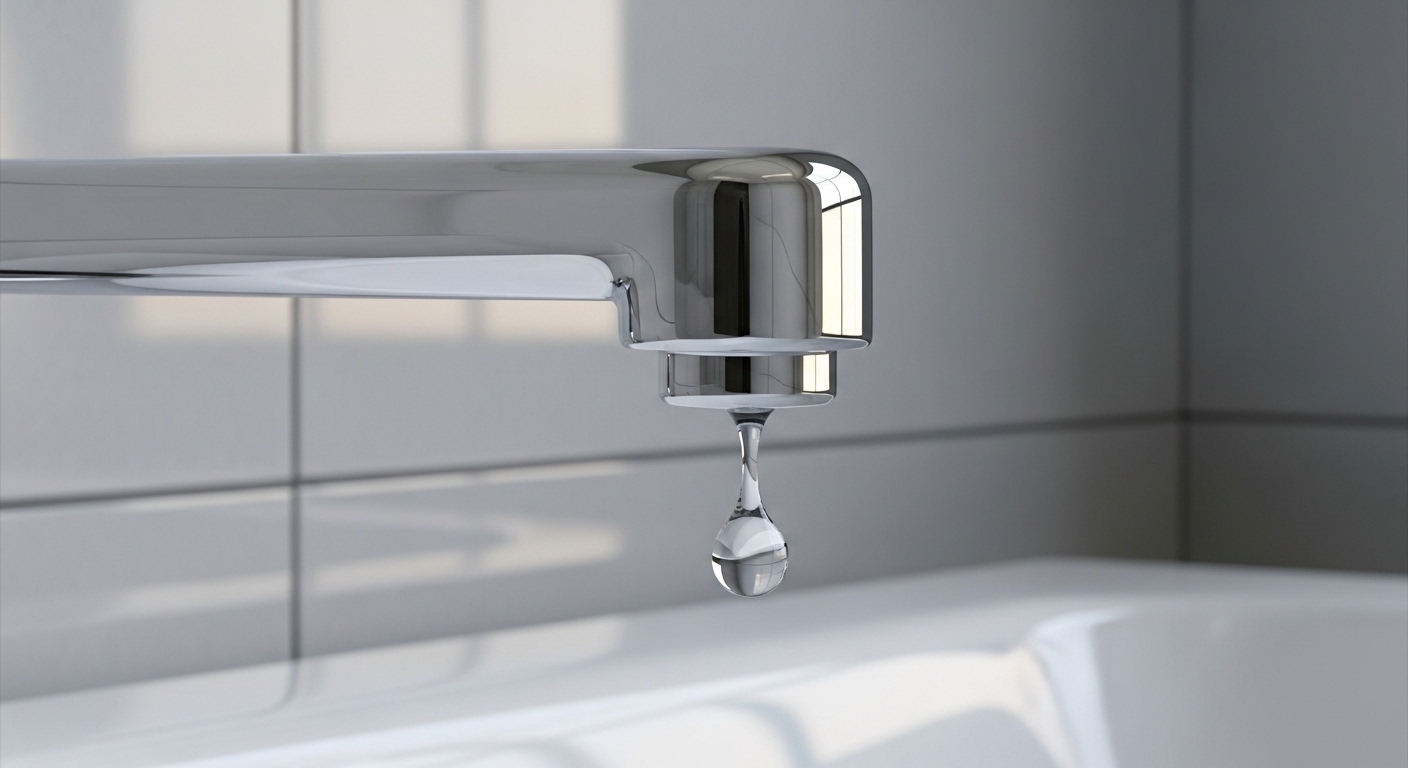
A tub spout dripping after you shut off the water is one of the most common bathroom annoyances, and the good news is that it’s usually cheap and quick to fix. The drip you see coming out of the spout is rarely the spout’s fault — it’s water sneaking past a worn seal deeper in the valve. Below, we’ll walk through exactly why it happens, how to diagnose which part failed, what it costs to fix, and when it’s smarter to just replace the whole thing. We test tub valves and spouts in-house at Fransiton, so this is the same troubleshooting order our own techs use.
Why is my tub spout dripping when the water is off?
If your tub spout drips after you’ve fully closed the handle, the seal inside the valve — the cartridge, stem washer, or seat — has worn out and can no longer block the water pressure behind it. The spout is just the exit point; the leak starts upstream. Constant household water pressure (typically 40–80 psi) pushes against that worn seal 24/7, so even a tiny bit of wear turns into a steady drip.
Here’s the mental model that makes everything click: your tub faucet has a valve behind the wall. When you turn the handle “off,” a rubber or ceramic seal presses against a metal seat to stop the flow. Over years of hot water, minerals, and friction, that seal gets grooved, cracked, or crusted with limescale. Once it can’t make a perfect seal anymore, pressurized water leaks through and gravity carries it out the lowest opening — your spout. That’s why the drip appears at the spout even though nothing is actually wrong with the spout.
A few things make dripping worse or faster:
- Hard water: Mineral deposits chew through washers and score ceramic discs. If you fight water spots constantly, your seals are wearing faster — see our guide on cleaning hard water stains from a faucet for prevention.
- Old rubber washers: Compression-style valves (two-handle, hot + cold) use rubber washers that harden and crack in 3–7 years.
- Grit in the line: After plumbing work, sediment can lodge on the seat and hold the valve slightly open.
- Over-tightening: Cranking the handle hard actually deforms the washer faster, so a “harder off” is not a fix.
Is the drip coming from the valve or the spout diverter?
Run a quick test: turn the shower on, then off, and watch the spout. If water dribbles from the spout only while the shower runs, your diverter is the culprit. If the spout drips with everything off, the valve cartridge or washer is worn.
Most tub spouts with a little pull-up knob on top are diverter spouts — pulling the knob forces water up to the shower head. When that internal diverter gasket wears out, some water always leaks back down and out the spout while you’re showering, which wastes pressure and water. That’s a spout replacement, not a valve repair, and it’s genuinely a five-minute job. A diverter that misbehaves is closely related to how a faucet spray diverter works on a sink — same principle, different fixture.
| Symptom | Most likely cause | Typical fix | Cost |
|---|---|---|---|
| Drips at spout with handle fully off | Worn cartridge / stem washer / seat | Replace cartridge or washer + seat | $10–$40 |
| Water out spout while shower runs | Failed diverter gasket | Replace diverter tub spout | $15–$45 |
| Leak at wall behind spout | Loose spout connection / bad thread seal | Reseat spout, re-tape threads | $0–$20 |
| Drip only from one handle (two-handle valve) | That side’s washer or seat | Replace that stem washer/seat | $5–$15 |
| Drip returns days after new washer | Corroded/pitted valve seat | Reseat or replace seat | $10–$25 |
How do I fix a dripping tub spout myself in under an hour?
For most single-handle and two-handle tubs, you can fix a dripping tub spout yourself in 30–60 minutes by shutting off the water, replacing the worn cartridge or washer, and reassembling. You don’t need a plumber for the common cases. Here’s the exact order.
- Shut off the water. Use the bathroom shutoff if you have one; otherwise turn off the main. Open the tub faucet to drain residual pressure.
- Plug the drain so no small screws vanish, and lay a towel in the tub.
- Identify your valve type. Single lever = cartridge. Two separate hot/cold handles = compression (washers) or two cartridges.
- Remove the handle. Pop the decorative cap, remove the screw, and pull the handle straight off.
- Pull the cartridge or stem. Remove the retaining clip or unscrew the bonnet nut. Note the orientation before it comes out — take a phone photo.
- Inspect and replace. Look for a cracked O-ring, flattened washer, or scored ceramic disc. Match the part number (it’s usually stamped on the cartridge) and swap it.
- Check the seat. Run a fingertip inside — if it feels rough or pitted, resurface it with a seat wrench/dresser or replace it. A new washer on a bad seat will just drip again.
- Grease and reassemble. Apply plumber’s silicone grease to O-rings, reinstall in the same orientation, restore water slowly, and test.
If the drip is specifically the diverter spout, skip all of that: unscrew the old spout (either a set-screw slip-fit type or a threaded type), clean the pipe, wrap fresh PTFE thread tape on threaded connections, and screw on the replacement. The tricky part is matching slip-fit vs. threaded and the pipe length — measure before you buy. Our deeper walkthrough on fixing a dripping shower faucet covers the cartridge-swap steps in more detail, and the general method applies to any dripping faucet at home.
What tools and parts do I actually need?
You need less than you’d think. For a valve repair: an Allen key set, a Phillips and flat screwdriver, an adjustable wrench, a cartridge puller (only for stubborn cartridges), plumber’s grease, and the correct replacement cartridge or washer kit. For a spout swap: an adjustable wrench or a cloth-wrapped pliers, PTFE tape, and the matching spout. Total parts cost is usually $10–$45.
When should I just replace the tub spout or valve instead of repairing it?
Replace instead of repair when the valve body is corroded, the seat is pitted beyond resurfacing, the spout is cracked or heavily scaled, or you’ve already replaced the cartridge and it still drips. At that point you’re throwing good money after bad, and a new spout or valve trim gives you a fresh seal and a cleaner look.
A simple decision rule our techs use: if the fix is a $15 cartridge, always repair first. If you’re staring at a corroded 20-year-old valve body buried in the wall, budget for a valve replacement (which may mean opening the wall) or at least a new spout and trim. A brand-new diverter spout is so inexpensive that replacing it is often the smart default rather than hunting for a tiny diverter gasket. If you’re rethinking the whole setup, our comparison of a shower system tub spout versus a plain shower head can help you decide whether to upgrade while the wall is open.
How much does it cost to fix a dripping tub spout?
DIY, you’ll spend $10–$45 on parts. A plumber typically charges $125–$350 depending on your area and whether the valve needs to come out of the wall. The drip itself isn’t free to ignore: a faucet leaking one drip per second wastes roughly 3,000 gallons a year, so a $20 cartridge pays for itself quickly on your water bill.
| Repair route | Parts cost | Labor | Best for |
|---|---|---|---|
| DIY cartridge/washer swap | $10–$40 | Your 30–60 min | Confident DIYers, accessible valve |
| DIY diverter spout replacement | $15–$45 | Your 5–15 min | Diverter leaks during shower |
| Plumber cartridge repair | $10–$40 | $125–$250 | No shutoff access, unsure of type |
| Full valve replacement | $60–$200 | $250–$600+ | Corroded valve body, wall access |
What if the tub spout is dripping AND leaking at the wall?
If you see water at the wall behind the spout — not just at the tip — the spout connection or the pipe joint has failed, and that’s a moisture problem you want to catch early before it reaches the drywall. This is a different issue from a normal drip and needs its own diagnosis.
Common causes are a loose slip-fit spout that has slid on its pipe, missing or dried-out thread sealant, or a cracked spout casting. Reseat the spout, apply fresh PTFE tape, and make sure a slip-fit spout’s set screw is snug against a clean pipe. If water still tracks behind the wall, you may have a compromised drop-ear elbow or pipe joint that needs opening the access panel. We cover this exact scenario in depth in why your tub spout leaks at the wall and how to fix it fast — start there if the wall is getting wet, because trapped moisture is what leads to mold, not the drip itself.
Does a dripping tub spout mean I have a bigger plumbing problem?
Usually no — a dripping spout is a localized seal failure, not a sign your whole plumbing system is failing. As long as the water stays inside the tub and doesn’t appear behind the wall, it’s a routine wear-and-tear repair. Watch for warning signs that warrant a closer look: water pooling behind the wall, a sudden pressure drop elsewhere in the house, or brown/rusty water, which can indicate corrosion in the valve or pipes.
Which type of tub valve is easiest to fix — and least likely to drip again?
Ceramic-disc and quality cartridge valves are the easiest to service and the most drip-resistant long-term because ceramic discs resist wear far better than old-style rubber washers. If you’re replacing a whole valve, a single-handle ceramic cartridge design is the low-maintenance choice.
- Compression (two washers): Cheapest to fix but drips most often; rubber washers wear fast. Common in older homes.
- Cartridge: Pull out the old cartridge, drop in a new one — arguably the easiest DIY repair. Very common today.
- Ceramic disc: Extremely durable, smooth quarter-turn feel, longest lifespan; the sealing surfaces rarely wear out.
- Ball valve: More parts inside, slightly fussier to rebuild, mostly seen on kitchen fixtures.
If you’re weighing a two-handle setup during a repair, our piece on whether a bathtub faucet two-handle setup is still the right choice lays out the trade-offs versus a single-handle cartridge valve.
How do I stop my tub spout from dripping in the future?
The best prevention is reducing wear on the seals: keep water pressure in a healthy range, descale periodically, and don’t overtighten the handle. Seals fail from friction and minerals, so slowing both extends their life by years.
- Have a plumber check that your home pressure is under 80 psi; install a pressure-reducing valve if it’s higher.
- Descale the spout and diverter a couple times a year, especially with hard water.
- Turn the handle to “off” gently — snug, not cranked.
- When you do a repair, always use plumber’s silicone grease on O-rings so they seal and move smoothly.
- Buy quality replacement parts; a ceramic cartridge outlasts a bargain rubber washer many times over.
FAQ
Why does my tub spout drip only at night or when no one’s using it?
That’s classic worn-seal behavior. With no water being drawn anywhere else in the house, full static pressure sits against the worn cartridge or washer, so any tiny gap lets water seep out the spout. It’s not the time of day — it’s the steady pressure. Replacing the seal fixes it.
Can I use pliers to remove my tub spout without scratching it?
Yes — wrap the spout in a thick cloth or use tape-covered jaws before you grip with pliers, and turn counterclockwise. Better yet, slip a screwdriver or handle into the spout opening for leverage on threaded spouts. For slip-fit spouts, loosen the small set screw underneath first; don’t twist those, just slide them off.
How long does a tub faucet cartridge last before it drips?
A quality ceramic-disc cartridge often lasts 15–20+ years, while rubber washers in compression valves typically last 3–7 years, less in hard-water areas. If you’ve never replaced yours and the tub is over a decade old, a drip means it’s simply time.
Is it safe to keep using the tub while it’s dripping?
Yes, as long as the water stays inside the tub — a dripping spout is a wear issue, not a safety hazard. The reasons to fix it promptly are wasted water (thousands of gallons a year) and preventing the worn seal from failing completely. If water appears behind the wall, stop and address that immediately.
Will replacing just the spout stop the drip?
Only if the drip is a diverter problem (water escaping the spout while the shower runs). If the spout drips with the handle fully off, the leak is in the valve, and a new spout won’t help — you need a new cartridge, washer, or seat. Diagnose which it is before buying parts.
What size and type of replacement tub spout should I buy?
Measure the pipe stub length and check whether your current spout is slip-fit (smooth pipe, set screw underneath) or threaded (screws onto a nipple). Match that type and the finish you want. If you’re unsure, take the old spout to the store or measure the pipe diameter — most are 1/2-inch threaded or 1/2-inch/3/4-inch slip-fit.
Author note: This guide was written by the Fransiton fixtures team and reviewed by our in-house plumbing product specialists, who bench-test tub valves and diverter spouts for seal durability and flow. About Fransiton: Fransiton designs and sells faucets, shower systems, and bathtub fixtures direct to homeowners, and our tub spouts are pressure-cycle tested and meet ASME A112.18.1 / NSF 61 standards, backed by a limited lifetime warranty on finish and function. We stand behind these repairs because we build the parts.