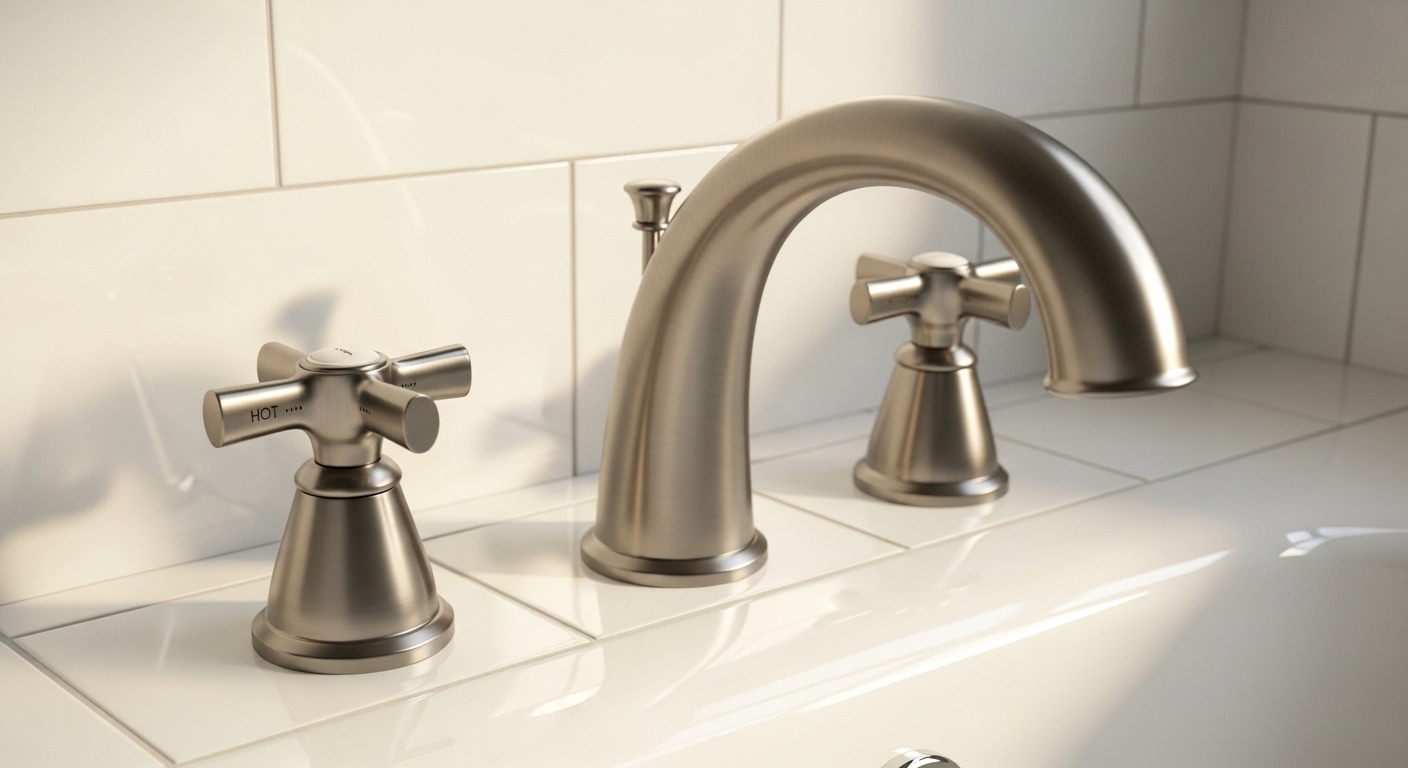
If you’re staring at your tub trying to decide whether a bathtub faucet two handle fixture is the smart pick or an outdated one, here’s the honest answer: two-handle tub faucets are still one of the most reliable, repairable, and cost-effective valve styles you can buy in 2026 — especially if your wall is already plumbed for three holes (hot, spout, cold). They give you granular temperature control, use dirt-cheap replacement stems and cartridges, and match both traditional and transitional bathrooms. The main trade-offs are that they take slightly longer to dial in your ideal temperature and they can’t be swapped for a single-handle valve without opening the wall. Below, I’ll walk you through exactly when a two-handle tub faucet wins, what to look for, how it compares to single-handle, and how to size one correctly.
What exactly is a “bathtub faucet two handle,” and how is it different from a single-handle?
A bathtub faucet two handle setup is a tub filler that uses two separate valves — one for hot, one for cold — each with its own handle, feeding a single spout in the middle. A single-handle faucet, by contrast, uses one lever over one mixing cartridge to control both temperature and flow at once.
That structural difference drives everything else. With two handles, you’re mixing water manually: open the hot a little, open the cold a little, and adjust each until the blend feels right. With a single lever, you push up for more water and swing left or right for hotter or cooler. Neither is “better” universally — they solve slightly different problems.
Two-handle tub faucets almost always come in a three-hole (8-inch center) configuration for a standard tub wall or deck, though widespread and Roman-tub variants exist. If your tub already has three holes drilled 8 inches apart on center, a two-handle faucet is very likely a direct, drop-in replacement — no tiling, no drilling, no drywall surgery.
When should you choose a two-handle tub faucet over a single-handle?
Choose a two-handle tub faucet when your wall or tub deck is already drilled for three holes, when you want the lowest-cost long-term repairs, or when you’re matching a classic, farmhouse, or transitional look. Choose single-handle when you’re doing a full remodel, opening the wall anyway, and want the simplest one-motion temperature control.
Here are the real-world scenarios where a two-handle wins clearly:
- You’re replacing an existing three-hole faucet. Swapping like-for-like takes an afternoon and no wall work. Going from three holes down to one means covering two holes — usually an escutcheon plate or retiling.
- You want cheap, forever-available parts. Two-handle stems, seats, and washers cost a few dollars and are stocked at every hardware store. A dripping two-handle faucet is often a $5 fix.
- You like a period-correct or traditional look. Cross handles and lever handles on separate hot/cold posts read “classic” in a way a single lever never will.
- Multiple people want repeatable temperature. Once you learn “hot at 2 o’clock, cold at 10 o’clock,” you get the same bath every time.
The flip side: if you’re gutting the bathroom, running new supply lines, and craving the cleanest modern look with fast temperature changes, a single-handle valve is worth the extra install effort. If you’re weighing the broader decision, our guide on how to choose the right bathroom faucet breaks down handle count, spread, and finish for the whole bathroom.
Two-handle vs. single-handle bathtub faucet: which is actually better?
For repairability and matching an existing three-hole tub, two-handle wins. For fastest temperature control and a minimalist modern look, single-handle wins. Here’s the side-by-side:
| Factor | Two-Handle Tub Faucet | Single-Handle Tub Faucet |
|---|---|---|
| Holes required | 3 holes (typically 8″ center) | 1 hole (plus wall access) |
| Temperature control | Precise but slower — mix two handles | Fast — one lever, one motion |
| Repair cost | Very low ($3–$15 stems/washers) | Moderate ($20–$60 cartridge) |
| Install difficulty (like-for-like) | Easy — usually a drop-in | Harder if converting from 3 holes |
| Best style match | Traditional, farmhouse, transitional | Modern, contemporary, minimalist |
| Typical price | $40–$180 | $60–$250 |
| Anti-scald protection | Optional — check for pressure-balance model | Often built into cartridge |
One thing people overlook: a two-handle deck-mounted or wall-mounted tub filler is not automatically anti-scald. If children or older adults use the tub, look specifically for a pressure-balance or thermostatic two-handle model, or add a thermostatic mixing valve upstream. Single-handle tub/shower valves more often bake anti-scald into the cartridge by default.
What sizes and configurations do two-handle tub faucets come in?
Two-handle tub faucets come in three main mounting styles — wall-mount, deck-mount (on the tub rim), and Roman tub (widespread, for garden and freestanding-style tubs) — and the critical measurement is the center-to-center spread between the holes. Measure before you buy.
The measurement that matters most is the distance between your outer supply holes, center to center:
- Standard tub/shower wall faucet: 8-inch center is the most common. Handles and spout share one trim plate or three individual escutcheons.
- Deck-mount two-handle: Mounts on the flat rim of the tub. Also usually an 8-inch spread, with a separate spout and two handle bases.
- Roman / widespread tub filler: A wider spread (often adjustable from around 8 to 16 inches) used on deck-mounted garden tubs. If that’s your setup, the Everstein Roman tub faucet guide covers deck-mounted widespread fillers in depth.
Also check whether your faucet is a tub-only filler or a tub-and-shower combo (which adds a diverter to send water up to a shower head). If you want both a tub spout and a shower, you need a diverter tub spout or an integrated diverter valve — see whether you actually need a full shower system tub spout or just a shower head.
How hard is it to install or replace a two-handle bathtub faucet?
If you’re replacing an existing two-handle, three-hole faucet with another one of the same spread, it’s a genuine DIY afternoon job — turn off the water, remove the old trim and stems, install the new ones, and reconnect. Converting from a different configuration is a much bigger project involving wall or deck access.
Here’s the realistic scope of a like-for-like replacement:
- Shut off the water at the tub’s dedicated valves or the main. Open the faucet to drain pressure.
- Remove old trim and handles, then unthread the stems or cartridges from each valve body.
- Inspect the valve bodies. If they’re corroded or you’re changing brands, you may need new valve bodies — that’s when the wall has to open.
- Install new stems/cartridges, spout, and handles, using fresh plumber’s tape on threaded connections.
- Turn water back on slowly and check every joint for leaks before you walk away.
The two jobs that trip people up are the spout and the supply pipes behind the wall. If your spout leaks where it meets the wall after install, that’s usually a seal or nipple-length issue — our walkthrough on why a tub spout leaks at the wall fixes it fast. And if you’re dealing with old, corroded rough-in plumbing, read how to replace bathtub faucet pipes without flooding the bathroom before you cut anything.
What should you look for when buying a two-handle tub faucet?
Prioritize a solid brass valve body, a ceramic-disc or quality stem cartridge, a PVD or ceramic-coated finish for hard-water durability, and — if safety matters — a pressure-balance or thermostatic mechanism. Match the finish to your other bathroom fixtures and confirm the hole spread.
Run through this checklist before you buy:
- Valve material: Brass valve bodies outlast zinc-alloy ones, especially with hard water. Cheap zinc cracks over years of thermal cycling.
- Cartridge type: Ceramic-disc cartridges resist drips far longer than old rubber-washer stems. If you want the classic look with modern reliability, look for two-handle models labeled “ceramic disc.”
- Finish: Chrome and brushed nickel are the most forgiving of water spots; matte black and brushed gold look striking but show mineral film faster. PVD (physical vapor deposition) finishes resist scratching and tarnish.
- Anti-scald: For kids or elderly users, choose a pressure-balance or thermostatic two-handle valve, or add a thermostatic mixing valve.
- Certification: Look for the fixture to meet ASME A112.18.1 / CSA B125.1 and be certified to NSF/ANSI 61 and 372 (lead-free) standards. This is a real quality and safety signal, not marketing.
- Spread: Measure center-to-center. An 8-inch faucet will not fit a 4-inch or widespread rough-in.
On finish: if you’re torn between the popular options, our take on whether brushed nickel faucets are worth it weighs durability against looks, and it applies to tub faucets just as much as sink faucets.
How do you keep a two-handle tub faucet from dripping or staining?
A two-handle faucet drips almost always because a rubber washer, seat, or O-ring inside one of the stems has worn out — a $5 fix — and it stains from hard-water minerals, which wipe off with a mild descaling routine. Neither problem means you need a new faucet.
Because each handle is its own valve, you can isolate which side is dripping — if the drip is hot, rebuild the hot stem; if cold, rebuild the cold. That’s the quiet superpower of the two-handle design: repairs are localized and cheap. Keep a small assortment of washers and seats on hand and a dripping tub faucet is a ten-minute job. For finish care, dry the handles after use and periodically wipe with a soft cloth; for stubborn buildup, follow our method on cleaning hard water stains from a faucet rather than scrubbing with anything abrasive that can dull the coating.
How much does a two-handle bathtub faucet cost, and is it worth it?
Expect to pay $40–$180 for the faucet itself, with most quality mid-range two-handle tub faucets landing around $80–$130; installation is free if you DIY a like-for-like swap or $150–$350 for a plumber. For the vast majority of three-hole tubs, it’s absolutely worth it — you get precise control, a repairable design, and decades of service from a brass-bodied model.
The value case is strongest when you already have a three-hole tub. You avoid wall and tile work, you get parts that will be available for the life of the house, and a good brass two-handle faucet can outlast two or three cheaper single-handle cartridges. Spend your money on the valve body and cartridge quality, not just the finish — that’s where longevity actually lives.
FAQ
Can I replace a two-handle tub faucet with a single-handle one?
Yes, but it’s a bigger job. A single-handle valve needs only one hole, so you’ll have to cover the two extra openings — usually with a large escutcheon plate or by retiling — and you’ll typically open the wall to install the new single valve body. If you want to avoid that, replace your two-handle faucet with another two-handle model.
Are two-handle tub faucets outdated?
No. They’re a mature, reliable design that’s still widely sold in 2026 because they’re precise, cheap to repair, and match traditional and transitional bathrooms. “Outdated” applies only if you specifically want a minimalist modern look, where a single lever fits better stylistically.
What is the standard hole spacing for a two-handle bathtub faucet?
The most common spread is 8 inches center-to-center between the two outer supply holes, with the spout in the middle. Widespread Roman tub fillers can run wider (often adjustable to around 16 inches). Always measure your existing holes before buying — an 8-inch faucet will not fit a 4-inch rough-in.
Do two-handle tub faucets protect against scalding?
Not automatically. A basic two-handle faucet mixes hot and cold manually with no compensation, so a flushed toilet can cause a temperature spike. For scald protection, choose a pressure-balance or thermostatic two-handle model, or install a thermostatic mixing valve on the supply lines.
How long does a two-handle bathtub faucet last?
A brass-bodied two-handle faucet with ceramic-disc cartridges commonly lasts 15–20+ years, and because stems, seats, and washers are inexpensive and replaceable, the faucet body itself often outlives multiple sets of internal parts. Zinc-alloy budget models tend to fail sooner, especially in hard-water homes.
Can I use a two-handle faucet for both my tub and shower?
Yes, if you choose a tub-and-shower combination faucet with a diverter — either a diverter built into the spout or a third handle/valve that redirects water up to the shower head. A tub-only two-handle filler has no diverter and feeds only the spout.
About the author: This guide was written by the Fransiton fixtures team, drawing on hands-on installation and bench-testing of two-handle and single-handle tub valves across chrome, brushed nickel, and matte black finishes. About Fransiton: Fransiton designs and sells faucets, shower systems, and bathtub fixtures at fransiton.net, and every valve we recommend is evaluated against ASME A112.18.1/CSA B125.1 performance and NSF/ANSI 61 & 372 lead-free standards. Our brass-bodied tub faucets are backed by a limited lifetime warranty on the finish and mechanical function against manufacturing defects, so you can repair rather than replace with confidence.