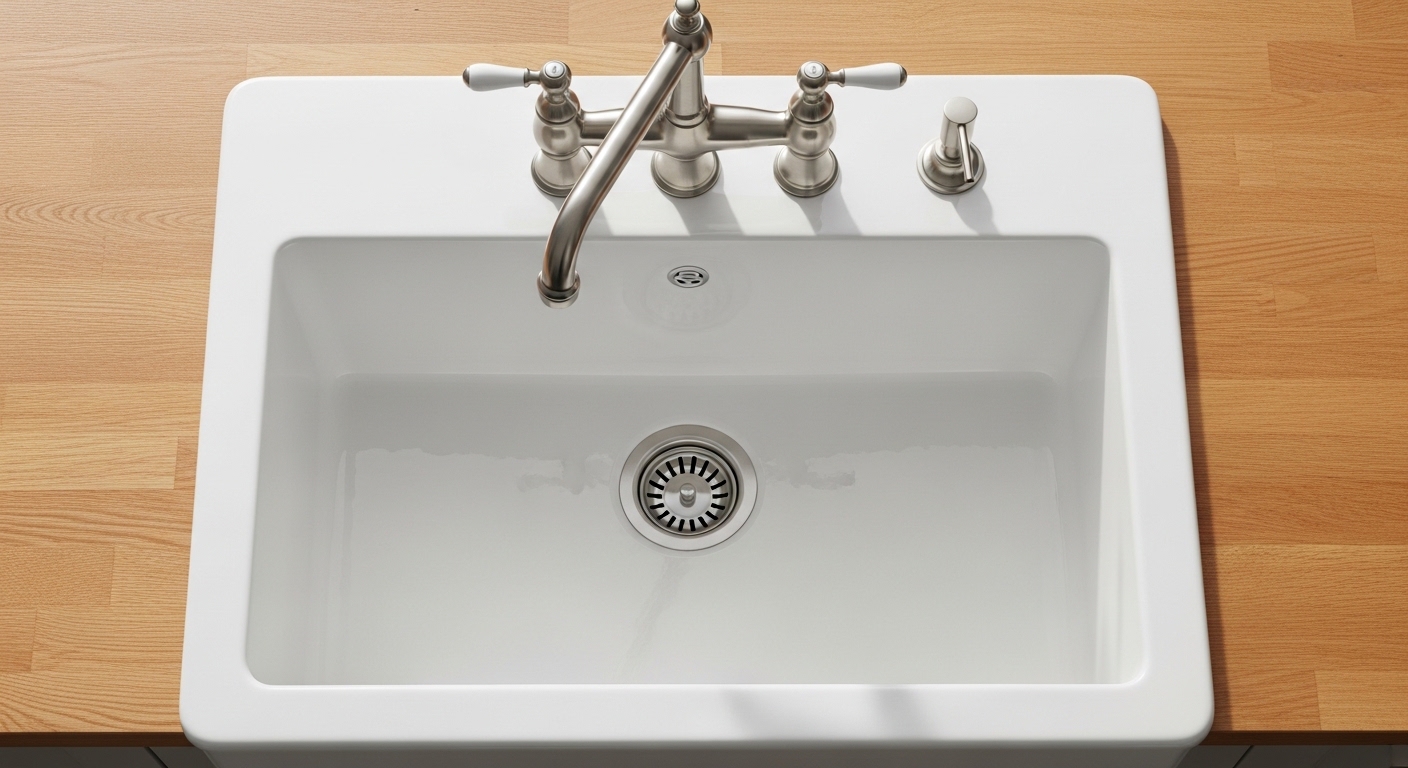
Choosing a farmhouse kitchen sink with faucet holes sounds like a small detail, but it quietly decides where your faucet lives, whether you can add a soap dispenser or side sprayer later, and how much your installer will charge you. Get it wrong and you’re either staring at an empty hole you can’t cover cleanly, or drilling a granite countertop you were told never to drill. So before you click “add to cart,” it’s worth understanding exactly what those holes do, how many you actually need, and when a no-hole sink is the smarter call.
At Fransiton we’ve fitted faucets to thousands of apron-front (farmhouse) sinks in fireclay, cast iron, and 16-gauge stainless steel, and the hole count is the single most common thing buyers get wrong. Let’s fix that.
What does “faucet holes” actually mean on a farmhouse sink?
Faucet holes are the pre-drilled openings on the flat back ledge (the “deck”) of the sink where a deck-mounted faucet and its accessories drop through and bolt to the underside. On a farmhouse sink, that ledge is the strip of material behind the basin, between the bowl and the wall. A sink is sold as “1-hole,” “2-hole,” “3-hole,” “4-hole,” or “no-hole,” and that number tells you how many fixtures the deck can carry.
Here’s the key thing people miss: a farmhouse kitchen sink with faucet holes puts the faucet ON the sink, while a no-hole farmhouse sink means the faucet goes somewhere else — usually drilled into the countertop directly behind the sink, or occasionally mounted on the wall. Neither is “better” in a vacuum; they’re two different plumbing layouts. The right one depends on your faucet, your countertop material, and how many extras you want at the sink.
Each hole has a job:
- Hole 1 — the faucet body: every faucet needs at least one hole (single-hole faucets use exactly this).
- Holes 2 & 3 — the handles: a traditional widespread or bridge faucet uses separate hot and cold handles that need their own holes, typically 8 inches apart center to center.
- Extra hole — accessories: a side sprayer, a soap/lotion dispenser, an air gap for a dishwasher, a hot-water dispenser, or a water-filter faucet.
How many faucet holes do I need for a farmhouse sink?
For most modern kitchens, you need one hole — because the majority of today’s kitchen faucets are single-hole, pull-down designs with the handle built into the body. If you also want a soap dispenser, add one hole for that. Traditional two-handle or bridge faucets need three or four holes. When in doubt, match the hole count to your chosen faucet’s spec sheet, not the other way around.
Quick way to figure it out: pick the faucet first, read its installation spec, then buy the sink to suit. Faucets are far harder to “adapt” than sinks. Here’s the typical breakdown:
| Faucet setup you want | Holes needed | Best sink choice |
|---|---|---|
| Single-hole pull-down faucet only | 1 | 1-hole sink, or no-hole sink + counter drill |
| Single-hole faucet + soap dispenser | 2 | 2-hole sink (or add-a-hole in counter) |
| Single-hole faucet + soap + air gap/filter | 3 | 3-hole sink |
| Widespread / bridge two-handle faucet | 3 | 3-hole sink, 8″ spread |
| Two-handle faucet + side sprayer | 4 | 4-hole sink |
| Wall-mounted or counter-drilled faucet | 0 | No-hole (undrilled) farmhouse sink |
A smart middle-ground trick: buy a sink with one hole and cover it with a hole cap or deck plate if you later change to a counter-mounted faucet. Covering a hole is easy; adding one to fireclay after the fact is basically impossible without cracking it. This is why, if you’re unsure, fewer holes is the safer bet — you can always drill a countertop, but you can’t un-drill a sink.
Farmhouse sink with faucet holes vs. no holes — which should I buy?
Choose a farmhouse sink with faucet holes if you have a laminate, butcher block, or thin countertop, if you’re doing the job yourself, or if you want the faucet visually centered on the sink. Choose a no-hole farmhouse sink if you have granite, quartz, or marble counters and want a clean, high-end look with the faucet drilled into the stone — or if you’re wall-mounting the faucet.
The deciding factor is almost always the countertop. Deck-mounting the faucet on a pre-drilled sink means no drilling of expensive stone — a big deal for DIYers and anyone nervous about cracking a $3,000 quartz slab. On the flip side, drilling the faucet into the counter (no-hole sink) gives you total freedom over faucet placement, spacing, and reach, and it’s the look most designers specify for premium fireclay farmhouse sinks.
| Factor | Sink with faucet holes | No-hole sink (drill counter) |
|---|---|---|
| Best countertop | Laminate, butcher block, thin decks | Granite, quartz, marble, solid surface |
| Drilling risk | None — holes are pre-made | Must drill stone (pro recommended) |
| Faucet placement | Fixed by hole location | Anywhere you want it |
| DIY-friendliness | High | Medium to low |
| Look | Classic, faucet on sink | Sleek, faucet on counter |
| Future flexibility | Limited to hole count | Fully flexible |
One caveat worth knowing: many premium fireclay and cast-iron apron sinks are sold only as no-hole, because manufacturers can’t guarantee a clean fired glaze around a pre-drilled hole. Stainless steel farmhouse sinks, by contrast, are commonly offered in both configurations because holes are simply punched into the steel. If you’ve fallen in love with a specific fireclay sink and it’s no-hole, plan on a counter-drilled or wall-mounted faucet — that’s normal.
Can I add or cover a faucet hole after installing a farmhouse sink?
You can easily cover an unused faucet hole with a chrome, brushed nickel, or matte black sink hole cover (they cost a few dollars and snap or bolt in). You generally cannot safely add a new hole to a fireclay or cast-iron sink after the fact — the glaze and material will chip or crack. Stainless steel can be drilled with a step bit, but it’s fiddly and you risk voiding the finish warranty.
So plan holes for what you might want in two or three years, not just today. A common regret: buying a 1-hole sink, then wanting a soap dispenser or a reverse-osmosis drinking-water faucet and having nowhere to put it. If a filtered-water tap is even a maybe, get the extra hole now, or leave room to drill the counter. (If you’re weighing an under-sink filter, our guide on whether a stainless steel RO faucet is the right choice for your reverse osmosis system walks through the dedicated tap that usually needs its own hole.)
To cover a hole cleanly:
- Match the cap finish to your faucet (brushed nickel cap with a brushed nickel faucet, etc.).
- Check the hole diameter — standard US faucet holes are 1⅜ inch (35 mm), some are 1½ inch.
- Drop the cap in, tighten the underside nut, and you’re done in five minutes.
What size are farmhouse sink faucet holes, and will my faucet fit?
Standard kitchen faucet holes in the US are 1⅜ inch (35 mm) in diameter, spaced 4 inches apart for accessory holes and 8 inches apart (center to center) for widespread two-handle faucets. Almost every mainstream single-hole faucet fits a 1⅜-inch hole; some heavier commercial-style faucets need 1½ inch, so always confirm on the spec sheet.
Two measurements matter when matching a faucet to a pre-drilled farmhouse sink:
- Hole diameter: 1⅜” (35 mm) is the norm. A slightly larger hole is fine — the faucet base and deck plate cover it. A hole that’s too small is a problem.
- Hole spacing: accessory holes usually sit 4″ from the main hole; two-handle “widespread” faucets need the classic 8″ spread. “Centerset” style is different again — if you’re unclear on the terminology, our explainer on centerset vs. widespread faucets lays out the spacing for each.
Also check the deck thickness your faucet can clamp onto. Farmhouse sink ledges vary; if the ledge plus any mounting spacer exceeds the faucet’s maximum deck thickness, the mounting nut won’t reach the threads. Reputable faucets list a deck-thickness range (often up to about 2.5 inches) right on the spec sheet.
Which faucet style works best with a farmhouse apron-front sink?
A tall, high-arc pull-down faucet is the most popular and practical match for a farmhouse apron-front sink, because deep single-bowl farmhouse basins need enough spout height and reach to fill big pots and rinse sheet pans. Bridge faucets suit traditional and cottage kitchens beautifully; touchless faucets are great for messy-hands cooking. All three work with either a 1-hole or no-hole sink.
A few matching tips from real installs:
- Match the reach to the bowl: a single deep bowl (9–10 inches) does best with a spout that reaches near the center drain. Too-short a spout and you’re splashing water off the back wall of the basin.
- Watch the height under a window: tall arc faucets can hit a low windowsill. Measure before you buy.
- Consider a side sprayer or built-in pull-down: if you skip the extra sprayer hole, a pull-down spray head does the same job from a single hole.
If your heart is set on the traditional apron-front look, it’s worth reading our deeper dive on the best farmhouse-style kitchen sink faucet for an apron-front sink — it covers finishes, spout height, and the exact hole layouts that pair well. And whichever route you take, when it comes time to fit it, our step-by-step kitchen faucet installation guide walks through the deck-mount and counter-mount process so the hole decision actually pays off.
How do I install a faucet on a pre-drilled farmhouse sink?
Installing a deck-mounted faucet on a pre-drilled farmhouse sink takes about 30–45 minutes and no special tools beyond a basin wrench and adjustable pliers. Because the holes already exist, you skip the scariest step — drilling — and go straight to mounting.
- Shut off the water at the under-sink stop valves and open the faucet to release pressure.
- Dry-fit the faucet through the hole to confirm the diameter and deck thickness work before committing.
- Seat the gasket or apply plumber’s putty under the faucet base per the manufacturer’s instructions (silicone/rubber gaskets are common on modern faucets).
- Drop the faucet through the hole and thread the mounting nut up from underneath; tighten with a basin wrench.
- Connect the supply lines — hot to hot, cold to cold — hand-tight plus a quarter turn. Don’t overtighten.
- Turn the water back on, check for drips, and run the faucet for a minute to clear the line.
If you’re covering an unused hole at the same time, do it now with a matching cap. And if you ever end up with a slow drip after install, it’s usually a loose connection or worn washer — our walkthrough on fixing a dripping kitchen sink faucet without calling a plumber covers the quick fixes before you panic.
FAQ
Can I use a single-hole faucet on a 3-hole farmhouse sink?
Yes. Install the single-hole faucet in the center hole and cover the two extra holes with a matching deck plate (escutcheon) or individual hole caps. Many single-hole faucets actually ship with an optional deck plate designed to span a standard 3-hole layout, so this is a very common and clean setup.
Do farmhouse sinks come without any faucet holes?
Most premium fireclay and cast-iron farmhouse sinks are sold with no faucet holes at all, because the faucet is meant to be mounted on the countertop or wall behind the sink. Stainless steel farmhouse sinks are commonly offered both ways. If your sink is no-hole, you’ll drill the counter or wall-mount the faucet.
What size hole does a kitchen faucet need in a farmhouse sink?
A standard US kitchen faucet needs a 1⅜-inch (35 mm) diameter hole. Some heavy commercial-style faucets require 1½ inch. Accessory holes for soap dispensers or sprayers are usually the same 1⅜ inch, spaced about 4 inches from the main faucet hole.
Is it hard to drill a faucet hole in a farmhouse sink myself?
For fireclay or cast iron, don’t — the material chips and cracks, and you’ll likely ruin the sink and void the warranty. Stainless steel can be drilled with a step bit and patience, but it’s risky. The safer path is to buy the sink already drilled for the number of holes you need, or to drill the countertop instead.
Should I pick the sink or the faucet first?
Pick the faucet first, then buy a farmhouse sink whose hole count matches it. Faucets have strict hole-count and spacing requirements, while sinks are easy to match or adapt (you can always cover an extra hole). Choosing the sink first is the most common cause of “my faucet doesn’t fit” returns.
Can I add a soap dispenser later if my sink has no spare hole?
Only by drilling a new hole — which is safe in the countertop but not in a fireclay or cast-iron sink. If a soap or lotion dispenser, filtered-water tap, or air gap is even a possibility down the road, buy a sink with one extra hole now, or leave counter space to drill later.
The bottom line from Fransiton
A farmhouse kitchen sink with faucet holes is the right choice when you want the faucet mounted on the sink itself, when your countertop is laminate or wood, or when you’re installing it yourself and want to avoid drilling. Go no-hole when you have stone counters and want the flexible, high-end look of a counter-drilled faucet. Either way, count your holes for the future — one for the faucet, one for a soap dispenser, maybe one for a filtered-water tap — because covering a hole is trivial and adding one to fireclay is not.
Author note: This guide was written by the Fransiton product team, drawing on hands-on installation of apron-front sinks in fireclay, cast iron, and 16-gauge stainless steel across residential kitchens. Fransiton designs and sells kitchen and bathroom fixtures direct to homeowners, and every faucet we ship is pressure- and cycle-tested to meet cUPC/NSF standards and backed by a limited lifetime warranty on finish and function. When a spec here says “1⅜ inch” or “8-inch spread,” it’s the same number we verify on the bench — so you can match your sink and faucet with confidence.
Pingback: What Size Farmhouse Kitchen Sink Do You Actually Need for a 36-Inch Cabinet? - Fransiton
Pingback: Which 3 Hole Farmhouse Kitchen Faucet Should You Buy for Your Apron-Front Sink? - Fransiton