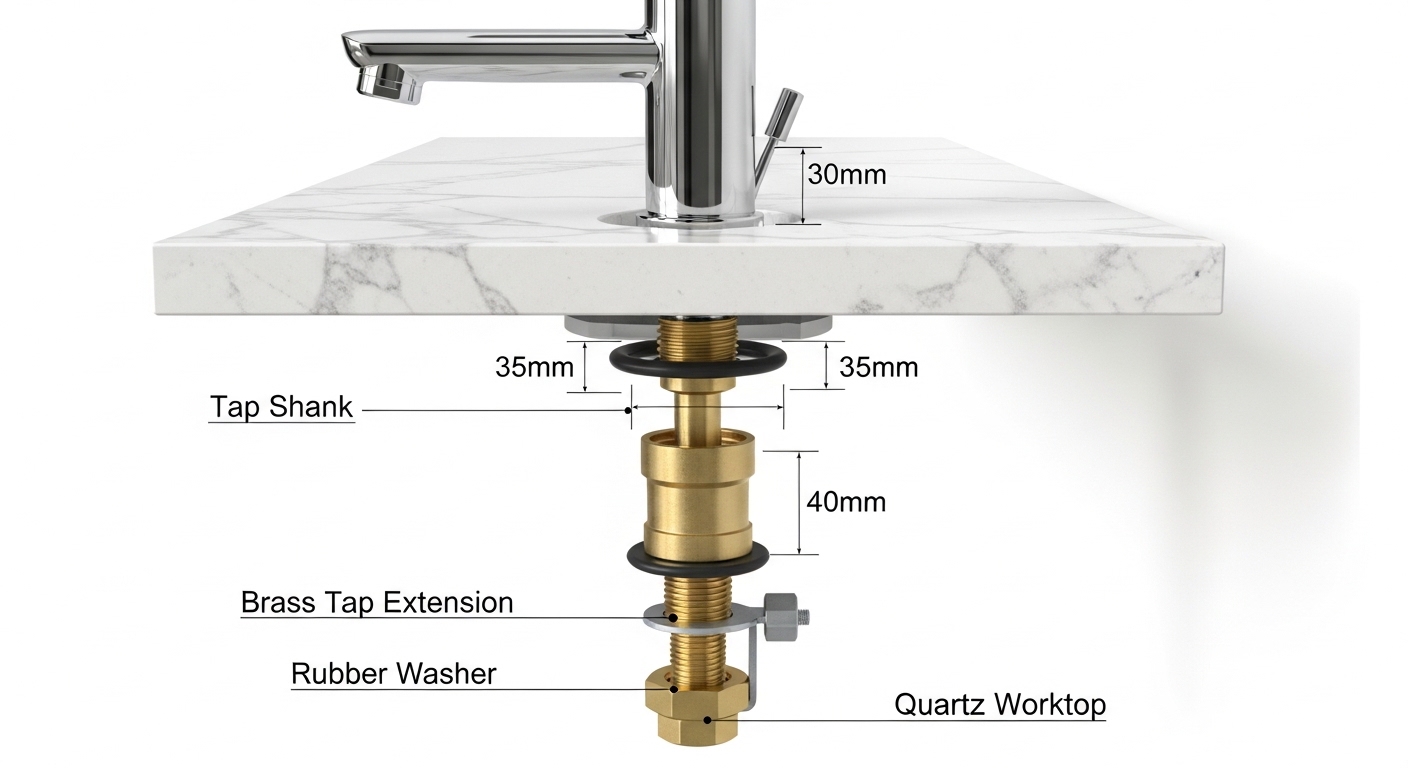
If you’ve ever tried to fit a basin tap into a chunky stone worktop and found the threaded shank simply won’t poke far enough through to catch the backnut, a brass tap extension is the £5–£25 part that saves the whole install. It’s an unglamorous fitting, but it’s the difference between a tap that clamps down rock-solid and one that wobbles, leaks, or won’t mount at all. This guide explains exactly what these extensions do, the different types, how to pick the right thread and length, and how to fit one without over-torquing and cracking anything.
What exactly does a brass tap extension do?
It adds threaded length in one of two places: the shank (the vertical stud that clamps the tap to the counter) or the spout/outlet (the pipe the water actually comes out of). Most extensions are solid brass tubes with a male thread on one end and a female thread on the other, so they thread in-line with what’s already there.
Here’s where they earn their keep in real installs:
- Thick worktops: Standard mono-block basin taps are threaded for a 25–40 mm deck. Drop that tap into a 60 mm quartz or a tiled worktop with backer board and the thread runs out — there’s nothing left for the washer and backnut to grab. A shank extension gives you the extra 30–50 mm you need.
- Vessel and countertop basins: A tall glass or ceramic vessel bowl sits high, and a standard spout can end up firing water at the rim instead of the center. A spout/outlet extension raises the reach.
- Supply-line reach: Sometimes the flexible tails or the isolation valve sit lower or further than the tap’s connection can reach. An extension closes the gap so you’re not stretching a flexi hose to its limit.
- Bidet, filter, and pillar taps: Retrofit jobs where the original hole spacing or depth doesn’t match the new tap.
How do I know if I actually need one — or can I mount the tap without it?
Do the math before you buy anything: measure your total deck thickness, then compare it to the usable thread length on your tap’s shank. If the thread is shorter than the deck plus about 10 mm (you need spare for the washer and backnut), you need an extension. If you’ve got 10 mm or more of thread poking below the underside of the counter, you’re fine as-is.
A quick field test: dry-fit the tap through the hole with the washer and backnut, and try to turn the backnut up by hand. If it spins on but never bites — or bites but only a thread or two before it stops — that tap is under-clamped and will loosen over time. That loosening is exactly the kind of thing that leads to a loose faucet handle or a tap base that rocks after a few months of use. An extension fixes the root cause instead of you re-tightening it forever.
One caveat: don’t reach for an extension just because a flexi hose feels a bit short. First check whether a longer flexible tail or repositioning the isolation valve solves it more cheaply. Extensions are for thread and reach problems, not a substitute for the right-length supply hose.
What are the different types of brass tap extensions?
There are four common families, and picking the wrong one is the #1 reason people end up returning the part. Match the job to the type first, then worry about size.
| Type | What it does | Best for | Typical thread |
|---|---|---|---|
| Shank / tail extension | Lengthens the vertical stud so the backnut can clamp through a thick deck | Stone, quartz, tiled or double-thickness worktops | M10, M8, or 1/2″ |
| Spout / outlet riser | Raises the water outlet height | Tall vessel basins, deep pot-filling | 1/2″ or 3/4″ BSP |
| Straight extension nipple | Adds in-line length between two threaded fittings | Connecting valves, filters, garden bibcocks | 1/2″ or 3/4″ BSP male–male / male–female |
| Flexible extension hose (braided, brass ends) | Adds reach with a bend | Awkward supply routing under the sink | 3/8″ or 1/2″ compression |
The material matters as much as the type. Cheap zinc-alloy “brass-look” extensions corrode and can seize or crack under load; genuine solid brass (often DZR / dezincification-resistant brass for potable water) holds thread integrity for decades. Chrome-plated brass is fine and adds corrosion resistance, but confirm there’s real brass under the plating.
Which thread size and length do I need for my tap?
Start with the thread standard, because a length that’s perfect won’t help if the thread doesn’t match. In the US you’ll mostly see NPT and standard faucet shank threads; in the UK, Europe, and much of the world it’s BSP (BSPP parallel for taps). The two are not interchangeable — BSP and NPT have different thread angles and will cross-thread and leak if forced.
Common tap thread sizes you’ll run into:
- 1/2″ BSP — the workhorse for spouts, bibcocks, and many supply connections.
- 3/4″ BSP — larger bath taps and some garden/utility fittings.
- M10 × 1 — very common on the threaded shanks of modern mono-block basin and kitchen taps.
- 3/8″ compression — the flexible-tail end that meets your isolation valve.
For length: measure your deck thickness, subtract the thread you already have poking through, then add 10–15 mm of margin for the washer and backnut. If your worktop is 60 mm and your tap gives you 20 mm of usable thread, you want an extension that nets you at least another 50 mm. Extensions commonly come in 30, 40, 50, and 100 mm lengths, and you can stack them if needed — though one correctly sized piece is always better than two stacked. If you’re unsure of the thread on your existing supply parts, our guide to the faucet supply line coupling walks through how to identify and match connection threads before you buy.
How do I install a brass tap extension without leaks?
Thread it on with fresh PTFE (plumber’s) tape, hand-tighten, then give it a firm quarter-to-half turn with a wrench — and stop. Over-torquing brass is how people crack fittings and split washers. Here’s the clean sequence:
- Shut off the water at the isolation valves and open the tap to relieve pressure.
- Clean the male thread — no old tape, no grit, no burrs.
- Wrap 3–5 turns of PTFE tape clockwise (in the direction the fitting screws on) on tapered/NPT threads. For parallel BSPP threads that seal with a washer, you rely on the washer, not tape.
- Thread the extension on by hand until snug, keeping it square — never at an angle, or you’ll cross-thread.
- Nip it up with a wrench, a quarter to half turn past hand-tight. Brass is soft; you want firm, not gorilla-tight.
- Fit the washer and backnut (for shank extensions), tighten from below, and check the tap sits square with no rock.
- Turn the water back on slowly and watch every joint for 60 seconds. A weep now is easy to fix; a weep behind a fitted vanity is not.
If you’re doing a full tap swap at the same time, it’s worth reading through a proper step-by-step kitchen faucet installation so the extension goes in as part of a clean, once-only fit rather than a mid-job improvisation.
Are brass extensions safe for drinking water, and will they corrode?
Yes — provided you use potable-rated brass. The concern with ordinary brass is dezincification: over years, aggressive or soft water can leach zinc out of the alloy, weakening it and sometimes leaving a chalky residue. That’s why quality potable fittings use DZR (dezincification-resistant) brass or are certified to drinking-water standards. Look for markings or spec sheets referencing standards like WRAS approval (UK), NSF/ANSI 61 or 372 “lead-free” compliance (US), or EN 12164/12165 brass grades.
Corrosion on the outside is a different issue — that’s usually water spotting and mineral scale, not the brass failing. If your extension or tap base keeps looking cloudy or crusty, that’s hard water at work, and it’s cosmetic; here’s how to clean hard water stains from a faucet without scratching the finish. Chrome-plated brass extensions resist that surface staining better than raw brass if the fitting will be visible.
Brass vs. stainless vs. plastic tap extensions — which should you buy?
For anything carrying pressurized potable water under a counter, solid brass is the default for good reason: it threads cleanly, seals reliably, tolerates repeated tightening, and lasts decades. Here’s how the common materials stack up.
| Material | Strength / longevity | Corrosion resistance | Best use | Watch out for |
|---|---|---|---|---|
| Solid brass (DZR) | Excellent — decades | Very good with DZR grade | Any pressurized water line, shank or spout | Confirm it’s real brass, not zinc alloy |
| Chrome-plated brass | Excellent | Excellent (plating protects surface) | Visible extensions, spout risers | Plating can chip if over-wrenched |
| Stainless steel | Excellent | Excellent | High-end or industrial fittings | Harder to thread; can gall without lubricant |
| Zinc alloy (“brass-look”) | Poor — years, not decades | Poor | Avoid for water lines | Cracks, seizes, dezincifies |
| Plastic / nylon | Low load only | Good chemically | Non-pressure or temporary | Strips easily; not for structural clamping |
Bottom line: buy solid brass (chrome-plated if it’s on show), verify the thread standard, and match the length to your deck. Skip anything vaguely described as “metal” or “brass-tone” without a stated alloy — that’s usually zinc.
What size problems trip people up most often?
The three that generate the most returns are: (1) buying NPT when you needed BSP (or vice versa), (2) getting the right thread but the wrong length so you still can’t clamp, and (3) confusing a shank extension with a spout riser. Measure twice: deck thickness, existing usable thread, and the actual thread standard on your tap. If your new tap swaps a two-hole for a single-hole layout, or you’re weighing basin styles, our breakdown of centerset vs. widespread faucets helps you confirm the hole spacing and mounting depth before you order any extension.
FAQ
Can I use a brass tap extension on both hot and cold supplies?
Yes. Solid brass handles hot and cold water equally well and won’t degrade at normal domestic temperatures. Just use the same quality DZR brass on both lines and seal each thread properly.
Will an extension reduce my water pressure or flow?
Not meaningfully. A short shank or spout extension of the same bore adds negligible resistance — you won’t feel a difference at the tap. Flow only drops if you use a much narrower internal bore or stack several long extensions, which you should avoid anyway.
How long can a brass tap extension safely be?
For shank/clamping extensions, keep it to what the install needs — typically 30–100 mm. The longer and more stacked the assembly, the more leverage on the joints, which can loosen over time. One correctly sized piece is always better than two short ones stacked together.
Do I need PTFE tape or a washer to seal it?
It depends on the thread. Tapered threads (like NPT) seal on the thread itself and need PTFE tape or thread sealant. Parallel threads (like BSPP tap threads) seal with a rubber or fiber washer, not tape. Using the wrong method is a common cause of slow weeps.
Can I paint or match the finish if the extension is visible?
Don’t paint plumbing fittings — it chips and looks worse over time. Instead, buy a chrome-plated or finish-matched extension. For visible spout risers, pick a finish that matches your tap (chrome, brushed nickel, matte black) so it reads as part of the tap rather than an add-on.
Is a brass extension strong enough to hold a heavy kitchen tap steady?
Yes, when it’s real brass and correctly torqued. The clamping force comes from the backnut against the washer, and solid brass threads hold that load indefinitely. The failures people see almost always trace back to zinc-alloy parts or under-tightening — not the concept of an extension itself.
The bottom line
A brass tap extension is a small, cheap, boring part that quietly solves a big install headache: not enough thread, not enough reach, or a spout sitting too low. Get the thread standard right, measure your deck, buy solid DZR brass, and torque it firm-not-savage. Do that and you’ll never think about it again — which is exactly what you want from a fitting buried under your counter.
Author note: This guide was written by the Fransiton fixtures team, drawing on hands-on bench testing of tap-mounting hardware across worktop thicknesses from 20 mm to 65 mm. About Fransiton: Fransiton designs and supplies faucets and bathroom fixtures with a focus on solid-brass builds and drinking-water-safe materials. Our brass fittings are manufactured from dezincification-resistant brass and tested against recognized potable-water and thread standards, and are backed by our product warranty. Always follow local plumbing codes and, for pressurized connections you’re unsure about, consult a licensed plumber.