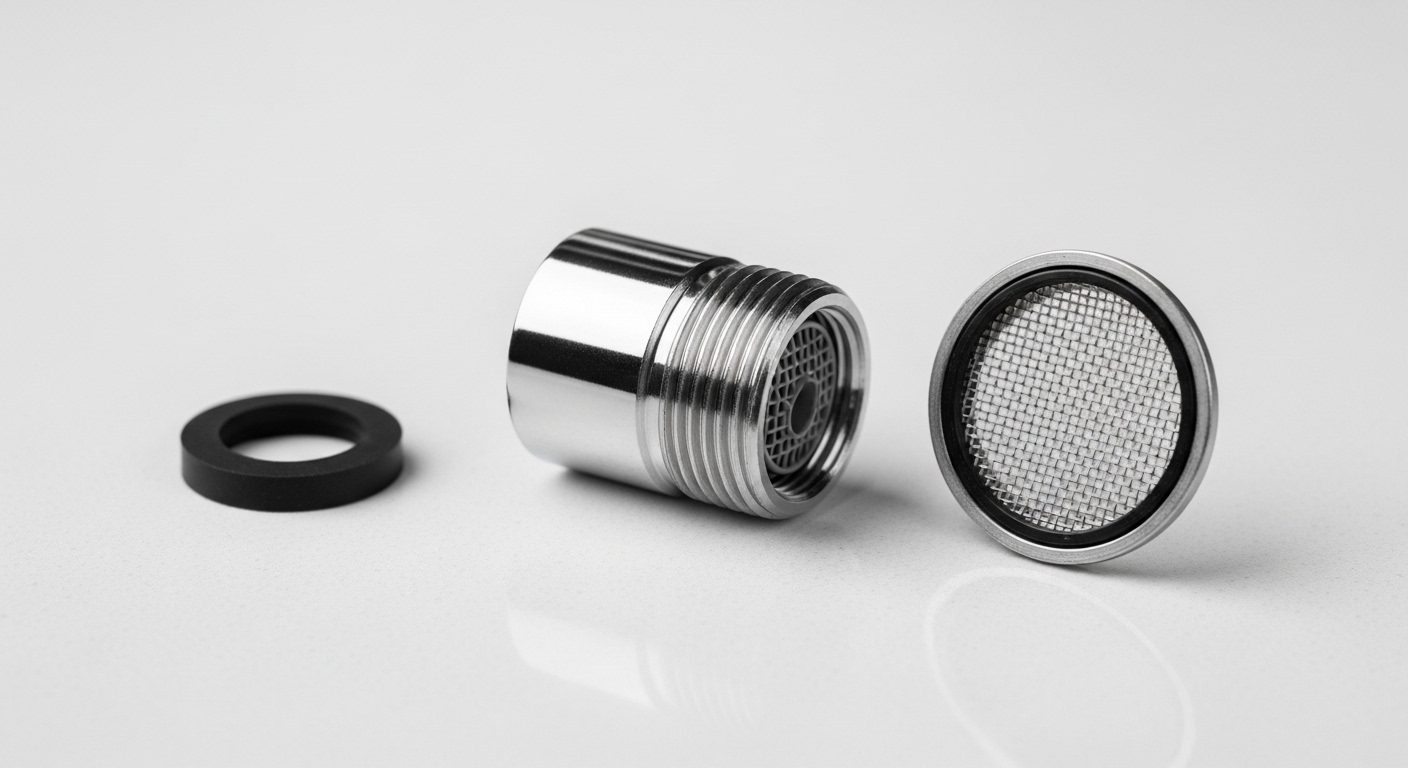
If you’ve ever unscrewed the tip of your tap to fix a weak or splashy stream, you’ve already met the part this faucet aerator guide is about. It’s a cheap component — often under $10 — but it quietly controls how your faucet feels to use and how much water your household burns through every day. Get the thread size wrong and it won’t screw on; get the flow rate wrong and you’ll either waste water or stand there waiting to fill a pot. Below, we’ll answer the real questions people ask before buying one, so you order the correct part the first time.
What does a faucet aerator actually do?
A faucet aerator does three jobs at once: it blends air into the water stream so the flow feels full while using less water, it reduces splashing in the sink, and it filters out tiny grit and debris with its mesh screen. That’s why water from an aerated faucet looks slightly white and cloudy for a second — those are the air bubbles.
Without an aerator, water leaves the spout as a single hard column at full pressure. That splashes off dishes and sink bottoms, wastes water, and often feels harsh. The aerator breaks the flow into many small streams surrounded by air. The result: a softer, more comfortable stream that can cut water use at that tap by 30% or more compared to an un-aerated spout, according to the EPA’s WaterSense program. Since roughly 15% of a home’s indoor water use runs through faucets, that adds up on a water bill.
One thing an aerator does not do is boost pressure. If your stream is weak, an aerator won’t fix low household water pressure — but a clogged aerator is one of the most common reasons a single faucet suddenly runs weak. More on that below.
How do I know which faucet aerator size and thread type I need?
Measure the threads on your spout — the two variables that matter are gender (male vs. female) and diameter. If the threads are on the outside of the spout tip, you need a female aerator that screws over them. If the threads are inside the spout, you need a male aerator. Bring the old aerator to the store or measure across the threads with calipers.
Standard North American sizes are surprisingly consistent, which makes replacement easy once you know the numbers:
- Regular male: 15/16″ (about 24 mm) — the most common kitchen faucet size.
- Regular female: 55/64″ (about 22 mm) — common on kitchen faucets with internal threads.
- Junior/small male: 13/16″ (about 20.5 mm) — typical on bathroom faucets.
- Junior/small female: 3/4″ (about 18.5 mm) — smaller bathroom faucets.
- Tom Thumb / Cache: a hidden aerator recessed inside the spout; needs a special key to remove.
A quick trick if you can’t measure precisely: a U.S. penny is about 3/4″ across. Lay it over the spout opening. If the penny is roughly the same width as the threaded area, you’re likely looking at a small/junior size; noticeably wider means a regular size. Still, calipers or bringing the old part in beats guessing.
What GPM flow rate should a faucet aerator have?
For a bathroom faucet, choose 1.0–1.5 GPM (gallons per minute); for a kitchen faucet, choose 1.5–2.2 GPM. GPM is stamped right on the side of most aerators, so you can read your current one and decide whether to go lower to save water or higher for faster pot-filling.
Here’s the logic. You wash your hands and brush your teeth at a bathroom sink — you don’t need much volume, so a low 1.0–1.2 GPM aerator saves water without any real downside. A kitchen faucet fills pots, rinses colanders, and fills the sink for washing, so a strangled flow there just wastes your time. Federal maximum flow for new faucets is 2.2 GPM, and California and a few other states cap kitchen faucets at 1.8 GPM and bathroom faucets at 1.2 GPM. WaterSense-labeled bathroom aerators are 1.5 GPM or lower.
If you care about how flow rate shapes the actual feel of water — and why a higher number isn’t automatically “better” — the same principle applies to showers, which we break down in our guide on what GPM a shower faucet should be.
| Use case | Recommended GPM | Best spray style | Why |
|---|---|---|---|
| Bathroom sink (hand washing) | 1.0–1.5 GPM | Aerated | Low volume needed; soft, splash-free stream |
| Kitchen sink (everyday) | 1.5–1.8 GPM | Aerated | Balances water savings with pot-filling speed |
| Kitchen sink (heavy prep) | 1.8–2.2 GPM | Spray | Fast fills and strong rinsing power |
| Utility/laundry sink | 2.2 GPM | Spray or laminar | Maximum volume for filling buckets |
| Filtered / RO drinking tap | 0.5–1.0 GPM | Laminar (non-aerated) | Keeps filtered water from picking up airborne contaminants |
Aerated vs. spray vs. laminar: which stream type is best for my sink?
Pick aerated for everyday bathroom and kitchen use, spray for scrubbing dishes and produce, and laminar for filtered water or where you want zero air mixed in. Each aerator produces a distinctly different stream, and it’s the choice most people don’t realize they have.
- Aerated: Mixes air into water for a soft, full, bubbly stream that resists splashing. The default and best all-rounder for most homes.
- Spray (or “needle spray”): Splits water into many separate droplet streams, like a tiny showerhead. Great rinsing coverage and less splashback in shallow sinks, but a bit weaker feel per stream.
- Laminar: Produces a crystal-clear, non-bubbly solid stream with no air mixed in. Preferred in healthcare settings because air can carry bacteria into a filtered stream, and popular for reverse-osmosis drinking taps.
That last point matters if you have a dedicated drinking-water faucet. Many RO and filter faucets deliberately skip aeration for water-quality reasons — see our breakdown of the stainless steel RO faucet if you’re setting up a reverse-osmosis system.
Why is my faucet aerator clogged, and how do I clean it?
Your aerator clogs because its fine mesh screen catches mineral scale, sediment, and little flecks of rubber or pipe debris over months of use — and in hard-water areas it happens fast. The fix is simple: unscrew it, soak it in white vinegar for an hour, brush the screen, and reinstall. You don’t need a plumber and you rarely need to replace the part.
Here’s the step-by-step:
- Unscrew the aerator by hand, turning toward you (counterclockwise as you face the spout). If it’s stuck, wrap it in a cloth and use pliers gently so you don’t scratch the finish.
- Disassemble it and note the order of the parts — housing, washer, screen, and any flow restrictor disc. Lay them out left to right.
- Soak everything in white vinegar for 30–60 minutes to dissolve mineral scale. For heavy buildup, leave it overnight.
- Scrub the screen with an old toothbrush and poke stubborn holes clear with a pin.
- Rinse, reassemble in the same order, and hand-tighten back onto the spout. Snug is enough — over-tightening can crack the housing or crush the washer.
If mineral buildup is a constant battle in your home, the aerator is just the first casualty — the whole faucet finish suffers too. Our guide on how to clean hard water stains from a faucet covers keeping the visible parts spotless. And if cleaning the aerator doesn’t restore flow, the drip or weak stream may be coming from a worn cartridge or washer inside the valve — our walkthrough on how to fix a dripping faucet at home handles that next layer.
Do I even need a faucet aerator, and are they worth it?
Yes for almost every standard sink — an aerator saves water, cuts splashing, and costs a few dollars, so it pays for itself quickly. The main exceptions are dedicated filtered-water taps that use laminar flow and a few commercial or accessibility fixtures. For a typical household kitchen or bathroom faucet, running without an aerator just means more splashing and a higher water bill.
The savings are concrete. Swapping a 2.2 GPM aerator for a 1.5 GPM WaterSense model in a bathroom cuts that faucet’s water use by roughly a third. Multiply that across a family brushing teeth and washing hands several times a day, and the EPA estimates the average family can save hundreds of gallons a year per faucet, plus the energy cost of heating water they no longer waste. For a part that costs less than a fast-food lunch, that’s a strong return.
The one place people go wrong: assuming a new aerator will fix genuinely low water pressure. It won’t. If every faucet in the house is weak, the issue is upstream — the main, a pressure regulator, or the supply lines — not the aerator. If only one faucet is weak, then yes, clean or replace its aerator first.
Can any aerator fit any faucet?
No — an aerator has to match your spout’s thread gender and diameter, or it simply won’t screw on. That’s the number-one reason a replacement aerator “doesn’t fit.” Before buying, either unscrew and bring your old one, or measure the threads. When in doubt, buy a multi-pack “assortment” kit that includes several common sizes plus dual-thread adapters that work as both male and female. It’s the safest bet if you can’t measure.
A few faucet designs use hidden “cache” or “Tom Thumb” aerators recessed inside the spout tip, which need a small plastic key (usually supplied with the faucet) to remove. If you don’t see external or internal threads at all, you likely have one of these. Choosing the right replacement is part of the bigger picture of matching parts to your fixture — our guide on how to choose the right bathroom faucet covers spout and style compatibility more broadly.
How often should you replace a faucet aerator?
Replace a faucet aerator every 1–3 years, or sooner if cleaning no longer restores full flow, the screen is torn, or the housing is cracked. Because the part is inexpensive, most people simply replace rather than deep-clean once the mesh degrades. In hard-water homes, the practical lifespan is shorter — you may find yourself cleaning every few months and replacing yearly.
Signs it’s time for a new one: a stream that stays weak or sprays sideways even after cleaning, visible corrosion or mineral crust you can’t dissolve, a cracked plastic housing, or a washer that no longer seals (you’ll see drips leaking around the threads). At that point, a fresh brass or stainless aerator restores the stream instantly.
How to install a new faucet aerator (quick guide)
Installing an aerator takes about two minutes and no tools. Turn the new aerator clockwise onto the spout by hand until snug, then give it a gentle quarter-turn with a cloth-wrapped hand if needed. Run the water and check for leaks around the threads — if it drips, the washer may be misaligned or the aerator slightly cross-threaded; unscrew and try again.
- Confirm the flow direction of any restrictor disc and washer (they only seal one way).
- Thread the aerator on by hand — never force it, which risks cross-threading soft brass.
- Hand-tighten, then a slight nudge with a cloth for grip. Avoid metal pliers on chrome.
- Run hot and cold water, watch for thread leaks, and confirm the stream looks even.
FAQ
Are all faucet aerators the same size?
No. They come in a handful of standard sizes — regular male (15/16″), regular female (55/64″), junior male (13/16″), and junior female (3/4″), plus hidden cache styles. Kitchen faucets usually take regular sizes; bathroom faucets often take junior sizes. Always measure or bring the old aerator when buying.
Does a faucet aerator reduce water pressure?
No — an aerator reduces flow rate (GPM), not pressure. It mixes air into the stream so a lower volume of water still feels full and strong. If your water pressure genuinely feels low at every tap, the cause is elsewhere in your plumbing, not the aerator.
Can I remove the aerator to increase flow?
You can, and the raw stream will have more volume, but it will splash badly and waste water. A better fix is to install a higher-GPM aerator (up to 2.2 GPM) rather than running the faucet bare. Removing it entirely also removes the debris screen, so grit can reach your dishes.
Why is my new aerator leaking around the threads?
Usually the rubber washer is missing, damaged, or misaligned, or the aerator is slightly cross-threaded. Unscrew it, confirm the washer is seated flat inside the housing, and re-thread carefully by hand. Hand-tight plus a small nudge is enough — over-tightening cracks the housing without stopping the leak.
What’s the difference between a WaterSense aerator and a regular one?
A WaterSense-labeled aerator is independently certified to use 1.5 GPM or less (for bathroom faucets) while still delivering satisfying performance in EPA testing. A standard aerator may flow up to the federal max of 2.2 GPM. WaterSense models save the most water without a noticeable drop in usability.
Will a faucet aerator work with a reverse osmosis or filtered tap?
Dedicated filtered and RO drinking taps typically use a low-flow laminar (non-aerated) tip instead, because mixing air into filtered water can reintroduce airborne contaminants. For your main kitchen and bathroom faucets, though, a standard aerated model is ideal.
About the author: This guide was written by the Fransiton product team, drawing on hands-on bench testing of hundreds of aerator and faucet assemblies for fit, flow rate, and durability. We measure GPM on a calibrated flow rig and pressure-cycle threaded components to confirm real-world seal life.
Why trust Fransiton: Fransiton designs and sells faucets, shower systems, and bathroom fixtures direct to homeowners at fransiton.net. Our aerators and faucet bodies are built to meet U.S. lead-free (NSF/ANSI 372) and flow (ASME A112.18.1) standards, and our fixtures carry a limited lifetime warranty on finish and function — so a replacement aerator is a quick, no-cost part when you need one.
Pingback: Tap Aerator UK Screwfix: Which One Should You Buy and How Do You Fit It? - Fransiton