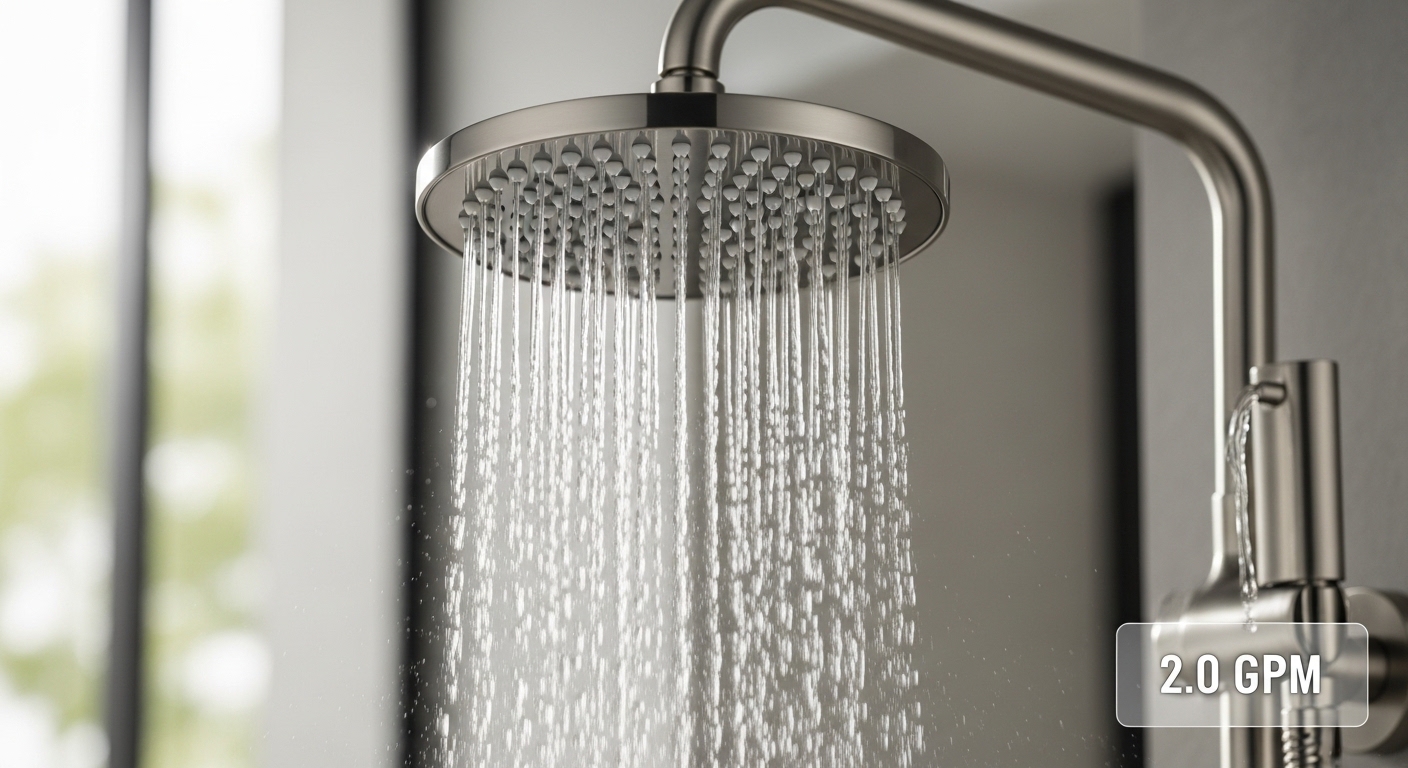
If you’ve ever stood in the shower aisle squinting at the spec sheet, the term shower faucet gpm is the single number that decides how your shower actually feels — how much water hits you, how strong the spray is, and how big your water and energy bills get. GPM stands for gallons per minute, and it’s simply the maximum amount of water a shower head or shower faucet can deliver in 60 seconds. Get this number right and you get a satisfying, drenching shower without waste. Get it wrong and you either feel like you’re rinsing under a garden mister, or you’re quietly paying for hundreds of extra gallons a month you never needed.
This guide breaks down exactly what GPM you should buy, what the law allows, how flow rate interacts with your home’s water pressure, and how to pick a shower faucet that feels powerful without wasting water. We test fixtures the way you actually use them, so the recommendations below are about real-world feel, not just numbers on a box.
What does GPM mean on a shower faucet, in plain English?
GPM is the maximum gallons of water your shower can put out per minute. A 2.5 GPM shower faucet delivers up to 2.5 gallons every minute; a 1.8 GPM model delivers up to 1.8. That’s the whole definition — it’s a measure of water volume over time, tested at a standard 80 psi of water pressure.
Here’s the part most product pages won’t tell you: GPM is a ceiling, not a guarantee. The rated flow assumes your home delivers a healthy 80 psi. If your house runs at 45 psi — which is common in older homes and upper floors — a “2.5 GPM” head will actually deliver less than that. This is why two people can buy the same faucet and have completely different experiences. The number on the box is the lab maximum; your plumbing decides what you really get.
One more distinction worth nailing down: the GPM rating belongs to the part that water sprays out of. On a built-in shower, that’s usually the shower head (or hand shower), not the valve trim behind the wall. So when you’re shopping, the GPM that matters is printed on the shower head spec, even though people loosely call the whole assembly a “shower faucet.”
What GPM should a shower faucet be for a normal home shower?
For a standard residential shower, aim for 1.8 to 2.5 GPM. That range covers almost everyone: 2.5 GPM is the legal max and gives the most drenching feel, 2.0 GPM is the most popular all-around choice, and 1.8 GPM is the efficiency pick that still feels full when it’s engineered well.
Think of it as three real-world tiers:
- 2.5 GPM — the maximum allowed in most states. Best if you have luxurious-shower preferences, long hair to rinse, or a large rain head and you don’t mind the higher water use.
- 2.0 GPM — the comfortable middle. Strong, satisfying spray for the vast majority of households, with a noticeable cut in water use versus 2.5.
- 1.5–1.8 GPM — WaterSense-style efficiency. Great for guest baths, kids’ bathrooms, drought-prone regions, or anyone chasing the lowest possible water bill. With a quality pressure-compensating head it still feels good; with a cheap one it can feel weak.
If you live somewhere with strict water rules — California and Colorado, for example, cap shower heads at 1.8 GPM — your decision is partly made for you, and that’s fine. Modern 1.8 GPM heads are dramatically better than the trickle-flow heads people remember from the early 2000s.
Is the 2.5 GPM shower limit a federal law, and can I go higher?
Yes — 2.5 GPM at 80 psi is the federal maximum for shower heads in the United States, set under the Energy Policy Act, and some states go lower. You legally cannot buy a new mainstream shower head rated above 2.5 GPM, and trying to remove a flow restrictor to exceed it isn’t something we’d ever recommend.
Here’s the state-by-state reality at a glance:
| Standard / Region | Max Shower Head GPM | Who It Applies To |
|---|---|---|
| Federal (EPAct) | 2.5 GPM @ 80 psi | All U.S. states (baseline) |
| EPA WaterSense (voluntary) | 2.0 GPM | Buyers wanting certified efficiency |
| California & Colorado | 1.8 GPM | New fixtures sold in-state |
| New York (proposed/varies) | 2.0 GPM | Check current local code |
People sometimes ask about pulling out the flow restrictor — the little plastic-and-rubber disc inside the head — to boost flow. We don’t recommend it. It can violate code, void your warranty, waste water and money, and on many modern heads it actually makes the spray worse, because the nozzle pattern was engineered around that restrictor. If your shower feels weak, the fix is almost never “rip out the restrictor” — it’s usually low water pressure or a clogged head, which we cover below.
Does higher GPM actually mean a stronger, better shower?
No — not by itself. A higher GPM number means more water volume, but the feeling of a “strong” shower comes from water pressure and nozzle design, not raw gallons. A well-designed 1.8 GPM head can feel punchier than a poorly designed 2.5 GPM head.
The trick is something called pressure compensation. Good shower heads use narrower, precisely angled nozzles that speed the water up as it exits — so even with fewer gallons, each droplet hits with force. That’s why two heads with identical GPM ratings can feel completely different, and why GPM alone is a bad way to judge shower quality.
What actually drives that satisfying, strong-shower feel:
- Your home’s water pressure (psi) — the biggest single factor. Below ~40 psi, almost any head feels weak.
- Nozzle design and count — fewer, well-aimed jets often feel stronger than a wide soft rain pattern at the same GPM.
- Spray mode — a concentrated “massage” setting feels far more forceful than a full rain setting, even on the same head at the same GPM.
- The head itself — air-injection and pressure-boost technologies make low-flow heads feel fuller.
So if you want a powerful shower, don’t just chase 2.5 GPM. Check your home’s water pressure first, then pick a quality head. A 2.0 GPM pressure-compensating head in a 60 psi house will beat a 2.5 GPM bargain head in a 40 psi house every time.
How much water and money does shower GPM actually use?
A 10-minute shower at 2.5 GPM uses 25 gallons; the same shower at 1.8 GPM uses 18 gallons — a 7-gallon difference per shower. Across a family of four showering daily, that’s roughly 28 gallons saved every day, or over 10,000 gallons a year, plus the energy cost of heating water you no longer use.
Here’s the math laid out for a single 10-minute shower:
| Shower Faucet GPM | Water per 10-min Shower | Daily (family of 4) | Yearly (family of 4) |
|---|---|---|---|
| 2.5 GPM | 25 gallons | 100 gallons | ~36,500 gallons |
| 2.0 GPM | 20 gallons | 80 gallons | ~29,200 gallons |
| 1.8 GPM | 18 gallons | 72 gallons | ~26,300 gallons |
| 1.5 GPM | 15 gallons | 60 gallons | ~21,900 gallons |
The hidden cost is hot water. Roughly two-thirds of the water in a typical shower is heated, so a lower-GPM head directly cuts your water-heating bill — gas or electric — not just your water bill. For most families, dropping from 2.5 to 1.8 GPM saves real money each year while still feeling like a proper shower, which is exactly why WaterSense-certified 2.0 GPM and 1.8 GPM heads have become the default for new construction.
How do I check my shower’s GPM and water pressure at home?
You can measure your real shower GPM in under two minutes with a bucket and a timer: run the shower into a measured container for exactly 10 seconds, multiply the gallons collected by 6, and that’s your actual GPM. If you catch 0.3 gallons in 10 seconds, you’re running at about 1.8 GPM in real life.
Step by step:
- Grab a bucket marked in gallons (or a 1-gallon jug to fill and count).
- Turn the shower to full hot-and-cold flow.
- Hold the container under the head for exactly 10 seconds.
- Measure the gallons collected, then multiply by 6 (because there are six 10-second blocks in a minute).
- The result is your true delivered GPM — which is often lower than the rated number if your water pressure is low.
If your measured GPM is well below the head’s rating, the culprit is usually low water pressure or a clogged head — not the faucet’s fault. Mineral buildup is a leading cause; the same hard-water scale that crusts your nozzles also affects sink fixtures, and the cleaning approach is similar to how you’d clean hard water stains from a faucet. A quick soak of the shower head in white vinegar overnight often restores flow that mineral deposits had choked off.
Which shower faucet GPM is right for my specific situation?
Match the GPM to your household, your water pressure, and your local rules. There’s no single “best” number — there’s a best number for you. Use these quick scenarios to find yours.
- Low water pressure home (under 45 psi): Choose a pressure-compensating head and don’t obsess over GPM. A 2.0–2.5 GPM head with air-injection tech will feel strongest. Consider a dedicated high-pressure model.
- Large family, high usage: Go 1.8–2.0 GPM WaterSense-certified to control the water-heating bill, since you’re running multiple long showers daily.
- Luxury or rain-head build: 2.5 GPM gives the most enveloping drench, but pair it with strong pressure or it’ll feel like soft rain that never quite rinses.
- Drought region / California / Colorado: 1.8 GPM is required for new fixtures; buy a quality one and you won’t miss the difference.
- Guest bath or kids’ bath: 1.5–1.8 GPM is plenty and keeps costs down where showers are shorter.
If you’re choosing a whole new fixture rather than just a head, the same careful, situation-first approach applies to the whole bathroom — the way we walk through it in our guide on how to choose the right bathroom faucet. Finish, valve type, and flow all work together, and a brushed finish in particular hides water spots well; if that’s on your mind, our take on whether brushed nickel faucets are worth it is a useful companion read.
Why Trust Fransiton on Shower Flow Rates
Fransiton designs and sells faucets and bathroom fixtures direct to homeowners, and every shower head we list publishes its true GPM rating tested to U.S. standards at 80 psi. Our fixtures meet federal EPAct flow requirements, and our efficiency models carry WaterSense-aligned 1.8–2.0 GPM ratings, backed by a manufacturer’s warranty on the valve cartridge and finish. We test heads on a calibrated pressure rig and in real bathrooms across a range of household water pressures, because a lab number means nothing if the shower feels weak at your house.
Author note: This guide was written by the Fransiton fixtures team — product specialists who spec, bench-test, and install shower valves and heads every week. We’ve measured hundreds of heads with the bucket-and-timer method described above, so the GPM advice here reflects how these fixtures behave in real homes, not just on paper.
FAQ
Is 1.8 GPM enough for a good shower?
Yes, for most people 1.8 GPM is plenty when the head is well designed. Pressure-compensating and air-injection heads make 1.8 GPM feel full and strong, especially if your home has decent water pressure (45 psi or higher). The old reputation of “weak low-flow showers” comes from cheap, dated heads — modern 1.8 GPM models are a different experience entirely.
What is the highest legal GPM for a shower head in the US?
2.5 GPM at 80 psi is the federal maximum. You cannot buy a new mainstream shower head rated higher, and some states are stricter — California and Colorado cap it at 1.8 GPM. Installing multiple shower heads to exceed the effective flow is also regulated in many jurisdictions, so check local code.
Does removing the flow restrictor increase shower GPM?
It can increase raw water flow, but we don’t recommend it. Removing the restrictor often violates local code, voids your warranty, wastes water and heating costs, and on many heads actually worsens the spray because the nozzles were tuned around that restrictor. If your shower feels weak, fix the real cause — low pressure or mineral clogging — instead.
Why does my high-GPM shower head still feel weak?
Almost always low water pressure or a clogged head, not the GPM rating. GPM is tested at 80 psi; if your home runs at 40 psi, you’ll never reach the rated flow. Check your pressure, descale the head in vinegar to clear mineral buildup, and if pressure is genuinely low, choose a pressure-boosting head designed for that situation.
What’s the difference between GPM on the shower head versus the shower valve?
The GPM that controls your experience is the shower head’s rating, since that’s where water sprays out. The valve and trim behind the wall regulate temperature and on/off, but they don’t set the flow limit — the head does. When comparing “shower faucets,” always compare the head’s GPM spec.
Will a lower-GPM shower head save me money?
Yes, on both water and energy. Dropping from 2.5 to 1.8 GPM saves about 7 gallons per 10-minute shower, and since roughly two-thirds of shower water is heated, you cut your water-heating bill too. For a family of four, that adds up to over 10,000 gallons saved per year plus the energy to heat them.