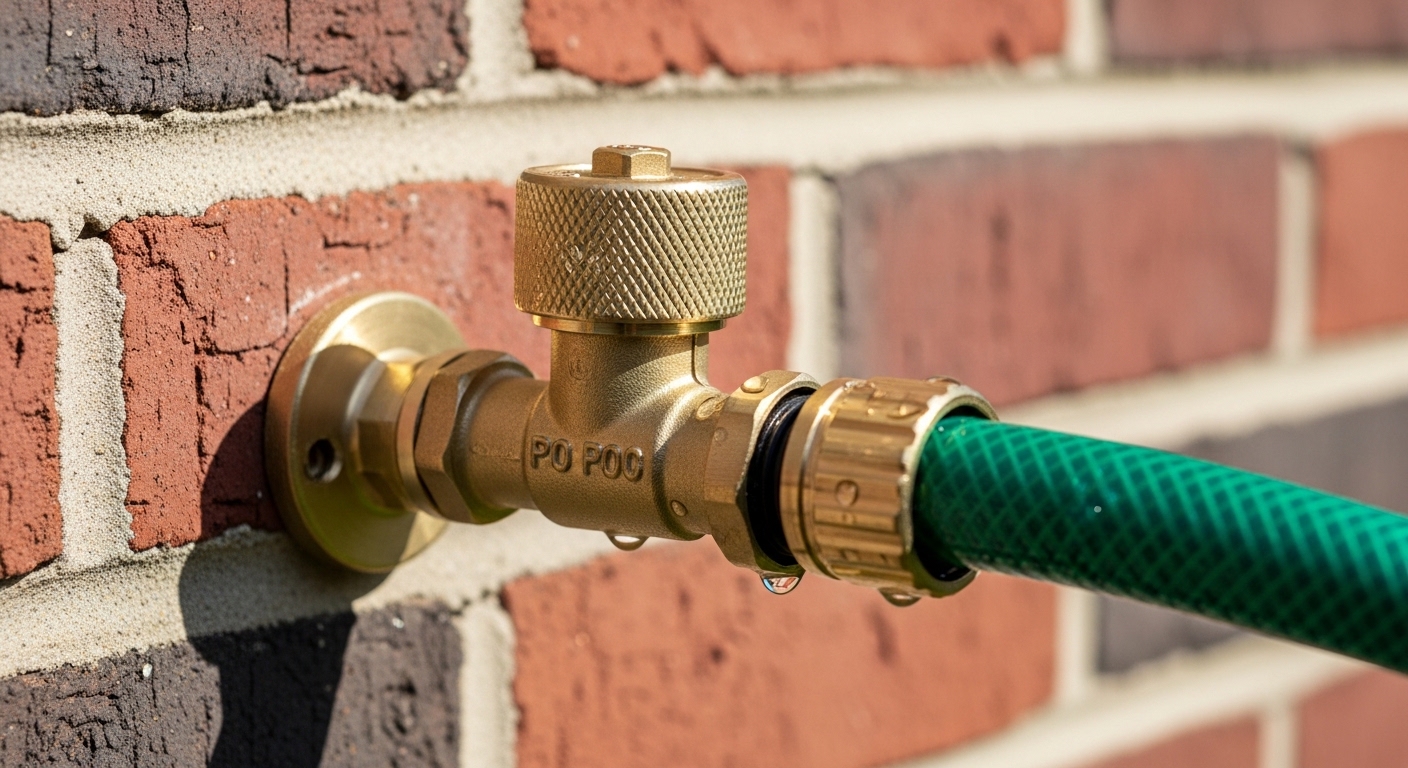
If you’ve ever fought a leaky spigot while dragging a hose across the lawn, you already know that choosing the right outdoor faucet for garden hose use is half the battle. The good news: it’s not complicated once you know the four things that actually matter — thread size, freeze protection, valve type, and material. Get those right and you’ll have a faucet that turns easily, never drips, and survives years of summer watering and winter freezes. This guide walks through exactly what to buy, what to avoid, and how the common types stack up.
What kind of outdoor faucet do I actually need for a garden hose?
You need a hose bibb (also called a sillcock or spigot) with a 3/4-inch male hose thread — the universal garden-hose connection in North America, technically called GHT (Garden Hose Thread). Any standard garden hose will thread right onto it without an adapter. That’s the single most important spec to confirm before you buy anything else.
Here’s the part that trips people up: the pipe end that connects to your house plumbing is measured differently from the hose end you screw your hose onto. The hose-thread spout is almost always 3/4″ GHT. The inlet that ties into your supply line is usually 1/2″ or 3/4″ NPT (National Pipe Thread) — and these are not interchangeable. NPT is a tapered pipe thread that seals with thread tape; GHT is straight and seals with a rubber washer. So when a listing says “3/4 inch,” always check whether they mean the inlet or the outlet.
- Outlet (where the hose goes): 3/4″ GHT — standard, don’t overthink it.
- Inlet (into your wall/pipe): typically 1/2″ or 3/4″ MIP/FIP (NPT). Match this to your existing plumbing.
- Mounting: wall-mount with a flange (most common) or a stub-out for replacing an old spigot.
Should I get a frost-free (freeze-proof) faucet or a standard hose bibb?
In any climate where temperatures drop below freezing, get a frost-free faucet — full stop. A frost-free (also called freeze-proof or anti-siphon frost-free) hose bibb places the actual shut-off valve 6–12 inches inside the heated wall of your house, not at the outdoor handle. When you turn it off, water drains out of the long exposed tube, so there’s no standing water outside to freeze, expand, and crack the pipe.
A standard hose bibb holds water right at the outdoor wall. In a hard freeze, that trapped water expands and can split the valve body or — worse — burst the pipe inside your wall, where you won’t notice until it thaws and floods. If you live anywhere with real winters (most of the U.S. north of the Gulf states), the $15 premium for frost-free is the best money you’ll spend.
One catch most people miss: a frost-free faucet only works if it’s installed with a slight downward pitch toward the outside and you disconnect the hose every fall. Leave a hose attached over winter and water can’t drain — the freeze protection is defeated and the faucet can burst anyway.
Frost-free vs. standard vs. ball-valve: which type wins?
For a garden hose in a freezing climate, a frost-free brass bibb wins. In a no-freeze climate (think coastal California, Florida, south Texas), a quarter-turn ball-valve bibb is the smoothest to operate and the most reliable. Here’s how the common types compare:
| Type | Best for | Freeze protection | Valve feel | Typical price |
|---|---|---|---|---|
| Frost-free sillcock (brass) | Cold-winter regions | Excellent (valve inside wall) | Multi-turn handle | $30–$60 |
| Quarter-turn ball valve bibb | Warm climates, frequent on/off | Poor (valve at wall) | Instant 90° on/off | $15–$35 |
| Standard multi-turn hose bibb | Budget, mild climates, utility use | Poor | Multi-turn, can drip with age | $10–$20 |
| Wall hydrant / yard hydrant | Farms, remote/buried lines | Excellent (drains below frost line) | Lever, high flow | $60–$150 |
The valve mechanism inside matters as much as the type. Older bibbs use a rubber compression washer that wears out and starts dripping — the same failure mode behind an indoor drip. If you’d rather never deal with that, look for a ceramic-disc or ball valve, which seals metal-on-ceramic and lasts far longer. If you do end up with a slow drip down the line, the fix is usually a cheap washer or cartridge swap, the same principle covered in our guide on how to fix a dripping faucet at home.
What material should an outdoor garden faucet be — brass, stainless, or zinc?
Go with brass or stainless steel; avoid zinc-alloy and cheap die-cast bodies. Outdoor faucets live in sun, rain, and freeze-thaw cycles, so corrosion resistance and material strength directly determine how many years you get. Brass is the long-standing standard because it resists corrosion, handles freeze stress, and machines into clean, leak-tight threads. Stainless steel is excellent too and looks great, though it usually costs a bit more.
- Forged brass: the gold standard — durable, corrosion-resistant, repairable. Look for “lead-free brass” if the faucet might supply drinking or pet water.
- Stainless steel (304/316): premium look, won’t rust, great near salt air. 316 is best for coastal homes.
- Zinc alloy / die-cast: cheap, but brittle in freezes and prone to corrosion at the threads — fine for a temporary fix, not a long-term install.
- Plastic/PVC bibbs: only for low-stakes, no-freeze utility use; they crack and the threads strip easily.
One health note: if anyone — kids, pets, gardeners — might drink from the hose, choose a faucet certified “lead-free” to NSF/ANSI 372 (the U.S. standard limiting lead content to 0.25% on wetted surfaces). It’s a small thing that’s worth checking on the box.
Do I need a vacuum breaker or backflow preventer on an outdoor faucet?
Yes — and in most U.S. jurisdictions it’s required by plumbing code. A vacuum breaker (an anti-siphon device, often a small cap on top of the spout) stops contaminated water from being siphoned back into your home’s drinking supply if pressure suddenly drops. Picture a hose lying in a puddle of fertilizer or a kiddie pool: without a backflow preventer, a pressure drop in the main could pull that water back into your pipes.
Most modern frost-free sillcocks have a vacuum breaker built in, so you may not need a separate one. If your existing faucet doesn’t, you can thread on an inexpensive add-on hose-bibb vacuum breaker for a few dollars. It’s cheap insurance and keeps you code-compliant. When you connect things up, this is also the right moment to make sure your supply connections are solid — a worn or mismatched fitting is a common slow-leak culprit, which is exactly why we put together a primer on the faucet supply line coupling and which one to buy.
How much should I spend, and is a $50 faucet worth it over a $12 one?
For a garden hose faucet you’ll use for years, $25–$60 buys a quality frost-free brass unit with a ceramic or quarter-turn valve and a built-in vacuum breaker — and yes, it’s worth it over a $12 big-box special. The cheap unit saves you $40 today and costs you a burst pipe, a wall repair, or an annual drip-and-replace cycle. The difference between the two isn’t marketing; it’s wall thickness, valve quality, and freeze engineering.
Here’s a simple way to decide what tier you need:
- Mild climate, light use ($15–$25): a quarter-turn brass ball-valve bibb is plenty.
- Cold climate, normal home use ($30–$50): a frost-free brass sillcock with built-in vacuum breaker — the sweet spot for most buyers.
- Hard freezes, well water, or a barn/farm ($60–$150): a freeze-proof yard hydrant that drains below the frost line.
Whatever you spend, check the warranty. Reputable manufacturers back outdoor faucets for 5 years to a lifetime on the body and finish, and test their valves to industry standards (look for a stated cycle rating or a nod to ASME/CSA/NSF compliance). A long warranty is a manufacturer telling you they expect the part to last — a strong signal when you’re comparing two similar-looking faucets.
How do I install or replace an outdoor faucet for a garden hose?
Replacing a wall-mount hose bibb is a 30–60 minute DIY job if the new faucet matches your old one’s inlet thread and length. The basic sequence is below; if you’re tying into a new line or unsure about pipe type, call a plumber — the connection inside the wall is where mistakes get expensive.
- Shut off the water to that line (often a dedicated indoor shut-off) and open the old faucet to drain it.
- Remove the old bibb — unscrew it from the threaded fitting or unsolder if it’s a sweated copper connection.
- Clean and tape the threads — wrap the male NPT inlet threads with 3–4 turns of PTFE (plumber’s) tape, clockwise.
- Thread in the new faucet hand-tight, then snug it with a wrench until the spout points down and it’s pitched slightly toward the outside (critical for frost-free draining).
- Restore water and test — check for leaks at the inlet and the valve, then thread on your hose and run it.
The thread-taping and leak-checking steps mirror indoor faucet work, so if you’ve never done it, our walkthrough on how to install a kitchen faucet step by step covers the same supply-line and sealing fundamentals in more detail. And because outdoor faucets get the brunt of mineral-heavy water, you’ll eventually see chalky buildup on the spout and aerator threads — the same approach in our guide to cleaning hard water stains from a faucet works perfectly on a hose bibb.
Quick buyer’s checklist before you click “add to cart”
- ✅ 3/4″ GHT outlet (fits any standard garden hose)
- ✅ Inlet thread matches your plumbing (1/2″ or 3/4″ NPT — measure first)
- ✅ Frost-free design if you get freezes
- ✅ Brass or stainless body (skip zinc/die-cast)
- ✅ Quarter-turn or ceramic-disc valve for drip-free shutoff
- ✅ Built-in vacuum breaker / anti-siphon for code compliance
- ✅ Lead-free certification if drinking water is a possibility
- ✅ 5-year-plus warranty
FAQ
Will any garden hose fit a standard outdoor faucet?
Yes. Standard garden hoses and outdoor hose bibbs both use 3/4-inch GHT (Garden Hose Thread) in North America, so any hose threads onto any spigot without an adapter. If a hose won’t fit, you’re likely dealing with an imported faucet using a metric (BSP) thread — in that case a cheap GHT adapter solves it.
What’s the difference between a hose bibb, a spigot, and a sillcock?
They’re mostly the same thing — an outdoor faucet you thread a hose onto. “Spigot” and “hose bibb” are used interchangeably for any outdoor tap. “Sillcock” usually refers specifically to the frost-free, longer-bodied version that passes through the wall, so it’s the term you’ll see on freeze-proof models.
Why does my outdoor faucet drip from the handle or spout?
A drip from the spout usually means a worn rubber washer or seat inside the valve; a drip or spray around the handle points to a worn packing/O-ring under the bonnet nut. Both are inexpensive fixes — replace the washer or O-ring rather than the whole faucet. Upgrading to a quarter-turn or ceramic-disc model largely eliminates this failure mode.
Do I really need to winterize a frost-free faucet?
Yes, partially. A properly installed frost-free faucet drains itself, but only if you disconnect the garden hose before freezing weather. A hose left attached traps water in the stem and can cause it to burst despite the frost-free design. So each fall: unthread the hose, store it, and confirm the faucet drips dry.
Can I drink water from an outdoor garden faucet?
Only if the faucet and hose are rated safe for potable water. Many outdoor bibbs aren’t certified lead-free, and standard garden hoses can leach chemicals and harbor bacteria. For drinking water, choose a faucet certified to NSF/ANSI 372 (lead-free) and pair it with a drinking-water-safe hose.
Author note: This guide was written by the Fransiton product team, who specs, sources, and pressure-tests faucets and fixtures for everyday home use. Fransiton (fransiton.net) designs faucets and bathroom fixtures built around durable brass and stainless construction, ceramic-disc valves, and lead-free, code-compliant components — backed by manufacturer warranties and tested against recognized plumbing standards (NSF/ANSI, ASME). Our recommendations reflect hands-on evaluation of the materials and valve mechanisms described above, not just spec sheets.
Pingback: What Is an Outdoor Faucet Frost Proof Design, and Do You Really Need One Where Winters Freeze? - Fransiton