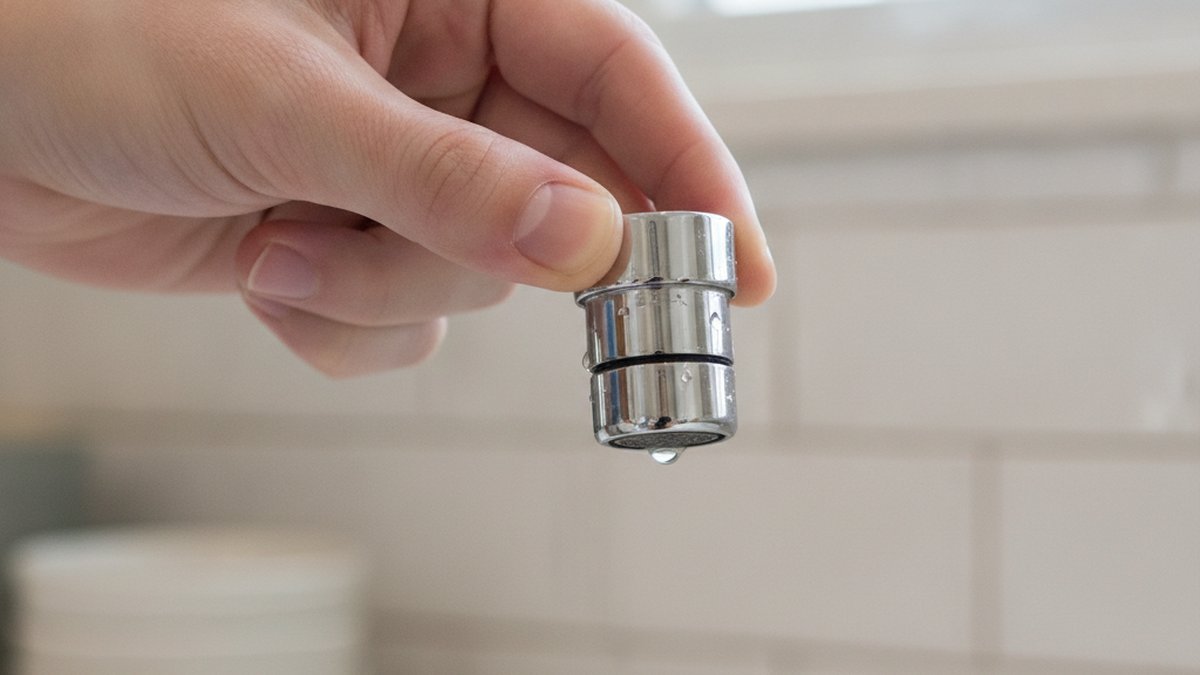
If you’ve searched “tap aerator uk screwfix,” you’re almost certainly staring at a tap that’s spitting, splashing, running weak, or crusted with limescale — and you want the cheap little insert that fixes it without a plumber. The good news: a tap aerator is one of the easiest and lowest-cost repairs in the whole bathroom and kitchen, usually under £10 and under ten minutes. The catch is that the UK uses a specific set of thread sizes that trip people up, so buying the wrong one is the number-one reason these jobs go sideways. This guide walks you through exactly which aerator to buy, how to measure the thread, how to fit it, and when a Screwfix own-brand or Neoperl part is the right call.
What Is a Tap Aerator and Why Does Yours Matter?
A tap aerator is the small mesh-and-housing insert that screws into the very tip of your tap spout, and it mixes air into the water stream so the flow feels strong while actually using less water. Without one, water blasts out as a hard, splashy jet; with one, you get a soft, even, bubbly stream that fills the sink without soaking your shirt.
Inside that little housing is a stack of components: a flow disc or restrictor, one or more fine mesh screens, and sometimes a rubber washer. Water is forced through the mesh, which breaks it into thousands of tiny streams and pulls in air through small side ports. The result is a stream that looks and feels fuller than the actual litres-per-minute passing through. That’s also why aerators are the single biggest water-saving trick on a tap — a good one drops a kitchen tap from around 12–15 litres per minute to 5–8, and a bathroom basin tap can go as low as 1.7–4 litres per minute.
Aerators also do quiet, unglamorous jobs: they straighten the flow so it doesn’t splash, they filter out grit and rust flakes from your pipes, and they cut splash-back noise. When one clogs with limescale or debris — extremely common in hard-water parts of the UK like London, the South East, and the Midlands — the flow goes weak, sideways, or sputtery. Nine times out of ten, cleaning or replacing the aerator fixes it, no other parts needed.
What Size Tap Aerator Do I Need for a UK Tap?
Most UK taps take one of two standard aerator threads: male M24 x 1 (the thread is on the outside of the tap tip) or female M22 x 1 (the thread is inside the tap tip). If you can’t measure it, M24 male and M22 female are the two you’ll meet most often, and many kits ship with both plus adaptors.
Here’s the part that confuses everyone: “male” and “female” refer to the tap, not the aerator, and a male tap needs a female aerator (and vice versa). If the threads are on the outside of your spout tip, that’s a male tap and you need a female-threaded aerator. If the threads are hidden inside the spout, that’s a female tap needing a male aerator. Get this backwards and nothing will screw together, even if the millimetre size is right.
Beyond the two standards, you’ll also see smaller and larger sizes on certain fittings. Here’s a quick reference for the common UK aerator thread sizes and where they typically show up:
| Thread size | Gender | Typical use | Rough diameter |
|---|---|---|---|
| M24 x 1 | Male (external) | Most kitchen & mixer taps | 24 mm |
| M22 x 1 | Female (internal) | Most bathroom basin taps | 22 mm |
| M18 x 1 | Male | Slimline / cloakroom taps | 18 mm |
| M28 x 1 | Male | Larger commercial / kitchen spouts | 28 mm |
| Cache / hidden | Recessed, needs key | Modern designer mixers | Varies (16.5–21.5 mm) |
The safest way to measure: unscrew the old aerator, take it to Screwfix or your merchant, and match it directly. If you can’t remove it, measure the outside diameter of the tap tip with a caliper or a ruler across the widest point of the thread. A reading around 24 mm across external threads means M24 male tap; around 22 mm across internal threads means M22 female tap. If you want the full breakdown of how these parts fit together and why flow rates differ, our complete faucet aerator guide covers the anatomy in more detail.
Is a Screwfix Own-Brand Aerator Good Enough, or Should I Buy Neoperl?
For a straightforward tap, a Screwfix own-brand or budget aerator (£2–£4) is genuinely fine and will last years. Step up to a Neoperl, Bristan, or Grohe aerator (£6–£12) if you have hard water, want a specific low flow rate, or need a “cache” recessed type — the better brass housings and Neoperl’s anti-limescale mesh simply hold up longer where scale is heavy.
Here’s how the tiers actually differ in practice:
- Budget plastic-bodied aerators (£2–£4): perfectly good for soft-water areas and rarely-used taps. The plastic thread can cross more easily and the mesh scales up faster, but at this price you just replace it.
- Brass-bodied standard aerators (£4–£8): the sweet spot for most kitchens. Metal threads bite cleanly, the housing survives being unscrewed for cleaning many times, and flow is a comfortable 5–8 L/min.
- Neoperl / premium aerators (£6–£12): the ones to buy for hard water. Neoperl’s PCA and Cache ranges use a self-cleaning silicone-nub mesh that flexes limescale off, and they hold a rated flow even as house pressure fluctuates — that “pressure-compensating” behaviour is why they cost more.
- Cache / hidden aerators: recessed into the spout on modern designer mixers so you can’t see them. These need a matching key (often supplied with the tap or the aerator) to remove — a normal spanner won’t grip.
One honest note: brand matters less than getting the thread, gender, and flow rate right. A £3 aerator in the correct M24 male will beat a £12 Neoperl in the wrong size every time, because the wrong one simply won’t fit. Buy on fit first, brand second.
How Do I Remove and Fit a Tap Aerator Without a Special Tool?
Most standard aerators unscrew by hand or with a cloth-wrapped pair of pliers; only recessed “cache” aerators genuinely need the plastic key. Turn the aerator clockwise as you look up at it from below to loosen it (that’s anticlockwise from the tap’s point of view), fit the new one finger-tight plus a gentle nudge, and you’re done — no PTFE tape needed on most because there’s a built-in washer.
Step by step for a standard aerator:
- Protect the finish. Wrap a cloth or a strip of duct tape around the aerator before you grip it with pliers, so you don’t scratch the chrome or brushed finish.
- Loosen it. Grip and turn. Looking up from underneath, turn clockwise to loosen. If it’s seized with limescale, don’t force it — see the soak trick below.
- Note the orientation. As it comes off, notice the order of the washer, restrictor disc, and mesh screens so you can match the new one. Keep the rubber washer if the new part didn’t ship with one.
- Clean the tap tip. Wipe scale off the tap’s own threads with a cloth or an old toothbrush so the new aerator seats square and doesn’t cross-thread.
- Fit the new aerator. Start it by hand — always by hand first — to avoid cross-threading, then snug it up finger-tight plus a quarter turn with the cloth-wrapped pliers. Overtightening cracks plastic housings and crushes the washer.
- Test. Run the tap. If it drips around the aerator, it’s not quite seated or the washer is missing; nip it up a touch more or reseat the washer.
If the old aerator is welded on with limescale, wrap a cloth soaked in white vinegar or a bit of descaler around it and leave it 30–60 minutes; the acid eats the scale and it’ll usually break free. This is also the exact fix when your flow has gone weak and you don’t want to replace anything — a clean is often all it takes. If your problem is actually a restrictor deeper in the tap rather than the aerator, our guide on kitchen faucet flow restrictor removal walks through that. And if the tap is dripping from the spout itself rather than the aerator, that’s a different job entirely — see why your faucet drips from the spout and how to stop it.
Which Flow Rate Should I Pick — and Will It Kill My Water Pressure?
No, a well-chosen aerator won’t wreck your pressure — an aerated flow feels strong even at low litres-per-minute because of the air mixed in. For a kitchen tap pick 5–8 L/min so you can still fill pots and pans quickly; for a bathroom basin 1.7–4 L/min is plenty and saves the most water and hot-water energy.
The trade-off is task speed, not “pressure” in the way people mean it. A 1.7 L/min basin aerator feels perfectly firm for washing hands but would be maddening trying to fill a saucepan — which is why kitchen taps stay higher. If your home runs on low mains pressure or a gravity-fed system, choose a “pressure-compensating” aerator (Neoperl markets these clearly): they hold a steadier flow across a range of pressures, so you don’t get a dribble on a bad-pressure day.
Two quick mistakes to avoid. First, don’t fit an ultra-low 1.7 L/min aerator on a combi boiler tap where the boiler needs a minimum flow to fire the hot water — you can end up with lukewarm output. Second, if you’ve got a spray or pull-out tap, aerators and spray inserts aren’t interchangeable; match the type. For hard-water homes, plan to unscrew and descale the aerator every few months — it’s a two-minute job and keeps flow honest.
Where’s the Cheapest Reliable Place to Buy — Screwfix, Toolstation or Amazon?
For same-day collection and known-fit UK sizes, Screwfix and Toolstation are the most convenient — you can hold the part, match the thread, and grab a key if needed. Amazon and specialist plumbing sites win on the widest range of Neoperl cache sizes and multipacks, but you can’t test-fit, so measure first.
A practical buying approach: if you already know your size, order online for the best price on a Neoperl or brand aerator. If you’re unsure, take the old aerator to a Screwfix or Toolstation trade counter and match it in person — the £1–£2 you might overpay is nothing next to a second wasted trip. Buy a small assortment kit (they include multiple thread sizes plus adaptors and a key) if you have several taps of different ages to sort in one go. When you’re also swapping other under-sink bits, it’s worth checking your faucet supply lines under the sink at the same time so you only shut the water off once.
FAQ
Are all tap aerators the same size in the UK?
No. UK taps use several thread sizes, but the two you’ll meet most are male M24 x 1 and female M22 x 1. There are also M18 and M28 sizes and recessed “cache” aerators. Always match the thread size and gender (internal vs external) of your specific tap — buying by brand alone is how people end up with a part that won’t screw on.
How do I know if my tap needs a male or female aerator?
Look at the tip of your tap spout. If the threads are on the outside, it’s a male tap and needs a female aerator. If the threads are hidden inside the spout, it’s a female tap and needs a male aerator. Remember it’s the opposite gender to the tap — a male tap takes a female aerator, and vice versa.
Why is my tap aerator leaking or dripping around the edge?
Almost always a missing or misseated rubber washer, or the aerator isn’t tightened enough. Unscrew it, check the washer is present and sitting flat, clean any grit off the threads, and refit finger-tight plus a small nudge. If it still weeps, the housing may be cross-threaded or cracked from overtightening — replace it, as a new one is only a few pounds.
Can I clean a limescale-clogged aerator instead of replacing it?
Yes, and you usually should first. Unscrew the aerator, disassemble the mesh screens, and soak them in white vinegar or descaler for 30–60 minutes, then brush off the residue and rinse. This restores weak, sputtery flow in most hard-water cases. Only replace it if the mesh is torn or the plastic body is degraded.
Do tap aerators actually save water and money?
Yes, noticeably. A kitchen tap can drop from around 12–15 litres per minute to 5–8, and a basin tap to as little as 1.7–4 L/min, while still feeling strong thanks to the mixed-in air. Because much of that water is hot, you save on heating energy too — which is why an aerator costing a few pounds often pays for itself within months.
What if my tap has a hidden aerator I can’t unscrew?
That’s a “cache” (recessed) aerator, common on modern designer mixers. It sits flush inside the spout and needs a small plastic key to remove — a spanner or pliers won’t grip it. The key is often supplied with the tap or with a replacement cache aerator; match the cache diameter (commonly 16.5–21.5 mm) when buying. If you’ve lost the key, a replacement aerator kit usually includes one.
The Bottom Line
A tap aerator is the cheapest, fastest upgrade or repair you can make to any tap — but only if you buy the right thread and gender for your UK fitting. Measure or match the old part, choose a brass-bodied or Neoperl aerator if you’re in a hard-water area, pick a flow rate that suits the tap’s job, and fit it hand-tight. Screwfix and Toolstation are the easy in-person options; online wins on range. Do that, and you’ll go from a splashy, weak, scaly tap to a clean, quiet, water-saving stream in under ten minutes.
Author note: This guide was written by the fransiton fixtures team, who spend their days testing, fitting, and troubleshooting taps and aerators across UK and international thread standards. Fransiton designs and supplies faucets and bathroom fixtures built to recognised flow and pressure standards, and we recommend choosing aerators that meet WRAS/water-efficiency guidance and, where offered, carry a manufacturer warranty. As always, if a job feels beyond a simple swap, call a qualified plumber.