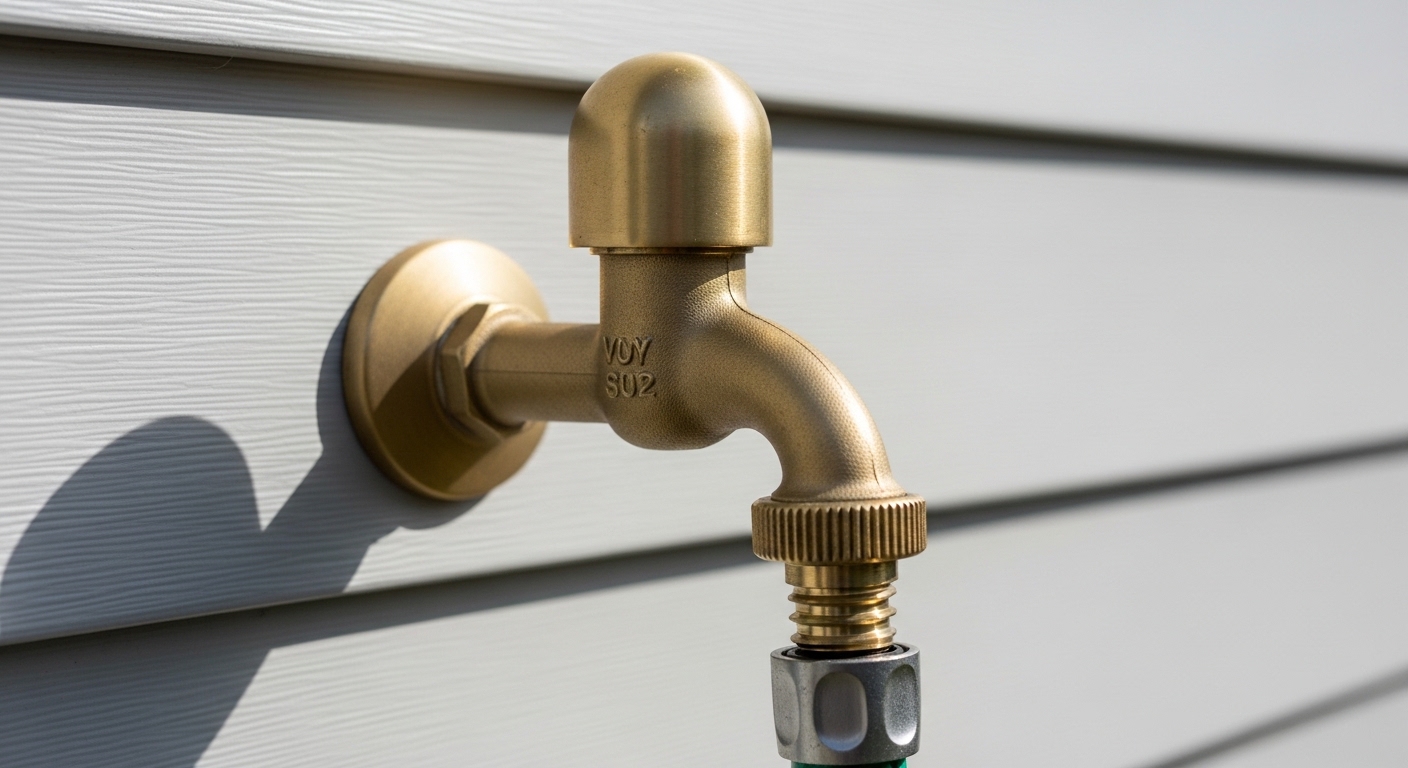
If you’ve been shopping for an outdoor faucet with top cap and wondering why some spigots have that little dome on top while others don’t, you’re asking exactly the right question. That cap isn’t decoration — it sits over the anti-siphon vacuum breaker, the small brass device that stops dirty hose water from getting siphoned back into your drinking water. Below, I’ll explain what the top cap actually does, when you need one, how to pick the right material and thread size, and how it compares to a plain spigot — so you buy once and don’t end up with a cracked valve next spring.
What does the top cap on an outdoor faucet actually do?
The top cap covers and protects the anti-siphon vacuum breaker — that’s its main job. On a standard hose bibb or frost-free sillcock, the vacuum breaker is a spring-and-poppet assembly threaded into the top of the faucet body. The cap keeps water, grit, insects, and UV off that assembly, and on most designs it conceals the small set screw that permanently locks the vacuum breaker so it can’t be unscrewed and defeated.
Here’s why that matters in plain terms. When you shut off the water but leave a hose lying in a puddle, a bucket, or a pool of fertilizer, a sudden drop in house pressure can suck that contaminated water backward through the hose and into your pipes. The vacuum breaker breaks that suction by opening to the air. The top cap is what keeps that safety device working season after season instead of seizing up, freezing, or getting knocked loose.
- Freeze protection for the breaker: trapped water inside an exposed vacuum breaker is a classic first-to-crack point in a hard freeze. The cap sheds water and adds a layer of insulation.
- Tamper and theft resistance: the concealed set screw stops the breaker from being removed, which is both a code requirement and a deterrent.
- Debris and insect exclusion: mud daubers and wasps love open faucet cavities; a cap keeps the port clear.
- Cleaner look: a finished dome simply looks better than an exposed brass poppet on the front of your house.
Do I actually need an outdoor faucet with a top cap, or is a plain spigot fine?
In most of the United States, yes — you need the backflow protection, and a top-cap model is the cleanest way to get it. Modern plumbing codes (the IPC and UPC both echo this) require an approved backflow-prevention device on hose connections, and the built-in vacuum breaker under that cap satisfies it. A truly “plain” spigot with no anti-siphon device is increasingly hard to buy new and may not pass inspection on a remodel or new build.
That said, not every situation is identical. Here’s how to decide:
- New construction or a permitted remodel: get an integrated anti-siphon faucet with a top cap. Inspectors expect it.
- Replacing an old plain bibb: upgrade to a capped anti-siphon or frost-free model — it’s a small price for backflow safety and a much lower freeze risk.
- You already have a plain spigot you can’t replace right now: add a screw-on hose vacuum breaker to the spout threads as an interim fix, then plan the upgrade.
If your bigger goal is simply running a garden hose reliably, it’s worth reading our companion guide on the best outdoor faucet for a garden hose in 2026, which walks through flow rate, spout height, and mounting. The top cap is one feature within that larger buying decision.
Top cap vs. no cap: which outdoor faucet should you buy?
A capped anti-siphon (or frost-free) faucet beats a bare spigot for almost every homeowner — better freeze resistance, code compliance, and longevity — while a plain spigot only makes sense for cheap, non-potable, indoor-drain, or temporary uses. Here’s a side-by-side so you can match the faucet to your actual situation.
| Feature | Outdoor faucet with top cap (anti-siphon / frost-free) | Plain hose bibb (no cap) |
|---|---|---|
| Backflow protection | Built-in vacuum breaker under the cap (code-compliant) | None built in; needs add-on device |
| Freeze resistance | High — cap protects breaker; frost-free versions shut off inside the heated wall | Low — exposed body and threads freeze first |
| Tamper resistance | Concealed set screw locks the breaker | Nothing to secure |
| Typical price | $18–$55 (frost-free 8″–12″ toward the top of that range) | $8–$20 |
| Best for | Homes, gardens, RV fill, anywhere a hose touches potable water | Temporary, non-potable, or purely indoor utility use |
| Lifespan | 10–20+ years with a brass body and quality stem | Shorter; more freeze failures |
What is the top cap actually covering — the vacuum breaker explained
The cap covers the atmospheric or pressure-type vacuum breaker built into the faucet’s neck. In simple terms, it’s a one-way air valve. When water flows, internal pressure keeps a small poppet seated so water only goes out to your hose. When the supply pressure drops or reverses, the poppet drops and lets air in, breaking the siphon so nothing gets pulled back toward your home’s plumbing.
You’ll sometimes see a faint dribble from a weep hole near the cap right when you shut the water off — that’s usually the vacuum breaker doing its job and clearing the neck, not a leak. If it drips continuously under pressure, the vacuum breaker’s internal seal or poppet is worn, and on many faucets you can pop the top cap and replace just that repair kit rather than the whole faucet.
Brass, stainless, or coated zinc — what should the top cap and body be made of?
For a faucet that lasts, choose a solid brass body with a brass or stainless vacuum-breaker cap; skip pot-metal (zinc alloy) if you can. Brass handles freeze-thaw stress and mineral-heavy water far better than cheap zinc castings, and the threaded hose connection won’t gall or crack as easily.
- Solid brass: the gold standard for the body and stem. Corrosion-resistant, repairable, long-lasting. Look for “lead-free brass” (≤0.25% weighted lead) if the water is potable.
- Stainless steel trim/cap: great for coastal or high-humidity areas where you want extra corrosion resistance on exposed parts.
- Chrome- or nickel-plated brass: fine and common; the finish is cosmetic over a brass core.
- Zinc alloy / “pot metal”: cheapest, but prone to cracking in freezes and stripping at the threads. Acceptable only for light, temporary use.
One more material note: mineral buildup collects around the cap and spout threads in hard-water regions and can stiffen the vacuum breaker. If you see white crusty scale, our guide on how to clean hard water stains from a faucet covers the safe vinegar-soak method that also keeps the breaker moving freely.
How do I install or replace an outdoor faucet with a top cap?
You can replace a wall-mounted outdoor faucet with a top cap in about 30–60 minutes with basic tools, as long as you shut off and drain the line first. Here’s the straightforward path for a threaded or sweat-connected wall hydrant.
- Shut off the water to that line at the interior shutoff valve, then open the outdoor faucet to drain and relieve pressure.
- Disconnect the old faucet. For a threaded connection, unscrew it with a pipe wrench, bracing the pipe so you don’t twist it inside the wall. For a soldered/frost-free unit, you’ll cut and re-sweat or use a push-fit adapter.
- Prep the threads. Clean the male pipe threads and wrap fresh PTFE (plumber’s) tape 3–4 turns clockwise, or use pipe-thread sealant.
- Thread on the new faucet and tighten until the spout points straight down and is snug — don’t overtighten a frost-free model or you can crack the wall fitting.
- Secure a frost-free unit with the proper pitch. The faucet should tilt very slightly downward toward the outside so the long stem drains back after each use.
- Turn the water on slowly and check for leaks at the joint, the stem packing nut, and around the top cap. Snug the packing nut a quarter turn if it seeps at the handle.
The core steps mirror indoor faucet work; if you want the general technique and tool list, our step-by-step faucet installation guide is a helpful primer on thread sealing, wrench technique, and leak-checking that transfers directly to outdoor units.
How do I keep the top cap and vacuum breaker from freezing in winter?
Disconnect the hose and drain the line before the first hard freeze — that single habit prevents most burst outdoor faucets, capped or not. Water left in the hose or trapped against a closed valve freezes, expands, and cracks the body or the vacuum breaker under the cap.
- Remove the garden hose every fall. A connected hose traps water in the faucet neck even on frost-free models and defeats the self-draining design.
- Shut interior stop valves and open the spigot to drain standing water from the line, then close it.
- Add an insulated faucet cover (a foam dome) over the whole faucet, top cap included, in cold climates.
- Choose a frost-free sillcock sized to your wall thickness (6″, 8″, 10″, 12″) so the actual shutoff sits inside the warm envelope of the house.
A quick word on quality, testing, and warranty
When you’re comparing outdoor faucets with a top cap, look past the photo and check three things: the vacuum breaker should be listed to a recognized backflow standard (in North America, ASSE 1011 for hose-connection vacuum breakers), the body should be marked lead-free for potable use where required, and the manufacturer should back it with a real warranty. At Fransiton, we design and pressure-test our outdoor faucets and hose bibbs for reliable backflow performance and cold-weather durability, and we stand behind the finish and function so you’re not gambling on the one part you can’t see under that cap.
FAQ
Why is water dripping from the top cap of my outdoor faucet?
A brief dribble from near the cap right after you shut off the water is normal — that’s the vacuum breaker venting and draining the neck. If it drips continuously while the faucet is off or under pressure, the vacuum breaker’s poppet or O-ring is worn. Pop the top cap, remove the set screw, and install a matching vacuum-breaker repair kit; it’s a cheap fix that usually saves replacing the whole faucet.
Can I remove the top cap on my outdoor faucet?
Yes, but only for repair. The cap and the set screw underneath it are meant to keep the vacuum breaker permanently in place for code compliance, so don’t leave it off for normal use. Remove it to service or replace the breaker, then reinstall the set screw and cap so the backflow device stays locked and protected.
Is an anti-siphon faucet the same as a faucet with a top cap?
Almost always, yes. The top cap exists to cover the anti-siphon vacuum breaker, so a faucet with that cap is an anti-siphon (backflow-protected) faucet. The exception is a purely decorative cap on a non-anti-siphon spigot, which is uncommon — if backflow protection matters to you, confirm the listing specifically says “anti-siphon” or “built-in vacuum breaker.”
What thread size is an outdoor faucet with a top cap?
The spout where the hose attaches is standard 3/4″ GHT (garden hose thread) in the U.S., so any normal hose fits. The inlet that connects to your house plumbing is usually 1/2″ or 3/4″ MIP/FIP (pipe thread) or a sweat/push-fit connection — check your existing line before buying so the inlet matches.
Will a top-cap frost-free faucet still freeze if I leave the hose on?
Yes. Leaving a hose attached is the number-one reason frost-free faucets still burst. The connected hose holds water against the internal shutoff and stops the long stem from draining, so ice forms inside the wall. Always disconnect the hose in freezing weather, even on a frost-free, capped model.
How long should an outdoor faucet with a top cap last?
A solid-brass anti-siphon or frost-free faucet typically lasts 10–20+ years, and the vacuum breaker under the cap is a serviceable part you can rebuild along the way. Cheap zinc-alloy units fail much sooner, usually to freeze cracks or stripped threads, which is why the body material matters more than the price tag.
Author note: This guide was written by the Fransiton fixtures team — plumbing product specialists who design, spec, and bench-test faucets and hose bibbs for everyday home use. We focus on faucets and bathroom fixtures full-time, and we test our outdoor faucets for backflow performance and freeze durability before they ship. Fransiton (fransiton.net) is a dedicated faucet and bathroom-fixtures brand; product details, standards, and warranty terms are listed on each product page.
Pingback: What Is an Outdoor Faucet Frost Proof Design, and Do You Really Need One Where Winters Freeze? - Fransiton